• 2010 nasa special
    a total eclipse of the Sun is visible from within a narrow corridor that traverses Earth's southern Hemisphere. The path of the Moon's umbral shadow crosses the South Pacific Ocean where it makes no landfall except for Mangaia (Cook Islands) and Easter Island (Isla de Pascua).
Showing posts with label International Space Station. Show all posts

A Timeline to Launch for the Alpha Magnetic Spectrometer


Artist concept of Alpha Magnetic Spectrometer on the International Space Station National Laboratory 

AMS, foreground, on the International Space Station National 
Trent Martin explains AMS installation sequence to Department of Energy representatives and NASA�s Bill Gerstenmaier, June 2010. 

Trent Martin explains installation sequence to Department of Energy representatives and NASA's Bill Gerstenmaier, June 2010. (NASA)
 
AMS 02 Ready for Launch in Endeavour Payload Bay, April 2011. 

AMS-02 Ready for Launch in Endeavour’s Payload Bay, April 2011. (AMS Collaboration)  

The Alpha Magnetic Spectrometer, or AMS, was carried into orbit on STS-134 on a mission to the International Space Station. While it may sound like just another instrument, in actuality it is the largest scientific collaboration to use the laboratory! This investigation is sponsored by the United States Department of Energy and made possible by funding from 16 different nations. Led by Nobel Laureate Professor Samuel Ting, more than 600 physicists from around the globe will be able to participate in the data generated from this particle physics detector.

According to Trent Martin, AMS project manager for NASA, "This type of collaboration is starting to become more common in the space science community, but AMS is by far the most diversely funded space based science detector ever built. This is the type of collaboration that NASA hopes the ISS National Laboratory will help foster in the space scientific community."

The mission, to seek out answers to the mysteries of antimatter, dark matter, and cosmic ray propagation in the universe, is only part of the story. To fully understand where the science is going, you have to look at  
NASA efforts with AMS began in 1994, when NASA's Johnson Space Center in Houston, Texas, conducted a feasibility study to see if such a delicate instrument could even fly in space and still produce usable data.

Ken Bollweg, AMS deputy project manager for NASA, mentions the challenges that needed to be overcome for the hazardous environment of space. "The detectors used in these types of experiments are typically used in an underground environment where the temperature doesn’t change more than two degrees from winter to summer and the bedrock hasn't moved in millennia," comments Bollweg. "Reviews of the detectors and their operating requirements indicated that it would be very challenging to adapt this technology to space -- but possible nonetheless."

Work on AMS integration and interface hardware began in earnest upon approval in 1995. One of the first understandings NASA needed to reach with the AMS Collaboration was the limitations of mass, size and power. For instance, the AMS Collaboration considered the AMS permanent magnet lightweight at approximately 2 tons, given that similar electromagnets on Earth weigh about 10,000 tons.

Working together, NASA and the AMS Collaboration developed a two-part plan to enable the mass requirements. The Unique Support Structure or USS-01 completed in 1997 and was launched with STS-91 in June of 1998. It carried a 9,197 lb engineering evaluation version of AMS. With the successful STS-91 mission and some extra time, since it was clear that the station would not be ready to host AMS in 2001, the scientists decided to make a few improvements. Plans for the AMS grew to be more complex, including the upgrade to a more powerful cryogenic superconducting superfluid helium-cooled magnet. These changes increased the projected weight for AMS to 15,251 lb, making it necessary to test a second support structure, called USS-02.

Determining a way to communicate the data from AMS to the ground was another important element of the undertaking. A digital data recorder system was developed and used during the STS-91 mission to capture data for the AMS Collaboration. Even though this was a preliminary effort to the overall AMS goal, the resulting data led to improved measurement sensitivity.

Several years passed as engineers continued working on procedures, certification requirements, and entered into the testing phases of development. In December 2001 NASA flew a prototype synchrotron radiation detector with STS-108. This flight test clarified performance of the detector for the AMS. The enhanced complexity of the AMS also meant an increase in data channels from close to 70,000 to over 300,000. In response, NASA developed a new digital data recorder system, which launched on STS-133 in February 2011. This enabled a trial run of the recorder system in preparation for the actual launch of AMS with STS-134.

With the announcement that the space station would continue to operate through 2020, the AMS Collaboration swapped out the current cryogenic magnet with a permanent magnet, which would have an infinite life. The entire AMS was taken apart, the magnets exchanged, and put back together for testing. From concept to implementation, this only took seven months to extend the potential life of the AMS investigation.

Martin commends the efforts of the many NASA and contractor personnel who made significant contributions to the completion of the AMS investigation. These individuals will continue to support AMS while it is on its mission in orbit to gather valuable data. Martin notes in particular the support of NASA's Bill Gerstenmaier, associate administrator for space operations. "[He was] critical to AMS's success, especially while AMS was off the space shuttle and space station manifests after the Columbia accident," says Martin. "He saw to it that Advanced Projects Office personnel were able to continue with the integration and certification tasks and personally visited AMS at various stages of development and testing."

The AMS will be the most advanced charge particle detector flown in space, increasing global knowledge of antimatter and dark matter and providing a powerful tool to physicists. The investigation will enable the discipline of modern physics to grow as scientists seek answers to the origins of our universe.


by Jessica Nimon
International Space Station Program Science Office
NASA's Johnson Space Center

Earthlings, It’s Time to Keep Your Chess Pieces From Floating Away

iss017e011574 -- Greg Chamitoff

Greg Chamitoff plays chess on the International Space Station in 2008. Photo Credit: NASA


After a brief postponement due to some electrical problems on the space shuttle Endeavour, the latest Earth vs. Space chess match is now under way, and you can post your suggestions on how to beat NASA astronauts Greg Chamitoff and Greg H. Johnson on Facebook and follow the match there or on Twitter.

Chamitoff and Johnson launched on a mission to the International Space Station on Monday, and have only two weeks to complete this match, so the action should be as fast and furious as the busy mission to deliver the Alpha Magnetic Spectrometer allows. They’re teaming up for this chess match challenge to the people of Earth.

NASA and the U.S. Chess Federation (USCF) hosted the first Earth vs. space match in 2008 when Chamitoff lived aboard the International Space Station. The public won that match thanks to help from chess champions at Stevenson Elementary School in Bellevue, Wash.

"Chess is a great game that challenges the mind and helps young people develop critical thinking skills that will serve them well in math, science, and all aspects of their future careers," Chamitoff said.

He and Johnson will play the game during their 14-day space shuttle flight to the International Space Station. The USCF will facilitate the match on its website at:


At the site, the public can suggest or vote on a chess move. The USCF will decide how to respond to the astronauts' moves. NASA and USCF will use Twitter and Facebook to notify participants about the status of the game and when to vote on moves.

Chamitoff, who will conduct two spacewalks during the shuttle mission, is a chess aficionado. He took a chess set when he launched to the space station in May 2008, and brought it back when he returned home in November 2008. He will be taking a different chess set for this trip.

"We hope to do better in this Earth vs. space match," Chamitoff said. "But, I have to admit it will be a challenge because we have an extremely busy flight ahead of us."

Updates on the chess match will be posted on the USCF Twitter and Facebook sites, Chamitoff's Twitter account and the International Space Station's official Facebook page:

http://twitter.com/chessmagnet

Charles Bolden: NASA's new endeavor (April 29)

Six astronauts are scheduled to lift off into space on shuttle Endeavour’s final mission today, reminding the world of the United States’ continued leadership in space. And while Endeavour will complete its last voyage, the Obama administration’s commitment to human exploration remains as strong as ever.

American astronauts continue to live and work aboard the International Space Station 24 hours a day, seven days a week, 52 weeks a year, as they have for more than 10 years. And this critical research facility in low- Earth orbit will continue to be the anchor of our human spaceflight for the next decade.

We at NASA are committed to maintaining America’s leadership role in human exploration — and sending U.S. astronauts into space aboard American-made spacecraft.

It’s time for NASA to get out of the expensive business of owning and operating space transportation systems to service the International Space Station, and focus our limited resources on developing new vehicles to take us farther into deep space.

We recognize this is a difficult time for much of the devoted workforce that has made the shuttle program the incredible success it has been for three decades. However, this new approach will spur economic activity, create jobs and allow NASA to focus on the really hard stuff — such as sending humans to an asteroid or Mars.

President Obama’s fiscal year 2012 budget achieves these ambitious goals by supporting all the elements of a hard-won, bipartisan NASA Authorization Act. It’s a budget that will help the nation win the future through innovation, expanded technological capabilities and strengthened U.S. competitiveness in the global marketplace.

Funding for the final shuttle mission in June, STS-135, was included as part of the budget agreement the president reached with Congress recently, and the president has included a half-billion dollars in next year’s budget to pay the pension costs of thousands of dedicated shuttle workers.

These workers met their obligations to us, and now a grateful nation will uphold its end of the bargain.

Obama to Watch Shuttle Launch as Florida’s ‘Space Coast’ Sees Jobs Lost

President Barack Obama is set to bid a personal farewell to America’s manned space shuttle at Cape Canaveral today, as Florida’s “space coast” prepares to say goodbye to thousands of NASA jobs in a state crucial to Obama’s re-election.

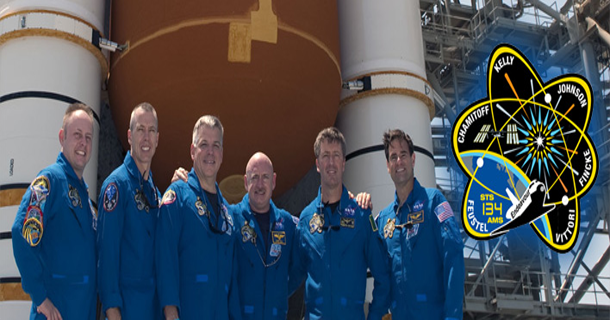
Obama is scheduled to watch the Endeavour’s final lift-off, the second-to-last shuttle launch in the program’s 30-year history. Also in the audience will be U.S. Representative Gabrielle Giffords, who is still recovering from a head wound she suffered in a mass shooting in Tucson, Arizona, on Jan. 8. Her husband, Navy Captain Mark Kelly, will be commanding the Endeavour on its 14-day mission to the International Space Station.

“At the Cape they stand to lose seven or eight thousand jobs in the next year because of the shuttle program ending,” said Bretton Alexander, the president of the Commercial Spaceflight Federation, a Washington-based trade association of companies promoting commercial human spaceflight. Obama and Senator Bill Nelson, a Florida Democrat who in 1986 flew one shuttle mission as a payload specialist, “are taking a lot of heat for that, but that was going to happen no matter what,” he said.

The shuttle’s demise was set in motion by President George W. Bush in 2004, and Obama’s plan to retool NASA’s mission kept the decision in effect.

The president has directed the National Aeronautics and Space Administration to focus on developing rocket systems that might eventually take humans into deep space, while relying on private companies to build spacecraft to ferry astronauts -- and potentially tourists -- to the space station.
Rocket Competition

On April 18, NASA announced $269 million in contracts to four companies competing to build commercial spaceships, with Chicago-based Boeing Co. (BA) receiving $92.3 million and Sierra Nevada Corp., based in Sparks, Nevada, winning $80 million. Space Exploration Technologies Corp. in Hawthorne, California -- whose chief executive officer, Elon Musk, gave Obama a tour of his launch facility last year -- received $75 million. Kent, Washington-based Blue Origin got $22 million.

“The space shuttle is coming to an end and it’s really pretty far past its sell-by date,” said Musk, whose company has a $1.6 billion NASA contract to deliver cargo to the space station. “It’s an amazing work of engineering, but it sort of architecturally is very expensive.”

The goal of the new system should be to lower the cost per mission and the improve safety, he said, noting the catastrophic failures aboard two shuttles that resulted in the deaths of 14 astronauts.

The space shuttle costs an average of about $450 million per mission, according to NASA. Musk estimates that SpaceX flights will cost $140 million.
New Era

“The public should see this as a dawning of a new era, which will hopefully be a significant improvement in the technology of space travel,” he said.

For some former astronauts, the end of the shuttle program should be an opportunity to revitalize space exploration.

“If we had evolved it, instead of just using it, we could have got the launch cost down and made it a safe vehicle,” said Loren Acton, a former astronaut and currently a professor at Montana State University in Bozeman.

“It’s a tremendous spacecraft,” he said. “I will be sorry to see it go.”

In his fiscal year 2012 budget, Obama proposed $18.7 billion for NASA, $1.5 billion less than his request last year. He also has ended NASA’s Constellation program, developed during the Bush administration, which would have built spacecraft for a return to the moon by 2020. Instead, he is seeking to focus NASA on exploring deep space and sending humans to Mars by the mid-2030s.
Consequences for Florida

Florida Republicans have criticized Obama’s approach.

While today’s launch “is an opportunity to celebrate Endeavour’s history and the brave people who have made it a proud one, it is also a bittersweet occasion,” Senator Marco Rubio wrote in the Orlando Sentinel on April 26. “The president’s space policy is jeopardizing America’s longstanding commitment to manned space exploration. This has serious consequences for Florida.”

The job losses in the space program will add to the woes of a state that has struggled to recover from the recession. While the Bloomberg Florida Index (BFLX) of stocks has gained 9.8 percent over the past year, the state’s unemployment rate is at 11.1 percent, compared with the national average of 8.8 percent.

Florida, the fourth-biggest U.S. state by population, has been a swing state in national elections and is a target for both parties in 2012.
Political Prize

Obama won Florida with 51 percent of the vote in 2008. Republican Bush claimed it in the two prior presidential elections, including the contested -- and pivotal -- balloting in 2000. In 2012, Florida will have adding importance because population gains will add two more Electoral College votes, giving whoever wins the state 29 of the 270 votes that are required for victory in the presidential election.

Planning to watch the launch with the president is Giffords, who made the trip to Florida from the Houston facility where she is undergoing rehabilitation. The Arizona Democrat was shot in the head during the attack in which six people were killed and 13, including Giffords, were wounded. She has begun to speak and is standing on her own, according to the Arizona Republic.

Before arriving in Florida, Obama is scheduled to stop in Alabama to view the damage from some of the tornadoes that tore through the U.S. Southeast. At least 280 people were killed in six states, the Associated Press reported, with the heaviest toll in Alabama.

To contact the reporter on this story: Hans Nichols in Washington at hnichols2@bloomberg.net

To contact the editor responsible for this story: Mark Silva at msilva34@bloomberg.net.

Cargo Craft Undocking Sets Stage for More Arrivals

ISS Progress 41 cargo craft

The ISS Progress 41 cargo craft backs away from the International Space Station after undocking Friday morning. Credit: NASA TV
The departure of an unpiloted Russian cargo craft Friday set the stage for the arrival of the next supply ship and a final visit from space shuttle Endeavour.

The ISS Progress 41 cargo craft, filled with trash and other unneeded items, undocked from the Pirs docking compartment at 7:41 a.m. EDT Friday as the International Space Station flew 220 miles over China. As the Progress slowly backed away from the station, Expedition 27 Commander Dmitry Kondratyev photographed the cargo craft through a window in the Russian segment of the orbiting complex to assess the condition of the rubber seals on its docking interface.

The Russian supply vehicle will remain in orbit a safe distance from the station for engineering tests before being commanded by flight controllers Tuesday to descend to a destructive re-entry into Earth’s atmosphere over the Pacific Ocean.

The departure of Progress 41 clears the way for the next unpiloted supply ship, ISS Progress 42, which is set to launch Wednesday from the Baikonur Cosmodrome in Kazakhstan. The new Progress will arrive at the station on April 29 at 10:29 a.m., just a little more than five hours before Endeavour launches to the station on its final trip into space. The shuttle’s STS-134 crew will deliver the Alpha Magnetic Spectrometer and spare parts including two S-band communications antennas, a high-pressure gas tank and additional spare parts for Dextre.

Flight Engineer Ron Garan spent some time Friday preparing for the arrival of Endeavour as he reviewed the robotics operations involved in removing the Orbiter Boom Sensor System from the shuttle’s payload bay with Canadarm2 and handing it off to the shuttle’s robotic arm.

Meanwhile Flight Engineer Paolo Nespoli performed maintenance on the spacesuits that the STS-134 crew will wear during the four spacewalks planned when Endeavour visits the station. Nespoli performed a water dump and refill of the feedwater tanks and conducted maintenance on the cooling loops of the suits.

Garan and Nespoli joined Flight Engineer Cady Coleman as they continue to unload cargo from the “Johannes Kepler” Automated Transfer Vehicle-2. The European Space Agency supply ship, which delivered seven tons of cargo when it docked to the aft port of the Zvezda service module on Feb. 24, will be reloaded with trash and undocked from the station for disposal in late June.

Cosmonauts Andrey Borisenko and Alexander Samokutyaev, both flight engineers, participated in the Pneumocard experiment, which studies the adaptation of the crew’s cardiovascular system during long-duration spaceflight.

Over the weekend the station’s six residents will enjoy some light-duty time as they attend to some weekly housekeeping chores, perform voluntary science activities and continue their daily two-hour exercise regimen to stave off the physical effects associated with long-duration spaceflight.

Canadarm2 Turns 10: Canadian Space Agency Celebrates a Decade of Success

ISS026-E-033204 -- The Kounotori2 H-II Transfer Vehicle In the grasp of Canadarm2 

Image above: In the grasp of the International Space Station's Canadarm2, the Kounotori2 H-II Transfer Vehicle is moved from the space-facing side of the Harmony node back to the Earth-facing port of Harmony in March 2011. Photo credit: NASA

Ten years ago today, Canadarm2 was launched to the International Space Station (ISS) aboard space shuttle Endeavour. A larger, more robust successor to the Shuttle’s Canadarm, Canadarm2 has provided a full decade of flawless service as the Station’s sophisticated “construction crane,” having assembled the ISS module by module in space.


Canadarm2 has unloaded hundreds of tons of equipment and supplies ferried by the shuttle and assisted almost 100 spacewalks. Endeavour’s last flight later this month will mark Canadarm2’s 28th Shuttle mission. Additionally, the robotic arm performed two “cosmic catches” where it captured, docked and later released two unpiloted Japanese resupply ships (HTV-1 and HTV-2).

Built for the Canadian Space Agency (CSA) in Brampton, Ontario, by MDA, Canadarm2 was installed on the ISS by astronaut Chris Hadfield during the first spacewalk by a Canadian. He was assisted in this feat by NASA Astronaut Scott Parazynski. In 2006, Steve MacLean, former astronaut and current President of the Canadian Space Agency became the first Canadian ever to operate Canadarm2 in space. CSA astronauts Julie Payette and Robert Thirsk are the only other Canadians to have ever operated Canadarm2 in space. The robotic arm is routinely operated by flight controllers at NASA’s Johnson Space Center and the Canadian Space Agency’s headquarters in Saint-Hubert, Quebec.

STS100-396-007 -- Astronaut Scott E. Parazynski works with cables associated with the Space Station Remote Manipulator System or Canadarm2
Astronaut Scott E. Parazynski, mission specialist, works with cables associated with the Space Station Remote Manipulator System or Canadarm2 during one of two days of extravehicular activity during STS-100. Photo credit: NASA

Canadarm2’s role on the International Space Station will expand as the orbital lab nears completion: in addition to performing routine maintenance, the robotic arm will make more frequent cosmic catches. When the Space Shuttle retires, reusable commercial spacecraft, like SpaceX’s Dragon and Orbital’s Cygnus, will be used to bring supplies and equipment to the ISS. Canadarm2 will capture each of these visiting vehicles, as well as the Japanese HTV transport vessels. In late 2011 and early 2012, Canadarm2 will capture a series of 6 commercial spacecraft in just 7 months, beginning with the Dragon spacecraft, currently scheduled to arrive in October 2011.

About the Canadian Space Agency

Established in 1989, the Canadian Space Agency (CSA) coordinates all civil, space-related policies and programs on behalf of the Government of Canada. The CSA directs its resources and activities through four key thrusts: Earth Observation, Space Science and Exploration, Satellite Communications, and Space Awareness and Learning. The Agency conducts its activities through three key business lines: 

Space Utilization: serving the needs of Government Departments; Space Exploration: positioning Canadian Science and Technology to advantage in future international space exploration missions; and, Space Science and Technology: which drives synergy and builds capacity in Academia, Industry and government to respond to the current and future needs of Canada’s Space Program. By leveraging international cooperation, the CSA generates world-class scientific research and industrial development for the benefit of humanity.

For more information, please contact:

Media Relations
Canadian Space Agency
450-926-4370
http://www.asc-csa.gc.ca