• 2010 nasa special
    a total eclipse of the Sun is visible from within a narrow corridor that traverses Earth's southern Hemisphere. The path of the Moon's umbral shadow crosses the South Pacific Ocean where it makes no landfall except for Mangaia (Cook Islands) and Easter Island (Isla de Pascua).
Showing posts with label NASA mission. Show all posts

From NASA to UMES: Rocket engineer teaches from experience

PRINCESS ANNE -- Ricky Stanfield has worked on some of America's critical defense and science projects over the past 20 years, including Army tactical hardware, Navy missile-flight tests and payload development for NASA's sounding rockets.
 
Now, the Northrop Grumman Corp. engineer is applying that real-world experience in the classroom, where he teaches a course on fluid mechanics at the University of Maryland Eastern Shore.

"I was a relentless builder of things growing up," Stanfield said. "It all started with Lego sets and model kits."

Fluid mechanics is the study of liquids and gases under stationary and moving conditions. Students who major in mechanical, aerospace and civil engineering will likely encounter fluid motion issues when designing cars, medical equipment and duct systems, to name a few.
Fluid mechanics is very difficult," said Derek Cooper, a 21-year-old mechanical engineering major at UMES. "But Dr. Stanfield definitely makes it easier to comprehend."

Northrop Grumman relocated its engineering and fabrication operation from Virginia to Somerset County in 2010 to support a U.S. Navy contract. Stanfield is engineering director and deputy program manager at the facility in the Princess Anne Industrial Park.

"Part of the attraction to moving to Princess Anne for me was the chance to teach at UMES," said Stanfield, who once considered teaching high school physics. This spring, he teaches a class with two mechanical and two aerospace engineering majors.

Stanfield graduated from Longwood College in Farmville, Va., with a Bachelor of Science degree in physics and a minor in mathematics and secondary education.

"Longwood is about the same size as UMES," he said. "I enjoyed attending a smaller college since it gave me the chance to be more involved with the college itself. Those were leadership experiences that I have been able to apply in my career."

Stanfield's first job was with the Department of the Army, where he worked as a physicist for 10 years.

"I worked on landmine countermeasures and tactical deception systems," he said. "Despite my title, they were using me more as a mechanical engineer than as a physicist, so I steered my graduate studies in that direction."

The New Jersey native, who grew up in an Air Force family, earned a Master of Science in engineering and a doctorate in mechanical engineering from The Catholic University of America in Washington, D.C.

"I attended all of my graduate school classes while working full time and raising a growing family, so I understand the pressures that non-traditional students have when balancing school, work, and family," Dr. Stanfield said.

Stanfield specialized in structure-borne acoustics and vibrations while attending graduate school at Catholic University.

"My dissertation focused on the use of axisymmetric shell finite element models to predict vibration in the airframes of sounding rockets," he said. "I also studied the use of passive vibration control techniques to manage these vibrations."

Stanfield -- who is married to his wife of 22 years, Theresa, and has two teenagers -- has worked for Northrop Grumman for 12 years. In the community, he volunteers as an assistant scoutmaster with the Boy Scouts of America; a referee for the American Youth Soccer Organization; and as a coordinator of the Chincoteague Island YMCA runner's group. He also is a marathon runner.

Stanfield would like to continue teaching the fast-paced fluid mechanics course at UMES, which includes advanced mathematics such as differential equations and integral calculus. He's also open to teaching other courses within the mechanical engineering field.
Next time someone says, "It's not rocket science," check with Stanfield's students. The answer might surprise.

Shuttle Endeavour Launch No Earlier Than May 8

CAPE CANAVERAL — NASA managers have determined space shuttle Endeavour will not launch before Sunday, May 8, but will not officially set a new launch date until early this week. 

After Friday’s launch scrub, Kennedy Space Center technicians searched for the cause of a failure in a heater circuit associated with Endeavour’s hydraulic power system. The failure was found to be in a power circuit in a switchbox in the shuttle’s aft compartment.

Managers and engineers are developing a schedule to remove and replace the switchbox and retest the new unit. That work will delay Endeavour’s launch until at least May 8.

The shuttle has three Auxiliary Power Units (APUs) that provide hydraulic power to steer the vehicle during ascent and entry. The hydrazine fuel lines on each APU have two heater circuits that prevent the fuel from freezing while the shuttle is in space.

NASA launch commit criteria and flight rules require all three APUs and heater circuits to be operational for liftoff.
Endeavour’s six astronauts have returned to NASA’s Johnson Space Center in Houston for several days of additional training.

NASA Satellite Sees Tornado Tracks in Tuscaloosa, Alabama


 In an image acquired by MODIS on NASA's Aqua satellite on April 28, three tornado tracks are visible through and around the city.
Deadly tornadoes raked across Alabama on April 27, 2011, killing as many as 210 people as of April 29. The hardest-hit community was Tuscaloosa. In an image acquired by the Moderate Resolution Imaging Spectroradiometer (MODIS) on NASA’s Aqua satellite on April 28, three tornado tracks are visible through and around the city.

The tracks are pale brown trails where green trees and plants have been uprooted, leaving disturbed ground. Though faint, the center track runs from southwest of Tuscaloosa, through the gray city, and extends northeast towards Birmingham. Two other tracks run parallel to the center track. The northernmost track is in an area where the National Weather Service reported a tornado, but no tornado was reported in the vicinity of the more visible southern track. In the southern region, strong winds were reported.

The tornadoes were part of a larger weather pattern that produced more than 150 tornadoes across six states, said the National Weather Service. The death toll had nearly reached 300 on April 29, making the outbreak the deadliest in the United States since 1974.

NASA Orbiter Reveals Big Changes in Mars' Atmosphere

Thickness map of buried carbon-dioxide deposit 

A newly found, buried deposit of frozen carbon dioxide -- dry ice -- near the south pole of Mars contains about 30 times more carbon dioxide than previously estimated to be frozen near the pole. Image credit: NASA/JPL-Caltech/Sapienza University of Rome/Southwest Research Institute

Cross section of buried carbon-dioxide ice on Mars 

This cross-section view of underground layers near Mars' south pole is a radargram based on data from the Shallow Subsurface Radar (SHARAD) instrument on NASA's Mars Reconnaissance Orbiter. Image credit: NASA/JPL-Caltech/Sapienza University of Rome/Southwest Research Institute

Pitting from sublimation of underlying dry-ice layer 

These images from orbit show an area near Mars' south pole where coalescing or elongated pits are interpreted as signs that an underlying deposit of frozen carbon dioxide, or "dry ice," has been shrinking by sublimation. Image credit: NASA/JPL-Caltech/Univ. of Arizona


PASADENA, Calif. -- NASA's Mars Reconnaissance Orbiter has discovered the total amount of atmosphere on Mars changes dramatically as the tilt of the planet's axis varies. This process can affect the stability of liquid water, if it exists on the Martian surface, and increase the frequency and severity of Martian dust storms. 

Researchers using the orbiter's ground-penetrating radar identified a large, buried deposit of frozen carbon dioxide, or dry ice, at the Red Planet's south pole. The scientists suspect that much of this carbon dioxide enters the planet's atmosphere and swells the atmosphere's mass when Mars' tilt increases. 

The findings are published in this week's issue of the journal Science.
The newly found deposit has a volume similar to Lake Superior's nearly 3,000 cubic miles (about 12,000 cubic kilometers). The deposit holds up to 80 percent as much carbon dioxide as today's Martian atmosphere. Collapse pits caused by dry ice sublimation and other clues suggest the deposit is in a dissipating phase, adding gas to the atmosphere each year. Mars' atmosphere is about 95 percent carbon dioxide, in contrast to Earth's much thicker atmosphere, which is less than .04 percent carbon dioxide. 

"We already knew there is a small perennial cap of carbon-dioxide ice on top of the water ice there, but this buried deposit has about 30 times more dry ice than previously estimated," said Roger Phillips of Southwest Research Institute in Boulder, Colo. Phillips is deputy team leader for the Mars Reconnaissance Orbiter's Shallow Radar instrument and lead author of the report.
"We identified the deposit as dry ice by determining the radar signature fit the radio-wave transmission characteristics of frozen carbon dioxide far better than the characteristics of frozen water," said Roberto Seu of Sapienza University of Rome, team leader for the Shallow Radar and a co-author of the new report. Additional evidence came from correlating the deposit to visible sublimation features typical of dry ice. 

"When you include this buried deposit, Martian carbon dioxide right now is roughly half frozen and half in the atmosphere, but at other times it can be nearly all frozen or nearly all in the atmosphere," Phillips said. 

An occasional increase in the atmosphere would strengthen winds, lofting more dust and leading to more frequent and more intense dust storms. Another result is an expanded area on the planet's surface where liquid water could persist without boiling. Modeling based on known variation in the tilt of Mars' axis suggests several-fold changes in the total mass of the planet's atmosphere can happen on time frames of 100,000 years or less. 

The changes in atmospheric density caused by the carbon-dioxide increase also would amplify some effects of the changes caused by the tilt. Researchers plugged the mass of the buried carbon-dioxide deposit into climate models for the period when Mars' tilt and orbital properties maximize the amount of summer sunshine hitting the south pole. They found at such times, global, year-round average air pressure is approximately 75 percent greater than the current level. 

"A tilted Mars with a thicker carbon-dioxide atmosphere causes a greenhouse effect that tries to warm the Martian surface, while thicker and longer-lived polar ice caps try to cool it," said co-author Robert Haberle, a planetary scientist at NASA's Ames Research Center in Moffett Field, Calif. "Our simulations show the polar caps cool more than the greenhouse warms. Unlike Earth, which has a thick, moist atmosphere that produces a strong greenhouse effect, Mars' atmosphere is too thin and dry to produce as strong a greenhouse effect as Earth's, even when you double its carbon-dioxide content." 

The Shallow Radar, one of the Mars Reconnaissance Orbiter's six instruments, was provided by the Italian Space Agency, and its operations are led by the Department of Information Engineering, Electronics and Telecommunications at Sapienza University of Rome. NASA's Jet Propulsion Laboratory, a division of the California Institute of Technology in Pasadena, manages the Mars Reconnaissance Orbiter project for NASA's Science Mission Directorate at the agency's headquarters in Washington. Lockheed Martin Space Systems in Denver built the spacecraft.
For more information about the Mars Reconnaissance Orbiter mission, visit http://www.nasa.gov/mro .
 
 
Guy Webster 818-354-6278
Jet Propulsion Laboratory, Pasadena, Calif.
guy.webster@jpl.nasa.gov

Maria Martinez 210-522-3305
Southwest Research Institute, San Antonio, Texas
maria.martinez@swri.org

Dwayne Brown 202-358-1726
NASA Headquarters, Washington
dwayne.c.brown@nasa.gov

NASA Awards Next Set Of Commercial Crew Development Agreements

WASHINGTON -- NASA has awarded four Space Act Agreements in the second round of the agency's Commercial Crew Development (CCDev2) effort. Each company will receive between $22 million and $92.3 million to advance commercial crew space transportation system concepts and mature the design and development of elements of their systems, such as launch vehicles and spacecraft.

The selectees for CCDev2 awards are:
-- Blue Origin, Kent, Wash., $22 million
-- Sierra Nevada Corporation, Louisville, Colo., $80 million
-- Space Exploration Technologies (SpaceX), Hawthorne, Calif., $75 million
-- The Boeing Company, Houston, $92.3 million

"We're committed to safely transporting U.S. astronauts on American-made spacecraft and ending the outsourcing of this work to foreign governments," NASA Administrator Charles Bolden said. "These agreements are significant milestones in NASA's plans to take advantage of American ingenuity to get to low-Earth orbit, so we can concentrate our resources on deep space exploration."

The goal of CCDev2 is to accelerate the availability of U.S. commercial crew transportation capabilities and reduce the gap in American human spaceflight capability. Through this activity, NASA also may be able to spur economic growth as potential new space markets are created.

Once developed, crew transportation capabilities could become available to commercial and government customers.

"The next American-flagged vehicle to carry our astronauts into space is going to be a U.S. commercial provider," said Ed Mango, NASA's Commercial Crew Program manager. "The partnerships NASA is forming with industry will support the development of multiple American systems capable of providing future access to low-Earth orbit."

These awards are a continuation of NASA's CCDev initiatives, which began in 2009 to stimulate efforts within U.S. industry to develop and demonstrate human spaceflight capabilities. For more information about NASA's Commercial Crew Program, visit:

http://www.nasa.gov/exploration  

Copies of the Space Act Agreements are available at:
http://procurement.ksc.nasa.gov/index.htm

Forensic Sleuthing Ties Ring Ripples to Impacts


Artist's concept shows comet Shoemaker-Levy 9 heading into Jupiter 

This artist's concept shows comet Shoemaker-Levy 9 heading into Jupiter in July 1994, while its dust cloud creates a rippling wake in Jupiter's ring. Image credit: copyright M. Showalter


Alternating light and dark bands, extending a great distance across Saturn's D and C rings, are shown here in these Cassini images 

Alternating light and dark bands, extending a great distance across Saturn's D and C rings, are shown here in these Cassini images taken one month before the planet's August 2009 equinox. Image credit: NASA/JPL/Space Science Institute


Tilting Saturn's rings animation graphic 

This graphic shows in a series of three images how Saturn's rings, after they became tilted relative to Saturn's equatorial plane, would have transformed into a corrugated ring. Image credit: NASA/JPL/Cornell


Subtle ripples in Jupiter's ring 

These images, derived from data obtained by NASA's Galileo spacecraft, show the subtle ripples in the ring of Jupiter that scientists have been able to trace back to the impact of comet Shoemaker-Levy 9 in July 1994. Image credit: NASA/JPL-Caltech/SETI


PASADENA, Calif. – Like forensic scientists examining fingerprints at a cosmic crime scene, scientists working with data from NASA's Cassini, Galileo and New Horizons missions have traced telltale ripples in the rings of Saturn and Jupiter back to collisions with cometary fragments dating back more than 10 years ago. 

The ripple-producing culprit, in the case of Jupiter, was comet Shoemaker-Levy 9, whose debris cloud hurtled through the thin Jupiter ring system during a kamikaze course into the planet in July 1994. Scientists attribute Saturn's ripples to a similar object – likely another cloud of comet debris -- plunging through the inner rings in the second half of 1983. The findings are detailed in a pair of papers published online today in the journal Science. 

"What's cool is we're finding evidence that a planet's rings can be affected by specific, traceable events that happened in the last 30 years, rather than a hundred million years ago," said Matthew Hedman, a Cassini imaging team associate, lead author of one of the papers, and a research associate at Cornell University, Ithaca, N.Y. "The solar system is a much more dynamic place than we gave it credit for." 

From Galileo's visit to Jupiter, scientists have known since the late 1990s about patchy patterns in the Jovian ring. But the Galileo images were a little fuzzy, and scientists didn't understand why such patterns would occur. The trail was cold until Cassini entered orbit around Saturn in 2004 and started sending back thousands of images. A 2007 paper by Hedman and colleagues first noted corrugations in Saturn's innermost ring, dubbed the D ring. 

A group including Hedman and Mark Showalter, a Cassini co-investigator based at the SETI Institute in Mountain View, Calif., then realized that the grooves in the D ring appeared to wind together more tightly over time. Playing the process backward, Hedman then demonstrated the pattern originated when something tilted the D ring off its axis by about 100 meters (300 feet) in late 1983. The scientists found the influence of Saturn's gravity on the tilted area warped the ring into a tightening spiral. 

Cassini imaging scientists got another clue when the sun shone directly along Saturn's equator and lit the rings edge-on in August 2009. The unique lighting conditions highlighted ripples not previously seen in another part of the ring system. Whatever happened in 1983 was not a small, localized event; it was big. The collision had tilted a region more than 19,000 kilometers (12,000 miles) wide, covering part of the D ring and the next outermost ring, called the C ring. Unfortunately spacecraft were not visiting Saturn at that time, and the planet was on the far side of the sun, hidden from telescopes on or orbiting Earth, so whatever happened in 1983 passed unnoticed by astronomers. 

Hedman and Showalter, the lead author on the second paper, began to wonder whether the long-forgotten pattern in Jupiter's ring system might illuminate the mystery. Using Galileo images from 1996 and 2000, Showalter confirmed a similar winding spiral pattern. They applied the same math they had applied to Saturn – but now with Jupiter's gravitational influence factored in. Unwinding the spiral pinpointed the date when Jupiter's ring was tilted off its axis: between June and September 1994. Shoemaker-Levy plunged into the Jovian atmosphere during late July 1994. The estimated size of the nucleus was also consistent with the amount of material needed to disturb Jupiter's ring. 

The Galileo images also revealed a second spiral, which was calculated to have originated in 1990. Images taken by New Horizons in 2007, when the spacecraft flew by Jupiter on its way to Pluto, showed two newer ripple patterns, in addition to the fading echo of the Shoemaker-Levy impact. 

"We now know that collisions into the rings are very common – a few times per decade for Jupiter and a few times per century for Saturn," Showalter said. "Now scientists know that the rings record these impacts like grooves in a vinyl record, and we can play back their history later." 

The ripples also give scientists clues to the size of the clouds of cometary debris that hit the rings. In each of these cases, the nuclei of the comets – before they likely broke apart – were a few kilometers wide. 

"Finding these fingerprints still in the rings is amazing and helps us better understand impact processes in our solar system," said Linda Spilker, Cassini project scientist, based at NASA's Jet Propulsion Laboratory, Pasadena, Calif. "Cassini's long sojourn around Saturn has helped us tease out subtle clues that tell us about the history of our origins." 

The Cassini-Huygens mission is a cooperative project of NASA, the European Space Agency and the Italian Space Agency. JPL, a division of the California Institute of Technology in Pasadena, manages the Cassini-Huygens mission for NASA's Science Mission Directorate, Washington. The Cassini orbiter and its two onboard cameras were designed, developed and assembled at JPL. The imaging team is based at the Space Science Institute in Boulder, Colo. JPL managed the Galileo mission for NASA, and designed and built the Galileo orbiter. The New Horizons mission is led by Principal Investigator Alan Stern of Southwest Research Institute, Boulder, Colo., and managed by the Johns Hopkins Applied Physics Laboratory, Laurel, Md., for NASA's Science Mission Directorate. 

More information about Cassini can be found at http://www.nasa.gov/cassini .
Additional contacts: Blaine Friedlander, Cornell University, Ithaca, N.Y., 607-254-6235, bpf2@cornell.edu; Karen Randall, SETI Institute, Mountain View, Calif., 650-960-4537, krandall@seti.org; and Joe Mason, Space Science Institute, Boulder, Colo., 720-974-5859, jmason@ciclops.org.
 
 
Media contact:
Jia-Rui C. Cook 818-354-0850
Jet Propulsion Laboratory, Pasadena, Calif.
jia-rui.c.cook@jpl.nasa.gov

Michael Buckley 240-228-7536
Johns Hopkins University Applied Physics Laboratory, Laurel, Md.
michael.buckley@jhuapl.edu

The Watched Pot and Fast CMEs


Movie of a SOHO Chronograph of the fast CME of March 7, 2011 with SDO 304 angstrom solar image overlaid.
› Download
Movie: A Solar Heliospheric Observatory (SOHO) chronograph of the fast coronal mass ejection (CME) of March 7, 2011 with a Solar Dynamics Observatory (SDO) 304 angstrom solar image overlaid. Credit: Naval Research Lab/Karl Battams

If you've ever stood in front of a hot stove, watching a pot of water and waiting impatiently for it to boil, you know what it feels like to be a solar physicist.

Back in 2008, the solar cycle plunged into the deepest minimum in nearly a century. Sunspots all but vanished, solar flares subsided, and the sun was eerily quiet.

"Ever since, we've been waiting for solar activity to pick up," says Richard Fisher, head of the Heliophysics Division at NASA Headquarters in Washington DC. "It's been three long years."

Aurora resulting from the March 7 X1.5 flare and CME as viewed from Grand Portage, Minnesota, on March 10, 2011.

Aurora resulting from the March 7, 2011 X1.5-class flare and CME as viewed from Grand Portage, Minnesota, on March 10, 2011. Credit: NASA/Travis Novitsky
NASA's Solar Dynamics Observatory recorded this X1.5-class solar flare on March 9, 2011.

Screen capture from movie of X1.5-class flare captured by the Solar Dynamics Observatory on March 9, 2011. Credit: NASA/SDO Quiet spells on the sun are nothing new. They come along every 11 years or so—it's a natural part of the solar cycle. This particular solar minimum, however, was lasting longer than usual, prompting some researchers to wonder if it would ever end.

News flash: The pot is starting to boil. "Finally," says Fisher, "we are beginning to see some action."

As 2011 unfolds, sunspots have returned and they are crackling with activity. On February 15th and again on March 9th, Earth orbiting satellites detected a pair of "X-class" solar flares--the most powerful kind of x-ray flare. The last such eruption occurred back in December 2006.

Another eruption on March 7th hurled a billion-ton cloud of plasma away from the sun at five million mph (2200 km/s). The rapidly expanding cloud wasn't aimed directly at Earth, but it did deliver a glancing blow to our planet's magnetic field. The off-center impact on March 10th was enough to send Northern Lights spilling over the Canadian border into US states such as Wisconsin, Minnesota, and Michigan.

"That was the fastest coronal mass ejection in almost six years," says Angelos Vourlidas of the Naval Research Lab in Washington DC. "It reminds me of a similar series of events back in Nov. 1997 that kicked off Solar Cycle 23, the solar cycle before this one."

"To me," says Vourlidas, "this marks the beginning of Solar Cycle 24."

The slow build-up to this moment is more than just "the watched pot failing to boil," says Ron Turner, a space weather analyst at Analytic Services, Inc. "It really has been historically slow."

There have been 24 numbered solar cycles since researchers started keeping track of them in the mid-18th century. In an article just accepted for publication by the Space Weather Journal, Turner shows that, in all that time, only four cycles have started more slowly than this one. "Three of them were in the Dalton Minimum, a period of depressed solar activity in the early 19th century. The fourth was Cycle #1 itself, around 1755, also a relatively low solar cycle," he says.

In his study, Turner used sunspots as the key metric of solar activity. Folding in the recent spate of sunspots does not substantially alter his conclusion: "Solar Cycle 24 is a slow starter," he says.

Better late than never.

After years of lying low, sunspot counts are on the rise again.  

The National Oceanic and Atmospheric Administration Space Weather Prediction Center (NOAA/SWPC) Sunspot Number Progression chart for January 2000 through March 2011. Credit: NOAA/SWPC

Geomagnetic Storm Subsiding

UPDATE: A geomagnetic storm that sparked auroras around the Arctic Circle and sent Northern Lights spilling over the Canadian border into the United States on April 12, 2011 is subsiding. NOAA forecasters estimate a 25% chance of more geomagnetic activity during the next 24 hours.

A sky watcher from Marquette, Michigan sent this picture, taken before sunrise on April 12th.
A sky watcher from Marquette, Michigan took this photo before sunrise today. Credit: NASA/Shawn Malone


April 12, 2011: A G1-class geomagnetic storm is in progress, sparked by a high-speed solar wind stream which is buffeting Earth's magnetic field. High latitude sky watchers should be alert for auroras.

What is a geomagnetic storm?

The Earth's magnetosphere is created by our magnetic field and protects us from most of the particles the sun emits. When a CME or high-speed stream arrives at Earth it buffets the magnetosphere. If the arriving solar magnetic field is directed southward it interacts strongly with the oppositely oriented magnetic field of the Earth. The Earth's magnetic field is then peeled open like an onion allowing energetic solar wind particles to stream down the field lines to hit the atmosphere over the poles. 

At the Earth's surface a magnetic storm is seen as a rapid drop in the Earth's magnetic field strength. This decrease lasts about 6 to 12 hours, after which the magnetic field gradually recovers over a period of several days.

For answers to other space weather questions, please visit the Spaceweather Frequently Asked Questions page.


Aurora visible over Fairbanks, Alaska on April 12, 2011.
Here's another great aurora image from Fairbanks, Alaska. Credit: NASA/Warren Gammel


Visit SpaceWeather.com for more terrific aurora imagery.

NASA: Final Launch of Space Shuttle Endeavour Set for April 29

Space shuttle Endeavour stands at Launch Pad 39A near the Atlantic seashore at NASA
Space shuttle Endeavour stands at Launch Pad 39A near the Atlantic seashore at NASA's Kennedy Space Center in Florida. The shuttle is slated to launch on its final mission, STS-134.
CREDIT: NASA/Jack Pfaller
This story was updated at 4:46 p.m. ET.
NASA's space shuttle Endeavour is ready to launch on its final voyage April 29, top mission managers decided today (April 19).

Shuttle officials approved the launch plan after a day-long meeting called the Flight Readiness Review (FRR), which allowed mission managers to discuss Endeavour's mission plan in detail and consider any possible issues that might delay liftoff.

Nasa Endeavour mission to be tweeted by ex-Norfolk DJ

CAPE CANAVERAL, FL - AUGUST 08: Space Shuttle Endeavour lifts off from launch pad 39-A at the Kennedy Space Center August 8, 2007 in Cape Canaveral, Florida. (Photo: Win McNamee/Getty Images) 
 
The Space Shuttle Endeavour will blast off on 29 April after being delayed
Continue reading the main story
 
A former BBC Radio Norfolk presenter is about to enter the final frontier after being selected by Nasa to report on its latest space mission.

Jack Dearlove, 20, has been chosen out of 4,000 people to fly to Florida and send live updates on the Space Shuttle Endeavour to the world through Twitter.
He will be the only person from England in a team of 150 people reporting for the American space agency on 29 April.

"It's amazing, I simply can't believe it," said Mr Dearlove, from Sprowston.
The space fan, who used to present music show BBC Introducing in Norfolk and is now a second year journalism student at the University of Leeds, will join his tweeting colleagues at the official Nasa "tweetup" a few days before the rescheduled launch.

Through his own Twitter account he will provide followers of @NASA with video, text and pictures from behind the scenes at the Kennedy Space Centre and will get to tour the rocket assembly building and talk to engineers, physicians and maybe even the astronauts.
Mr Dearlove will then get to watch the Endeavour blast off from a press tent three miles from the launch pad.

'Once-in-a-lifetime opportunity'
"The previous 'tweetups' for Discovery got to meet a lot of the engineers who are involved in the shuttle and they were shown how the astronauts' pressure suits were put on," said Mr Dearlove.
Jack Dearlove  
 
Jack Dearlove has been a fan of space exploration since childhood
"I think they did briefly meet some of the astronauts but you've got to remember the 'tweetup' is happening the day before the launch, so a lot of things are subject to scheduling and whether they've got time to speak to us and the rest of the media.
"It's going to be a once-in-a-lifetime opportunity whatever I do."
Mr Dearlove has to fund the trip himself but is thrilled at being given the lucky break in Nasa's random ballot. And his family in Norfolk are delighted he can fuse together his journalism and love of space.


"Mum and dad couldn't believe it. I got the e-mail really late at night and I phoned mum up immediately and told her about it - there was a stunned silence," he said.
"The idea is to use social media to engage more people's interest in space.

"If at the end of it some of the material I've created encourages someone else to work a bit harder at their physics A-level next year and do something a bit more space-based, that's great."
The April launch will be the penultimate outing for the Space Shuttle Endeavour before it is put into retirement.

During the two-week mission the crew will deliver the Alpha Magnetic Spectrometer-2 (AMS) to the International Space Station, which will study the origins of the universe through cosmic rays.

NASA Updates OV-103/Discovery End State Requirements

  One month after the completion of her STS-133 mission, Discovery is nearing completion of Down Mission Processing (DMP) activities inside OPF-2 at the Kennedy Space Center. With DMP nearly complete, technicians will soon begin the initial stages of Transition & Retirement processing on the Shuttle Program’s fleet leader. With this step, technicians will follow a revised/updated Delta End State Flow Review for Discovery, as approved by the Program Requirements Control Board.
Background:

A few months ago, at the End State Flow Review (ESFR) for orbiter Discovery, “direction was given to place OV-103 into T&R (Transition & Retirement) processing as soon as practical following wheel stop” on the vehicle’s final mission: STS-133.

As such, a plan was put in place to safe and secure Discovery post-landing and to perform “minimal” DMP. This minimal DMP included the removal of Discovery’s OMS (Orbital Maneuver System) pods and Forward Reaction Control System (FRCS) pod and subsequent shipment of those pods to the Hypergolic Maintenance Facility (HMF) at KSC for initial post-career deservicing. 

Furthermore, at the ESFR, “two self-imposed actions were taken to ensure there were no issues to proceeding directly into T&R following DMP.”

First, the OPO (Orbiter Project Office) and Integrated Logistics (IL) would need to determine if there would be any hardware elements on OV-103 in need of protection as spares for safe flyout STS-134 and STS-135.

Second, a Risk Assessment would need to be performed to verify that T&R processing on OV-103 could be carried out concurrently with flight processing of OV-105 (Endeavour/STS-134) and OV-104 (Atlantis/STS-135) – the results of which would be reported at the Delta End State Flow Review (Delta ESFR) for OV-103.


OV-103 Spares Supportability Plan for SSP Manifest Flyout:

Upon direction of the ESFR, an investigation occurred to determine what components, if any, from OV-103 would be required for retention as spares for STS-134/Endeavour and STS-135/Atlantis SSP (Space Shuttle Program) manifest flyout.

“OPO worked with IL to determine what hardware should be protected to support flyout of SSP. An assessment was also performed for rollover to the VAB during T&R for OV-103.”
 

This investigation yielded a list of several select hardware elements from OV-103 for removal during DMP. To this end, all hardware removals have been identified and are planned to occur prior to OV-103′s transfer to VAB HB 4 (Vehicle Assembly Building High Bay 4) in late-April/early-May for temporary storage.

All hardware elements not identified as necessary for SSP manifest flyout will remain installed on Discovery. Should their removal become necessary, however, a plan has been adopted to remove these elements either before rollover to the VAB for storage or after transfer of OV-103 in early June to OPF-1 for complete T&R processing.

This plan was approved at the PRCB (Program Requirements Control Board) meeting on March 18, 2011.

To accomplish complete protection of OV-103′s hardware elements (those not immediately identified for retention as spares through manifest flyout), Discovery will be hooked up to purge air during all DMP and T&R processing activities. She will even have purge air hook-ups during her one month of storage in VAB HB 4.


According to the late March, 2011 Delta ESFR presentation, available for download on L2, “While in the VAB, hardware can be protected by maintaining full purge on the vehicle.”
The purge would be accomplished through all three  purge circuits and drag on crew cabin purge. For this, the orbiter’s vent doors “will be placed in the purge configuration prior to leaving OPF-2 and moving into VAB.”

Should a purge outage occur while in storage in the VAB, no waiver will be taken; however, nominal purge will be restored as soon as possible and all necessary documentation on hardware elements taken for review by potential hardware costumers.
Furthermore, positive pressure on all vehicles compartments will be maintained during VAB storage.
DMP Operations & Maintenance Plan Updates: 
 

As originally intended and baselined at the OV-103 End State Requirements Review (ESRR) in September 2010, Discovery was originally to be kept in flight-ready condition with only select fluid system de-servicing prior to flyout of the SSP manifest.

“With the new direction to proceed directly into T&R following DMP, updates of the OMP (Operations and Maintenance Plan) may be required.”

Therefore, any changes to the ESRR baselined plan will have to be submitted for review to the GO Project & Requirements Office. The changes will then require the signatures of USA GO / NASA System Engineers and USA Orbiter Elements Representatives prior to implementation.
USA GO Project & Requirements Office will track all changes to the OMP for OV-103, with all changes to the OMP presented to the SSP prior to the completion of DMP on Discovery.
Display Site Requirements:


With confirmation that OV-103/Discovery will be handed to the Smithsonian Air and Space Museum just outside Washington, D.C. expected on Tuesday, April 12 (the 50th anniversary of the first manned spaceflight and the 30th anniversary of the launch of STS-1/Columbia), discussions regarding Discovery’s specific Display Site Requirements (DSR) and configuration for the Smithsonian can begin.
However, until those discussions are complete, Discovery’s T&R team will process OV-103 toward the SSP’s agreed upon generic orbiter DSR configuration.
As noted by the OV-103 Delta ESFR presentation, “Display Site Requirements (DSR) T&R Team has partnered the baseline display configuration. Configuration is generic to all vehicles. Any future changes or updates to the DSR [will] be handled in accordance with NSTS 07700 Volume XX.”
White Sands Test Facility OMS/RCS Processing:

For Discovery’s FRCS and OMS pods deservicing, a White Sands Test Facility (WSTF) tiger team was developed in October 2010 following a Technical Interchange Meeting to determine specific processing plans for these hardware components as well as a shipment configuration plan.

 
For shipment to WSTF from KSC’s HMF, all thruster jets will be removed and shipped separately from and before the FRCS and OMS pods. The thruster’s propellant supply lines will also be capped for transport.

For specific deservicing and display configuration processing, the Delta ESFR presentation notes that all “GSE (Ground Support Equipment) has been identified and is being refurbished/fabricated as required.”

Meanwhile, the specific processing plan for Discovery’s OMS pods and FRCS is still being finalized per the Project Management Plan and WSTF Test Directive. This processing flow is being mapped out as an integrated flow for not only Discovery’s OMS and FRCS pods, but Atlantis’s and Endeavour’s as well.

While no insurmountable issues have been identified for the shipment of Discovery’s OMS and FRCS pods, numerous elements for the transport are still under consideration. Not the least of which being STS-Last hardware requirements and impacts -specifically, the potential requirement/desire to keep Discovery’s FRCS and OMS pods in as close to flight-ready condition as possible until the launch of STS-135/Atlantis.

Should this be the desired course of action, Discovery’s overall T&R schedule would only be impacted by two (2) weeks.


Meanwhile, while the OMS pods and FRCS will be taken out of flight-ready condition prior their removal from Discovery, the Delta ESFR presentation notes that they can be returned to flight-ready condition if needed.

Nonetheless, if the pods are not required for future SSP use, several processing steps will need to be completed in the HMF before they can be shipped WSTF. These steps include: system draining, thruster removal & line capping, packaging for shipment, and loading onto commercial carrier vehicles.

Moreover, in terms of STS-Last Orbiter Hardware retention requirements, “JSC Engineering has compiled a list of hardware to be retained” through the flyout of the SSP manifest. This list was compiled with the assistance of KSC Engineering, SLS (Space Launch System), WSTF, and the NESC (NASA Engineering Safety Council).
These requirements have been implemented into the DMP and T&R processing schedules for Discovery.

Specifically, some of these STS-Last hardware elements are the payload bay ROUEs, ELC (Express Logistics Carrier) keels, DragonEYE DTO, LWAPA, payload bay & umbilical cameras, TSAs (Tool Stowage Assemblies), winches, PFR, and OBSS (Orbiter Boom Sensor System) sensor palates.
Replica Shuttle Main Engines Status:

Unlike the OMS pods and FRCS, which will be reinstalled onto Discovery as part of her final museum display configuration, her tell-tale and stalwart Space Shuttle Main Engines (SSMEs) will not be returned to her.
 

For the RSMEs, NASA has completed dynamics/stress analysis review on the Ferry strut configuration of the RSMEs, design reviews, nozzle adaptor drawing release to vendors for bids, and OV-103 RSME installation plan.

It will take vendors ~3 months to fabricate and deliver the first set of the three (3) nozzle adaptors. 

Fabrication of all nine (9) RSME nozzles for Discovery, Atlantis, and Endeavour is currently in-work at Canoga Park. RMSE installation and closeout plans for all three orbiters are also in-work at this time, as is the overall RMSE risk assessment.

In all, KSC need dates for the finished RSMEs for OV-103/Discovery is July 5, 2011, October 3, 2011 (coincidentally, the 26th anniversary of Atlantis’s maiden voyage) for Atlantis/OV-104, and March 5, 2012 for Endeavour/OV-105.
Forward Plan for OV-103:


With DMP currently in work on Discovery, the Delta ESFR presentation team concluded that all T&R early start work for OV-103 can be accomplished in conjunction with flight processing for sisters Atlantis and Endeavour.

Furthermore, at the conclusion of DMP, Discovery will be ready to begin T&R processing in accordance with NSTS 07700 Volume XX. As such, Discovery will not be maintained in flight-ready status through the flyout of the SSP manifest.

“The plan for full-up T&R processing is ready for implementation, and the teams are requesting approval to start T&R processing at completion of DMP.”

((Further articles will follow, as we follow Discovery all the way to the exhibition. L2 members refer to L2′s ongoing coverage sections for internal coverage, presentations, images and and updates from engineers and managers. Images via NASA.gov, L2 documentation and Larry Sullivan - MaxQ Entertainment/NASASpaceflight.com).

NASA Chat: Live From the Top of the World on Earth Day


Ice 

On April 7, Lora Koenig (right) observes first-look data available immediately from the Airborne Topographic Mapper. The instrument measures the surface elevation of ice, similar to measurements previously collected from space. Combining the records, scientists can look at the behavior of ice over long periods. Credit: NASA/Jefferson Beck

Ice 
On April 12, Lora took a day off from flying for a hike to the calving front of southwest Greenland's Russell Glacier. IceBridge is using a radar instrument to achieve a detailed map of Russell Glacier's bedrock. Credit: NASA/Kathryn Hansen

Ice 

On April 12, Lora took a day off from flying for a hike to the calving front of southwest Greenland's Russell Glacier. Massive pieces of debris from a recent calving event are free of snow, showing off the glacial ice's spectacular blue hue. Credit: NASA/Jefferson Beck

A NASA team of Arctic explorers is in Greenland right now on an airborne science mission to keep a careful eye on changes in the ice landscape on land and sea. On Earth Day, April 22, you can chat online with NASA scientists including Lora Koenig in Kangerlussuag, Greenland, about the Operation IceBridge mission.

Despite its name, Greenland is covered by a white ice sheet spanning an area equal to Alaska, Washington and Oregon combined. And it's losing that ice at a rate of more than 170 gigatons per year.

NASA has for years used satellites to monitor polar ice from space, but since the loss of the Ice, Cloud, and land Elevation Satellite in 2009, researchers have relied on a different approach. During annual treks to the Arctic and Antarctic for Operation IceBridge, scientists operate a suite of instruments on aircraft to monitor the ice from the sky. The mission is now about halfway through its third Arctic campaign.

The airborne Arctic explorers have flown tens of thousands of miles over challenging terrain, including surveying from 1,500 feet glaciers coursing though jagged mountain valleys.

On Earth Day, NASA scientists involved with the mission will be available online to answer your questions about the mission and Greenland's changing ice. Simply visit this page on April 22, from 3 p.m. to 4 p.m. EDT. The chat window will open at the bottom of this page starting at 2:30 p.m. EDT. You can log in and be ready to ask questions at 3 p.m.

More About the Experts

Lora Koenig from NASA's Goddard Space Flight Center in Greenbelt, Md., is IceBridge's deputy project scientist. Lora manages operations on the B-200 King Air, the campaign's second airborne platform that carries a high-altitude laser instrument used to map the ice sheet's elevation. She has also joined science flights on the P-3B, which carries a suite of instruments to study sea ice, the ice sheet's surface, the many layers of snow and ice, and the bedrock below.

Tom Wagner, NASA's cryosphere program manager, will be online from NASA Headquarters in Washington, to field questions about IceBridge and the state of the ice. Tom has appeared on TV news programs, adeptly describing the global importance of keeping watch over Arctic sea ice and land ice.

Space Shuttle Endeavour To Call California Home After Last Flight

NASA announced today the locations for the four retiring Space Shuttle orbiters and Los Angeles was one of the cities chosen. The Space Shuttle Endeavour will be permanently displayed at the California Science Center in Exposition Park in Los Angeles.


The Endeavour will take its final flight on April 29, launching from the Kennedy Space Center in Florida on a 14-day mission to the International Space Station. Endeavour will deliver the Alpha Magnetic Spectrometer (AMS) and spare parts including two S-band communications antennas, a high-pressure gas tank, additional spare parts for Dextre and micrometeoroid debris shields. This will be the 36th shuttle mission to the International Space Station.  

Prior to this mission, Endeavour will have been used on 24 missions, orbited the Earth 4,429 times and traveled 103,149,636 miles.
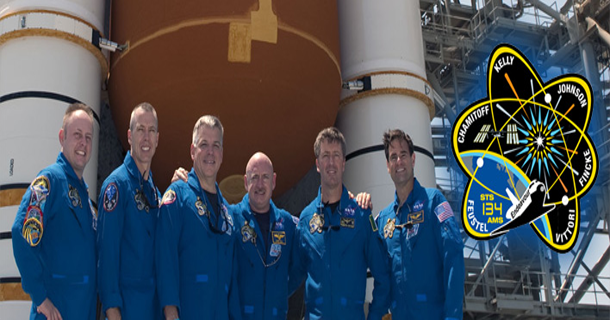
The STS-134 crew members are Commander Mark Kelly, Pilot Gregory H. Johnson and Mission Specialists Michael Fincke, Greg Chamitoff, Andrew Feustel and European Space Agency astronaut Roberto Vittori.

Today’s announcement was praised by shuttle fans and politicians alike, with Senator Barbara Boxer adding her endorsement to NASA’s decision.
“I am excited that NASA has announced that the Space Shuttle Endeavour will be permanently displayed at the California Science Center,” Boxer said. “California has a long history of supporting the shuttle program and we are proud to welcome this inspiring symbol of American scientific achievement and ingenuity to the Golden State.”

In 2008, NASA announced a national competition among museums and science centers for the right to permanently display one of the retiring space shuttles.  The California Science Center competed with more than 20 other institutions nationwide.  Other winners include the Kennedy Space Center in Florida, the Intrepid Sea, Air and Space Museum in New York City and the Smithsonian Institution’s Udvar-Hazy Center in Virginia.

Senator Boxer and Senator Diane Feinstein wrote to NASA Administrator Charles F. Bolden, Jr. in July 2010 requesting that California receive one of the shuttles.
California has a long history with the shuttle program.  Beginning in 1972, all five space shuttle orbiters were fabricated in Downey, California and assembled in Palmdale, California.  All of the space shuttles were tested at Edwards Air Force Base just outside of Palmdale, which also served as the secondary landing site to Kennedy Space Center in Florida and has welcomed home 53 of NASA’s 133 shuttle missions.


UTC unit moves to diversify as shuttle ends

The Space Shuttle Atlantis backdropped against the Earth prior to docking with the International Space Station, May 16, 2010. REUTERS/NASA

COLORADO SPRINGS, Colo. | Thu Apr 14, 2011 10:49am EDT
COLORADO SPRINGS, Colo. (Reuters) - Pratt & Whitney Rocketdyne is moving to diversify its business to reduce dependence on NASA amid an uncertain outlook for the U.S. space program, the company's president said on Wednesday.
Jim Maser, president of the United Technologies (UTX.N) unit that supplies the space shuttle's main engine, also reiterated that layoffs and supplier exits from space work could ramp up later this year if NASA doesn't soon unveil a successor program to the shuttle.

The shuttle program is set to end this year, and NASA is looking to free up funds to develop new spacecraft capable of space missions. Maser said the agency's silence on a successor plan was leaving industry suppliers uncertain.

"Our concern is that they're taking too long and this perishable intellectual capital is being put at risk," Maser said in an interview at the National Space Symposium conference in Colorado Springs. "For the first time in our history, our major launch system is ending and we don't even know what the replacement is."

He said the industry could undergo "some structural changes" after the shuttle program ends this summer. "I think it could get very traumatic and damaging by the end of this year," Maser added.
Maser said Rocketdyne was looking to diversify its business portfolio by growing in missile defense, energy and solar power technology and other areas.

REVENUE TO DROP THIS YEAR
Maser said NASA accounts for 60 percent of Pratt & Whitney Rocketdyne's revenue now, down from as much as 80 percent four years ago.

"We've been investing in our core products and technology but also in a diversification approach that we think is making for a healthier business," Maser said.

Pratt & Whitney Rocketdyne, which has about 2,800 workers, has cut staff about 15 percent over the past year through voluntary retirements, layoffs and attrition, Maser said. Amid the shuttle program uncertainty, he added revenue at Rocketdyne will drop this year.

Maser said the management of parent United Technologies expected the Rocketdyne business to work its way through the current business cycle.
"I think that once this settles out, I had better have a good path back to growth," he added.
(Reporting by Karen Jacobs, editing by Bernard Orr)

Purdue Alumnus to Fly on NASA Mission to Space Station

Andrfeustelew Feustel, a Purdue University alumnus and NASA astronaut, is scheduled to make three spacewalks during a space shuttle mission to the International Space Station this month.

The 14-day mission, scheduled to launch April 29, will deliver an instrument called the Alpha Magnetic Spectrometer, which is a sophisticated particle physics detector, and other components including communications antennas, a high-pressure gas tank, spare parts for the two-armed Dextre robot and micrometeoroid debris shields.

"It's an amazing chapter for me personally," said Feustel, who first flew on the shuttle during the final Hubble Space Telescope servicing mission in 2009. "To be lucky enough to see Hubble and the space station is pretty remarkable."

He is scheduled to lead three out of four spacewalks to perform critical installations and maintenance. Astronauts on shuttle missions are well-suited to perform certain spacewalking tasks instead of space station residents because their practice sessions on Earth are more recent and focus on specific jobs.

Spacewalking tasks for a shuttle crew vary from mission to mission. The spacewalkers on this flight, compared to those on the Hubble mission, will need to cover more ground while performing their space station duties, Feustel said.
"The Hubble work required more detailed, fine-motor-skills, whereas the space station work involves larger objects," he said.

This flight is scheduled to be the penultimate space shuttle mission, as the spacecrafts' storied history draws to a close after 30 years.
Purdue President France A. Córdova, a former NASA chief scientist, said the mission to the space station demonstrates Purdue's continued contributions to the U.S. space program.
"The space station is a symbol of international cooperation to further human exploration, and it has been crucial for advancing scientific research in a microgravity environment and testing systems that will be needed for missions to the moon and Mars," Córdova said. "Purdue alumni have served on previous missions to the space station, and Purdue faculty have performed many experiments in microgravity, aiding research in disciplines ranging from biology to physics."

The shuttle Endeavour will remain docked to the station for nine days, with its six-person crew working with the station's six personnel. Following Endeavour's departure, the crew will re-approach the station to test a new sensor technology that will make it easier and safer for spacecraft to rendezvous and dock to the International Space Station.

One additional mission, the 135th in the shuttle program, is scheduled before the fleet is retired from service. The final mission is targeted for June 28 to deliver supplies and spare parts to the space station.

To date, 22 Purdue alumni have been chosen for spaceflight, including Neil Armstrong, the first person to walk on the moon, and Eugene Cernan, the most recent to do so. In addition, Scott Tingle, who earned a master's degree in mechanical engineering in 1988, will soon complete his astronaut training.

Feustel, 45, earned a bachelor's degree in solid earth sciences in 1989 and a master's degree in geophysics in 1991, both from Purdue, and a doctoral degree in geological sciences from Queen's University, in Kingston, Ontario, Canada, in 1995.
Purdue holds a special place in the Feustel family legacy. His great-great-uncle graduated from Purdue in 1905, followed by his father and uncle. His wife and her sister also earned Purdue degrees.

He joins a crew of commander Mark Kelly, pilot Greg H. Johnson and mission specialists Michael Fincke, Roberto Vittori and Greg Chamitoff.
Feustel is married to Indira Devi Bhatnagar, whom he met while both were graduate students at Purdue. They have two children.

Feustel specializes in seismology in underground mines and measurement techniques and applications in site characterization. For three years he worked as a geophysicist for the Engineering Seismology Group in Kingston, Ontario, installing and operating microseismic monitoring equipment in underground mines throughout Eastern Canada and the United States. In 1997 Feustel began working for the Exxon Mobil Exploration Co. in Houston as an exploration geophysicist designing and providing operational oversight of land, marine and borehole seismic programs worldwide.

A native of Lake Orion, Mich., he was an exploration geophysicist in the petroleum industry at the time of his selection by NASA.