• 2010 nasa special
    a total eclipse of the Sun is visible from within a narrow corridor that traverses Earth's southern Hemisphere. The path of the Moon's umbral shadow crosses the South Pacific Ocean where it makes no landfall except for Mangaia (Cook Islands) and Easter Island (Isla de Pascua).
Showing posts with label nasa space updates. Show all posts

Soyuz undocking could be shuttle photo opp

APE CANAVERAL, Fla. — Iconic images of the shuttle joined to a completed International Space Station will be snapped Monday night if an unprecedented space operation goes off as planned.

For the first time, a Russian space taxi is scheduled to leave the station while a shuttle is docked there.

The departure presents what may be the only opportunity to take pictures NASA and many space fans covet of the shuttle, on the eve of its retirement, parked at the $100 billion outpost that is its greatest legacy.

"Hopefully those pictures will show up in textbooks for years to come," said Kenny Todd, NASA's station manager for operations and integration.

Around 5:30 p.m., a Soyuz spacecraft piloted by Russian cosmonaut Dmitry Kondratyev and carrying a NASA astronaut and an Italian astronaut will undock from a port 50 feet from Endeavour and back away to a distance of about 650 feet.

The station then will rotate 130 degrees in an unusual sideways pose that offers a good view of the station, Endeavour, and two cargo ships flown by Russia and Europe.

Italian astronaut Paolo Nespoli will climb temporarily into the windowed Soyuz module — a part of the craft that burns up during re-entry — and begin taking pictures and video of the shuttle and station floating 220 miles above the planet.

Nespoli will have about five minutes to take in the unique view before Soyuz thrusters fire to separate the spacecraft from the station and put Kondratyev, Nespoli and American Cady Coleman en route to a landing in Kazakhstan late Monday night.

It sounds simple enough, but the whole process involves risks that took years to gain acceptance.

"There's been a lot of work by a whole lot of teams to make sure this is really a good thing to be doing, but folks are very comfortable with the plan," Courtenay McMillan, a station flight director, said of the photo opportunity.

"Now, instead of a unique configuration, we have more of what I term more of a unique opportunity," Todd said since not every vehicle would be represented in the picture.

The opportunity arose when shuttle and station program leaders approved what is known as "dual docked operations."

In the past, vehicles coming and going from the station were conflicts for a shuttle mission to avoid.

Another showstopper could be coordinating shuttle and Soyuz crew schedules so each gets enough rest and can execute their separate missions without interference.

In this case, engineers determined there was acceptable rocket fuel plume risk , and the schedules could be managed.

But the photo opportunity presented additional challenges.

The Soyuz will back away much like it always does, but at a slightly higher angle to make sure the sun doesn't blind Kondratyev while he manually keeps the spacecraft hovering behind the station for an extended period.

The station had to figure out a pose that ensured good lighting, and flying in any new position, even for half an orbit, requires verification that systems won't be exposed to harmful temperatures.

The photo orientation is "different enough from what we usually fly that it is outside what we know about, so folks had to go off and do the math and figure out what the problems would be," McMillan said.

After taking the pictures, Nespoli will return to his seat in the crew module and seal the hatch. The crew module separates from two others and is the only part of the ship that survives atmospheric re-entry.

But the Soyuz won't be able to immediately return to its port if there is trouble sealing the hatch, which normally is closed prior to undocking. The maneuver hasn't been studied enough to know it can be done safely.

Managers say a hatch problem is highly unlikely, the Soyuz has backup landing opportunities through Tuesday and managers would come up with a solution if necessary.

"We would get there," said Derek Hassmann, the lead flight director for Endeavour's visit to the station.

Plans continue for another round of photos to be taken during the final shuttle flight. But that could be dropped if Monday's operation produces the desired imagery, which could be released within days.

If the effort succeeds, Todd said he hopes the photos give future generations an appreciation for the feat represented by the station, which couldn't have been built without the shuttle.

"So if we're ever to end up in the future somewhere in a book, it would be great to have the space shuttle represented there with us, as well as all the other international partners," he said.

Exploring the Wonders of the Universe

Exploring the Wonders of the Universe

The newly-installed Alpha Magnetic Spectrometer-2 is visible at center of the International Space Station's starboard truss. The Alpha Magnetic Spectrometer, or AMS, is the largest scientific collaboration to use the orbital laboratory. 

This investigation is sponsored by the U.S. Department of Energy and made possible by funding from 16 nations. Led by Nobel Laureate Samuel Ting, more than 600 physicists from around the globe will be able to participate in the data generated from this particle physics detector. 

The mission of the AMS is, in part, to seek answers to the mysteries of antimatter, dark matter and cosmic ray propagation in the universe. 

 International Space Station

Space Shuttle Mission: STS-134

Commander Mark Kelly and Mission Specialist Mike Fincke 

Image above: Commander Mark Kelly (left) and Mission Specialist Mike Fincke aboard space shuttle Endeavour talk to students at Mesa Verde Elementary School in Tucson, Ariz. Photo credit: NASA TV

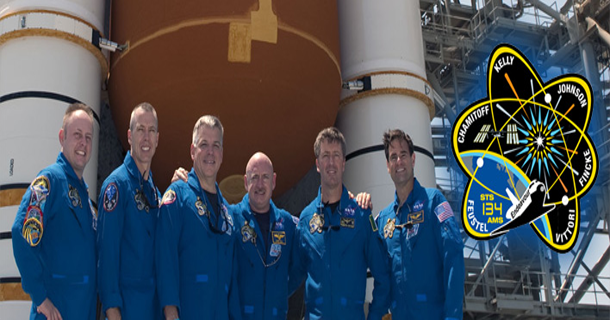
The crew members for space shuttle Endeavour's STS-134 mission are Commander Mark Kelly, Pilot Gregory H. Johnson and Mission Specialists Michael Fincke, Greg Chamitoff, Andrew Feustel and European Space Agency astronaut Roberto Vittori.

During the 16-day mission, Endeavour and its crew will deliver the Alpha Magnetic Spectrometer (AMS) and spare parts including two S-band communications antennas, a high-pressure gas tank and additional spare parts for Dextre.

The Power of A Moon Rock

"This is a moon rock and it's on our kitchen table. This rock encapsulates all of the optimism and unlimited potential that Americans had at the time. It made me believe that anything is possible. I wanted kids of this generation to have this experience. So, although it wasn't easy -- I borrowed a Moon Rock from NASA."
--Debra Sea in "Moon Rock"
Between 1969 and 1972 six Apollo missions brought back 382 kilograms (842 pounds) of lunar rocks, core samples, pebbles, sand and dust from the lunar surface. The six space flights returned 2,200 separate samples from six different exploration sites on the Moon.

Debra Sea and her brothers, David and William, admire an Apollo 11 moon rock on their kitchen table

In 1970, Debra Sea and her brothers, David and William, admire a Moon Rock from Apollo 11 as it sits atop their kitchen table.

Credit: Sea Family
To view the film, "Moon Rock," by Debra Sea, please visit:

moonrockthemovie.com/movie.html
The sample that sat before Debra and two of her younger brothers in 1970 returned to Earth from Apollo 11. And it landed on her kitchen table by way of her father, Duane Sea, a former a NASA science demonstrator, also known as a Spacemobiler.

Duane and his Spacemobile traveled to schools across the Mid-West, reaching more than 400,000 students. In the summer, Debra and her siblings would go along for the ride.

"Like everyone else, we were wildly optimistic about the future of space science," Debra said.

At age 10, her Moon Rock experience was documented with a photograph, which was labeled as "Moon Rock" in her family album. So, it was only natural that her film would also be labeled as "Moon Rock."

"It was always a story I wanted to tell," said Debra. "The timing was perfect."

Perfect because she was a working on her Master's of Fine Arts (MFA) at the University of North Carolina Greensboro when she chose "Moon Rock" as her Master Production film project. She was one of three students chosen to receive a 2011 Carole Fielding Student Grants awarded by the University Film and Video Association.

Debra Sea with Apollo 14 moon rock 

For her thesis film, "Moon Rock," Debra Sea borrowed a Moon Rock from NASA's Langley Research Center in Hampton, Va.

Credit: NASA/Sean Smith
But Debra quickly learned that borrowing a Moon Rock from NASA was no easy task.

After six months and a great deal of determination, her Lunar Sample Application was approved. For pick-up, she was referred to NASA's Langley Research Center in Hampton, Va., because it was in her outreach region.

The larger, display Moon Rocks are considered a national treasure that cannot be shipped, only hand carried. With possession, comes a strict set of guidelines. It must be kept in sight or in a safe. It can't be kept in a motel room overnight. And don't touch the Lucite without gloves, because the oil from skin can damage and cloud the Lucite.

"We were like old friends," Debra said of the Moon Rock. Except this was a different rock -- from Apollo 14. And this time, she was responsible for it. That was quite the burden for Debra, who constantly worried about the rock, much like a mother worries for her child.

Meghan Guethe, Langley's exhibits manager, helped Debra through the process. She understood and appreciated Debra's desire to keep it safe. "Everything is priced when it is sent out with an exhibit," Guethe said. "We cannot price these."

Debra Sea and her brothers beside their father's Spacemobile van 

In the summer, Debra Sea and her brothers would travel in a Spacemobile driven by their father Duane, a former NASA Science demonstrator, also known as a Spacemobiler.

Credit: Sea Family
It took a lot of planning to prepare the invaluable Moon Rock's trip to three classrooms at Wadena-Deer Creek, a K-12 school in Minnesota, where Debra's brother David teaches. She created a contingency plan for each airport.

And when she and her film assistant Adrienne Ostberg, a first-year MFA student, had their last flight canceled, they rotated staying with the rock in a private, locked room, purposed for nursing moms.

Their "baby" was a Moon Rock, which was enclosed in a Lucite pyramid. The 115-gram rock had its own carrying case and a small brass plate on the case reads, "IF FOUND, RETURN TO -- NASA, JOHNSON SPACE CENTER, HOUSTON, TEXAS 77058."

Duane accompanied her to the school. And despite the fact that he hadn't worked for NASA in 40 years, he smoothly converted back into his Spacemobiler ways.

"Have you ever driven a nail with a banana?" Duane asked the students after dipping one into a container of liquid nitrogen and freezing it solid.

As the banana proved to have the power of a hammer, the looks of authentic amazement and surprise on the student's faces spoke powerfully. And so did their questions.

Apollo 14 moon rock 
This Moon Rock, from Apollo 14, visited three classes at Wadena-Deer Creek, a K-12 school in Minnesota, where Debra's brother David teaches.
Credit: NASA/Sean Smith
"Is this a magic trick?" a student asked.

"No, magic. Just science" Duane replied.

"He had such a presence," Debra said of her father.

The Moon Rock temporarily abolished his presence. The students put gloves on and one-by-one touched the pyramid and gazed into the rock that had traveled some 238,857 miles (384,403 km) back to Earth 40 years prior.

"Everyone wanted to touch it, like a relic," Debra said of the students, and even airport security personnel that help her to guard it from harm.

But the contact that truly mattered was that of the students.

"I keep hearing that kids are different today than they were years ago. I just don't buy that," Duane said. "Kids are kids. The same eager faces that you see in front of you today are the same that I saw in front of me 40 years ago."

Debra and two of her brothers recreated the "Moon Rock" photo, and the moment that sparked their own sense of wonder. It seemingly had a great affect on them as each studied and works in a science-related field.

Whether Science or magic, their Moon Rock experience was afforded to a new generation. And now, it's up to them to decide what to do with it.

"I see incredible optimism and potential in these kids. And after bringing the Moon Rock home, I feel really hopeful about the future," Debra said. "I still believe that anything is possible. And I know I always will."


Denise Linberry
The Researcher News
NASA Langley Research Center

Free-Floating Planets May Be More Common Than Stars

This artist's conception illustrates a Jupiter-like planet alone in the dark of space, floating freely without a parent star. 

This artist's conception illustrates a Jupiter-like planet alone in the dark of space, floating freely without a parent star. Image credit: NASA/JPL-Caltech
 
PASADENA, Calif. -- Astronomers, including a NASA-funded team member, have discovered a new class of Jupiter-sized planets floating alone in the dark of space, away from the light of a star. The team believes these lone worlds were probably ejected from developing planetary systems. 
                     
The discovery is based on a joint Japan-New Zealand survey that scanned the center of the Milky Way galaxy during 2006 and 2007, revealing evidence for up to 10 free-floating planets roughly the mass of Jupiter. The isolated orbs, also known as orphan planets, are difficult to spot, and had gone undetected until now. The newfound planets are located at an average approximate distance of 10,000 to 20,000 light-years from Earth.
"Although free-floating planets have been predicted, they finally have been detected, holding major implications for planetary formation and evolution models," said Mario Perez, exoplanet program scientist at NASA Headquarters in Washington. 

The discovery indicates there are many more free-floating Jupiter-mass planets that can't be seen. The team estimates there are about twice as many of them as stars. In addition, these worlds are thought to be at least as common as planets that orbit stars. This would add up to hundreds of billions of lone planets in our Milky Way galaxy alone. 

"Our survey is like a population census," said David Bennett, a NASA and National Science Foundation-funded co-author of the study from the University of Notre Dame in South Bend, Ind. "We sampled a portion of the galaxy, and based on these data, can estimate overall numbers in the galaxy."
The study, led by Takahiro Sumi from Osaka University in Japan, appears in the May 19 issue of the journal Nature. 

The survey is not sensitive to planets smaller than Jupiter and Saturn, but theories suggest lower-mass planets like Earth should be ejected from their stars more often. As a result, they are thought to be more common than free-floating Jupiters. 


Previous observations spotted a handful of free-floating, planet-like objects within star-forming clusters, with masses three times that of Jupiter. But scientists suspect the gaseous bodies form more like stars than planets. These small, dim orbs, called brown dwarfs, grow from collapsing balls of gas and dust, but lack the mass to ignite their nuclear fuel and shine with starlight. It is thought the smallest brown dwarfs are approximately the size of large planets. 

On the other hand, it is likely that some planets are ejected from their early, turbulent solar systems, due to close gravitational encounters with other planets or stars. Without a star to circle, these planets would move through the galaxy as our sun and other stars do, in stable orbits around the galaxy's center. The discovery of 10 free-floating Jupiters supports the ejection scenario, though it's possible both mechanisms are at play.
"If free-floating planets formed like stars, then we would have expected to see only one or two of them in our survey instead of 10," Bennett said. "Our results suggest that planetary systems often become unstable, with planets being kicked out from their places of birth." 


The observations cannot rule out the possibility that some of these planets may have very distant orbits around stars, but other research indicates Jupiter-mass planets in such distant orbits are rare.
The survey, the Microlensing Observations in Astrophysics (MOA), is named in part after a giant wingless, extinct bird family from New Zealand called the moa. A 5.9-foot (1.8-meter) telescope at Mount John University Observatory in New Zealand is used to regularly scan the copious stars at the center of our galaxy for gravitational microlensing events. These occur when something, such as a star or planet, passes in front of another, more distant star. The passing body's gravity warps the light of the background star, causing it to magnify and brighten. Heftier passing bodies, like massive stars, will warp the light of the background star to a greater extent, resulting in brightening events that can last weeks. Small planet-size bodies will cause less of a distortion, and brighten a star for only a few days or less. 


A second microlensing survey group, the Optical Gravitational Lensing Experiment (OGLE), contributed to this discovery using a 4.2-foot (1.3 meter) telescope in Chile. The OGLE group also observed many of the same events, and their observations independently confirmed the analysis of the MOA group.
NASA's Jet Propulsion Laboratory, Pasadena,Calif., manages NASA's Exoplanet Exploration program office. JPL is a division of the California Institute of Technology in Pasadena. 

More information about exoplanets and NASA's planet-finding program is at http://planetquest.jpl.nasa.gov.
 
 
Whitney Clavin 818-354-4673
Jet Propulsion Laboratory, Pasadena, Calif.
whitney.clavin@jpl.nasa.gov

Trent Perrotto 202-358-0321
Headquarters, Washington
trent.j.perrotto@nasa.gov

Space Shuttle Mission: STS-134

The STS-134 crew members are welcomed aboard the station. 

Image above: Commander Mark Kelly and the STS-134 crew are welcomed aboard the International Space Station by the Expedition 27 crew. Photo credit: NASA TV

The crew members for space shuttle Endeavour's STS-134 mission are Commander Mark Kelly, Pilot Gregory H. Johnson and Mission Specialists Michael Fincke, Greg Chamitoff, Andrew Feustel and European Space Agency astronaut Roberto Vittori.

During the 16-day mission, Endeavour and its crew will deliver the Alpha Magnetic Spectrometer (AMS) and spare parts including two S-band communications antennas, a high-pressure gas tank and additional spare parts for Dextre.

The Far Side of the Moon -- And All the Way Around


image of lunar far side


Because the moon is tidally locked  And what a surprise -­ unlike the widespread maria on the nearside, basaltic volcanism was restricted to a relatively few, smaller regions on the farside, and the battered highlands crust dominated. A different world from what we saw from Earth.

Of course, the cause of the farside/nearside asymmetry is an interesting scientific question. Past studies have shown that the crust on the farside is thicker, likely making it more difficult for magmas to erupt on the surface, limiting the amount of farside mare basalts. Why is the farside crust thicker? That is still up for debate, and in fact several presentations at this week's Lunar and Planetary Science Conference attempt to answer this question.

The Clementine mission obtained beautiful mosaics with the sun high in the sky (low phase angles), but did not have the opportunity to observe the farside at sun angles favorable for seeing surface topography. This WAC mosaic provides the most complete look at the morphology of the farside to date, and will provide a valuable resource for the scientific community. And it's simply a spectacular sight!

The Lunar Reconnaissance Orbiter Camera (LROC) Wide Angle Camera (WAC) is a push-frame camera that captures seven color bands (321, 360, 415, 566, 604, 643, and 689 nm) with a 57-km swath (105-km swath in monochrome mode) from a 50 km orbit. One of the primary objectives of LROC is to provide a global 100 m/pixel monochrome (643 nm) base map with incidence angles between 55°-70° at the equator, lighting that is favorable for morphological interpretations. 
Each month, the WAC provides nearly complete coverage of the Moon under unique lighting. As an added bonus, the orbit-to-orbit image overlap provides stereo coverage. Reducing all these stereo images into a global topographic map is a big job, and is being led by LROC Team Members from the German Aerospace Center (Deutsches Zentrum für Luft- und Raumfahrt; DLR). Several preliminary WAC topographic products have appeared in LROC featured images over the past year (Orientale basin, Sinus Iridum). 
For a sneak preview of the WAC global DEM with the WAC global mosaic, view a rotating composite moon (70 MB video from ASU's LROC website). The WAC topographic dataset will be completed and released later this year.

The global mosaic released today is comprised of over 15,000 WAC images acquired between November 2009 and February 2011. The non-polar images were map projected onto the GLD100 shape model (WAC derived 100 m/pixel DTM), while polar images were map projected on the LOLA shape model. In addition, the LOLA derived crossover corrected ephemeris, and an improved camera pointing, provide accurate positioning (better than 100 m) of each WAC image.

As part of the March 2011 PDS release, the LROC team posted the global map in ten regional tiles. Eight of the tiles are equirectangular projections that encompass 60° latitude by 90° longitude. In addition, two polar stereographic projections are available for each pole from ±60° to the pole. These reduced data records (RDR) products will be available for download on March 15, 2011. As the mission progresses, and our knowledge of the lunar photometric function increases, improved and new mosaics will be released! Work your way around the moon with these six orthographic projections constructed from WAC mosaics. The nearside view linked below is different from that released on 21 February.


images of the moon Six orthographic views of the Moon created from the new WAC global mosaic. From upper left to lower right the central longitude is 0°, 60°, 120°, 180°, 240°, 300°. Credit: NASA/Goddard/Arizona State University.

TRMM Maps a Wet Spring, 2011 for the Central U.S.

NASA's Tropical Rainfall Measuring Mission satellite has been keeping track of the drenching rainfall that has been occurring in the central U.S. this springtime, and a newly created rain map from that data from April to May 4, 2011 shows those soaked areas.

A combination of heavy rains and a large snow melt has put parts of the central U.S. at risk for record flooding this spring with several locations along the Mississippi already at or near record levels. One likely culprit is La Niña. Despite the fact that the current La Niña appears to be winding down, its effects in the atmosphere can persist for a while. Furthermore, although not every La Niña brings major flooding to the region, La Niña's are conducive for above-normal rainfall from East Texas and northern Louisiana up through Arkansas and the Tennessee and Ohio Valleys with below-normal rainfall across Texas, southern Louisiana and Florida.

Rainfall anomalies were created in this rainfall map for the period April 4 to May 4, 2011 for the eastern two thirds of the country.

TMPA rainfall anomalies were created in this rainfall map for the period April 4 to May 4, 2011 for the eastern two thirds of the country. The anomalies were constructed by computing the average rainfall rate over the period and then subtracting the 10-year average rate for the same period. Credit: NASA/SSAI, Hal Pierce

During La Niña, below-normal sea surface temperatures occur in the equatorial East Pacific and above-normal temperatures in the West Pacific. This pattern leads to enhanced tropical thunderstorm activity over the West Pacific, which in turn can influence the weather in middle latitudes by shifting the jet stream pattern. On average, La Niña's favor an upper-level trough over the Midwest with the jet stream dipping down out of the northern Rockies and flowing west-to-east across the central Mississippi and Ohio Valleys before heading back up over the Northeast. This pattern steers developing low pressure systems across the Plains and central Mississippi into the Tennessee and Ohio Valleys. These areas of low pressure provide the focus for showers and storms while drawing warm moist air up from the Gulf of Mexico, resulting in enhanced rainfall across the central part of the country.

The main objective of the Tropical Rainfall Measuring Mission or TRMM satellite is to measure rainfall over the global Tropics. TRMM measures rainfall using a combination of passive microwave and active radar sensors. For expanded coverage, TRMM can be used to calibrate rainfall estimates from other satellites. The TRMM-based, near-real time Multi-satellite Precipitation Analysis (TMPA) at the NASA Goddard Space Flight Center, Greenbelt, Md. provides rainfall estimates over the global Tropics.

TMPA rainfall anomalies were created in a rainfall map for the period April 4 to May 4, 2011 for the eastern two thirds of the country. The anomalies were constructed by computing the average rainfall rate over the period and then subtracting the 10-year average rate for the same period. The resulting pattern shows a broad area of above-normal rainfall (shown in green and blue) stretching from eastern Oklahoma across the central Mississippi Valley and up into the lower Ohio Valley with below-normal rainfall along the northern Gulf Coast. This rainfall pattern is consistent with a La Niña.

In addition to rainfall, this type of jet stream pattern can lead to strong storms by allowing strong jet stream winds to override warm moist air from the Gulf as was evidenced by the recent tornado outbreak. In fact, some of the biggest tornado outbreaks, including the previous record "Super Outbreak" in 1974, have occurred during La Niña's.

TRMM is a joint mission between NASA and the Japanese space agency JAXA.
 
Steve Lang
SSAI/NASA Goddard Space Flight Center

Dawn Reaches Milestone Approaching Asteroid Vesta

Artist's concept of Dawn NASA's Dawn spacecraft, illustrated in this artist's concept, is propelled by ion engines. Image credit: NASA/JPL

› Journal entry on approach phase

PASADENA, Calif. – NASA's Dawn spacecraft has reached its official approach phase to the asteroid Vesta and will begin using cameras for the first time to aid navigation for an expected July 16 orbital encounter. The large asteroid is known as a protoplanet – a celestial body that almost formed into a planet.

At the start of this three-month final approach to this massive body in the asteroid belt, Dawn is 1.21 million kilometers (752,000 miles) from Vesta, or about three times the distance between Earth and the moon. During the approach phase, the spacecraft's main activity will be thrusting with a special, hyper-efficient ion engine that uses electricity to ionize and accelerate xenon. The 12-inch-wide ion thrusters provide less thrust than conventional engines, but will provide propulsion for years during the mission and provide far greater capability to change velocity.

"We feel a little like Columbus approaching the shores of the New World," said Christopher Russell, Dawn principal investigator, based at the University of California in Los Angeles (UCLA). "The Dawn team can't wait to start mapping this Terra Incognita."

Dawn previously navigated by measuring the radio signal between the spacecraft and Earth, and used other methods that did not involve Vesta. But as the spacecraft closes in on its target, navigation requires more precise measurements. By analyzing where Vesta appears relative to stars, navigators will pin down its location and enable engineers to refine the spacecraft's trajectory. Using its ion engine to match Vesta's orbit around the sun, the spacecraft will spiral gently into orbit around the asteroid. When Dawn gets approximately 16,000 kilometers (9,900 miles) from Vesta, the asteroid's gravity will capture the spacecraft in orbit.

"After more than three-and-a-half years of interplanetary travel, we are finally closing in on our first destination," said Marc Rayman, Dawn's chief engineer, at NASA's Jet Propulsion Laboratory in Pasadena, Calif. "We're not there yet, but Dawn will soon bring into focus an entire world that has been, for most of the two centuries scientists have been studying it, little more than a pinpoint of light."

Scientists will search the framing camera images for possible moons around Vesta. None of the images from ground-based and Earth-orbiting telescopes have seen any moons, but Dawn will give scientists much more detailed images to determine whether small objects have gone undiscovered.

The gamma ray and neutron detector instrument also will gather information on cosmic rays during the approach phase, providing a baseline for comparison when Dawn is much closer to Vesta. Simultaneously, Dawn's visible and infrared mapping spectrometer will take early measurements to ensure it is calibrated and ready when the spacecraft enters orbit around Vesta.

Dawn's odyssey, which will take it on a journey of 4.8-billion kilometers (3-billion miles), began on Sept. 27, 2007, with its launch from Cape Canaveral Air Force Station in Florida. It will stay in orbit around Vesta for one year. After another long cruise phase, Dawn will arrive at its second destination, an even more massive body in the asteroid belt, called Ceres, in 2015.

These two icons of the asteroid belt will help scientists unlock the secrets of our solar system's early history. The mission will compare and contrast the two giant bodies, which were shaped by different forces. Dawn's science instrument suite will measure surface composition, topography and texture. In addition, the Dawn spacecraft will measure the tug of gravity from Vesta and Ceres to learn more about their internal structures.

The Dawn mission to Vesta and Ceres is managed by JPL for NASA's Science Mission Directorate in Washington. Dawn is a project of SMD's Discovery Program, which is managed by NASA's Marshall Space Flight Center in Huntsville, Ala. UCLA is responsible for overall Dawn mission science. Orbital Sciences Corp. of Dulles, Va., designed and built the Dawn spacecraft. 

The framing cameras have been developed and built under the leadership of the Max Planck Institute for Solar System Research in Katlenburg-Lindau in Germany, with significant contributions by the German Aerospace Center (DLR) Institute of Planetary Research in Berlin, and in coordination with the Institute of Computer and Communication Network Engineering in Braunschweig. The framing camera project is funded by NASA, the Max Planck Society and DLR.

JPL is a division of the California Institute of Technology, Pasadena.

For more information about Dawn, visit: http://www.nasa.gov/dawn and http://dawn.jpl.nasa.gov

To learn more about Dawn's approach phase, read the latest Dawn Journal at http://blogs.jpl.nasa.gov/2011/05/dawn-begins-its-vesta-phase/


Jia-Rui C. Cook 818-354-0850
Jet Propulsion Laboratory, Pasadena, Calif.
jia-rui.c.cook@jpl.nasa.gov

New Deputy Brings International Education Experience

Dean Aaron Kern 

Dean Aaron Kern Credit: NASA Exploration for a different challenge and new opportunities has landed Dean Aaron Kern a new position as Deputy Director for the Office of Education at Goddard. He arrives with a wealth of national and international teaching experience he hopes to share with others.

Kern admits being excited about his new position because of a positive NASA experience over 20 years ago. “My first exposure to NASA was part of an international group of teachers attending a two-week training project at the Johnson Space Center. At the end I remember saying this was a great opportunity for teachers to receive training from the experts and lots of great resources for the classroom,” he said.

In college Kern admits he was a typical student, altering his direction of study several times before settling on a duel major in elementary and special education. Ultimately, he had to decide between a course in classroom design or neuropsychology. “Neuropsychology and disabilities was much more interesting and led to my interest in learning more about how to work with students with disabilities in the classroom.”

After receiving a bachelor’s degree from Northern Arizona University (NAU) Kern began his teaching career in Phoenix, Arizona. “I’ve been a special and elementary education teacher at all levels of K-12 and even taught music at one point in my career” he said. Along the way, Kern obtained a Master of Arts degree in education administration from NAU, and continued doctorial studies at the University of Colorado at Denver.

Kern spent 10 years teaching in four different countries working in international American and British sponsored schools before returning to the U.S. He worked for several more years in the emerging education school choice effort known as charter schools at the local and state levels before joining the U.S. Department of Education in 2002 as Director of the Charter Schools Program. “I became interested in the charter school programs from a civil rights and social perspective where you are addressing a critical issue and the achievement challenges for kids because of their zip code, ethnicity, and/or race,” Kern said. “I see the NASA experience as another opportunity to use my educational background to have a positive influence on student learning.”

As Deputy Director, Kern will oversee Goddard’s educational programs. “We are indeed fortunate to have Dean join the Goddard staff,” said Dr. Robert Gabrys, director of Goddard’s Office of Education. “His background in education at the school, state, and government levels provides us with a depth of education expertise that will serve both the Center and Headquarters (NASA) well.”

According to Kern, NASA’s Summer of Innovation program is definitely a part of the national conversation. “It brings to the forefront more visibility for STEM (Science, Technology, Engineering, and Mathematics), which is becoming part of the mainstream conversation when talking about education reform.”

Kern believes this opportunity will allow direct influence over programs that will inspire our next generation to explore. “I believe insight is key when rolling out new programs, initiatives, or training. How will it be received at the teacher, state, and national level is key to successfully gaining classroom access. Whatever you are doing, it must support the national policy conversation in education, at all levels.”

For the avid bike rider, Kern’s new position in Maryland puts an end to the daily 20-mile bike commute from Old Town Alexandria, Virginia to the Department of Education in Washington, D.C. “On the weekends I cram to make up those miles.” In addition to traveling with wife Monica, Kern enjoys singing in the Metropolitan Chorus and bargain hunting at second-hand stores.
 
 
Dewayne Washington
NASA's Goddard Space Flight Center

Explore@NASA Goddard: Saturday, May 14, 2011, 11 a.m. - 5 p.m. FREE!

Explore at NASA Goddard logo Have a blast exploring the universe at a FREE open house event at NASA Goddard Space Flight Center in Greenbelt, Maryland. Explore@NASA Goddard, on Saturday, May 14, from 11am to 5pm rain or shine, is full of family fun, music, food, and science. Free satellite parking and transportation to Goddard will be provided. There is no public parking at the Center.

Explore@NASA Goddard will include indoor and outdoor exhibits and entertainment that will thrill and educate at the same time.

The event is organized into six zones:

* Earth Science: Experience how NASA measures and monitors our changing Earth from space

* Solar System: Discover how solar cycles affect Earth’s climate and how space weather changes the magnetosphere. Witness planetary science in action

* Universe: Explore the many ways the universe and everything in it is constantly changing

* Engineering & Technology: See discoveries in science through technological research, development, and engineering

* People: Investigate the diverse people and careers at Goddard Space Flight Center

* On the Mall: Discover the fun activities, great food, crafts, and entertainment on our mall area. Fantastic foods abound, from soul food to BBQ, and ice cream to souvlaki. Music features the a cappella group Sweet Honey in the Rock®, and Milkshake with great music for kids.


Facebook logo › Check out Explore@NASA Goddard on Facebook

NASA’s Spaceward Bound Takes Teachers Trekking across the Mojave Desert

biological soil crust  

Click image for full resolution.
Leaving civilization behind, the group searched for biological soil crusts, referred to as BSCs, in the vast plains of the desert. BSCs are a complex community of cyanobacteria, moss and lichen that represent how life can survive in extreme environments.
Image credit: NASA/Matthew F. Reyes
sand dunes in the Mojave desert 

Cima Sand Dunes are beautiful but deceitful. To survey the landscape, students and teachers headed for the highest point of the dunes. They soon discovered that for every step they took up, they slid down 0.75 steps.
Image credit: NASA/Matthew F. Reyes

weather balloon launch  

Click image for full resolution.
Students from Valley View Middle School, Pleasanton, Calif., launched an instrumented weather balloon designed and built by Columbus High School, Ga., students in the Doing Research at Extreme Altitudes by Motivated Students (DREAMS) program.
Image credit: NASA/Matthew F. Reyes
students at Spaceward Bound Mojave 

"The most rewarding part of the experience was meeting with scientists and their crews every night after dinner," said Leyla Morrison, a teacher from Valley High School, Las Vegas, Nev.
Image credit: NASA/Matthew F. Reyes

What clues found on Earth do NASA scientists use to help them deduce that there may be life on other planets? Can the same process be applied in the classroom to inspire and motivate the next generation of explorers?

This spring, Spaceward Bound, a NASA education program, took teachers and education students on a high desert expedition across the dry, hot plains of the Mojave Desert. Students, teachers and scientists travelled to the Mojave National Preserve, Death Valley National Park and surrounding regions, including Cima Crater and the Kelso Dunes, March 21-25 and April 18-22. Their mission was to find microbial life that also may be found on other planets.

Developed at NASA's Ames Research Center, Moffett Field, Calif., Space ward Bound's mission is to train the next generation of space explorers. Led by science teams from NASA and its research partners, students and teachers are given real planetary research experience by conducting field experiments at planetary analogue sites throughout the world. California State University's (CSU) Desert Studies Center, Zzyzx, Calif., served as the base camp for the 2011 expeditions.

"My experience was fantastic! After talking with scientists, working in the field and analyzing samples in the lab, I remembered why I fell in love with science," said Jan Winter, a science teacher from Stanley Middle School, Lafayette, Calif. "It also reminded me to ask my students more open-ended questions."

Teachers sometimes use "cookbook" experiments in their classrooms. By collaborating with scientists to analyze their data and formulate hypotheses after a long day of field research, teachers experienced an alternative method for teaching science. They noted significant differences between the highly structured techniques used in the classroom, and the less-structured approach of fieldwork, where results and indications from one day's work guided decisions about what to do the next day. As part of any investigation, "Students need to be told that we don't always know the 'right' answer," Winter said.

During the expedition, teachers from Las Vegas, Nev., Spaceward Bound alumni teachers and science education majors from California Polytechnic State University, and CSU's San Bernardino and San Francisco universities were taught how to evaluate microbes in the desert soil crusts, make batteries out of "dry" lake bed mud, launch instrumented high altitude balloons, remotely control rovers, and conduct other geology and soil experiments.

During field research, the group headed for the Kelso Dunes and Cima Dome and Lava Tubes to find and collect samples of biological soil crusts (BSC), complex communities of cyanobacteria, moss and lichen that are studied for their ability to survive extreme environments. Driving along desert plains, the expedition found samples large enough to collect without harming the viability of the colony. Their next task was to find a section of barren land and compare it to the life found in the BSC samples.

"Looking at soil crusts and hypoliths are tangible activities that can be incorporated into the school curricula," said Paula Mills, a teacher and curriculum leader from Prince Alfred College, Kent Town, South Australia. "I am currently thinking about including more Earth science in the middle school curricula. This program has enabled me to find new, exciting and real activities that students can participate in."

The desert group also travelled a rocky road to the Lava Tubes, where they observed gaps in the Earth formed by geologically "young" (approximately 10,000-15,000 years old) magma. After descending into the depths of the caves, they explored the interiors and took thermographic images as future satellites and astronauts might to identify potential habitats on other planets.

"This experience changed my view of how to teach science one hundred percent," said Leyla Morison, a science teacher from Valley High School, Las Vegas, Nev. "The most rewarding part of the experience was meeting with scientists and their crews every night after dinner. I was able to participate, as well as witness scientists justifying their empirical data, theories, paradigms, hypotheses, and data analysis to their peers."

As part of the field research experience, teachers and students were given time to practice laboratory techniques using field samples they had gathered during the day.

They also were given the opportunity to watch students from Valley View Middle School, Pleasanton, Calif., launch an instrumented weather balloon designed and built by Columbus High School, Ga., students in the Doing Research at Extreme Altitudes by Motivated Students (DREAMS) program. Mission objectives included investigating various perchlorates in Mars-like conditions, testing a full flight video system, using remote sensing to survey the Mojave National Preserve, collecting Geiger counter samples for full flight, performing an algae ultraviolet exposure experiment, and logging environmental data for full flight.

"We need to emphasize to our students the importance of working as a group. My students saw the videos I took of daily meetings, where scientists discuss their findings each day and their plans for the next day. It takes all types of scientists working together to solve problems," said Winter.

"I definitely feel that I have a better understanding of science practices. Now I can better motivate students in the classroom to be science professionals," said Morrison.

For more information about the DREAMS program, see:

http://dreams.columbus2space.org/

All Eyes on the Shuttle

Perhaps one of the most impressive images is that of a space shuttle lifting off the launch pad. But more than just an impressive sight, images play a critical role in shuttle flight safety. Each successful mission depends heavily on still and video images that allow the launch team to closely scrutinize the spacecraft before and after liftoff.

Long before the main engines fire and the solid rocket boosters ignite, the entire shuttle stack has been photographed and monitored with TV cameras as the countdown clock ticks down.

The Final Inspection Team plays a large part in providing prelaunch imagery and analysis to the launch team during the critical time after the huge, orange external fuel tank has been filled with super-cold liquid oxygen and liquid hydrogen.

Ice Team member Ivan Bush
Image above: It's Final Inspection Team member Ivan Bush's job to use a laptop to send images back to the Launch Control Center during countdown. Image credit: NASA/Cheryl Mansfield
 
"The images we take on the Final Inspection Team are sent back to the Launch Control Center," says Tom Ford, NASA's lead for the inspection team. "When we give the report to the Mission Management Team, and to the launch director and shuttle project engineer, they can look at our imagery, and in particular the ones we single out and tell them that we know there is a problem here, and they can do analysis of their own on those images." The trained eyes of the team members can spot potential problems that might go undetected without their on-the-spot inspection.

"Imagery is really what we're all about," says team photographer Ivan Bush, a United Space Alliance employee who transmits the images from the pad back to launch control. "We're responsible for getting the launch team, the launch director and the crew assessment via imagery of how the space vehicle is ready to go for flight."

But it was only a few years ago that the team gained the ability to send the digital images directly from the launch pad to launch control via laptop computer. Prior to that, the digital cards had to be hand delivered by the team. It's not that sending images from a laptop computer was a revolutionary idea. But it had been impossible since wireless transmission wasn't feasible with a fully fueled space shuttle standing just feet away.

"We looked into sending images back wirelessly, but our safety requirements wouldn't allow that," explains Ford. "So we said OK, we have to have this. Let's think of a bare-bones system that will work while meeting the safety requirements, and we came up with the (fiber-optic) drop."

Inspection team picture of ice
Image above: On the second trip to the launch pad during the STS-120 countdown, the inspection team was able to send back this image of the dissipating area of ice (indicated by the arrow), giving launch managers time to make a "go" for launch call. Image credit: NASA/Final Inspection Team

The new capability was put to the test immediately in the fall of 2007, as the countdown clock clicked down toward the launch of space shuttle Discovery on mission STS-120. Launch managers had to make the "go/no-go" decision. Before making the call, they needed to carefully examine a small ice build-up on the external tank's liquid hydrogen umbilical that had been spotted by the inspection team.

The team members used the new fiber-optic capability to send back their photos, including some showing the ice buildup. In a rare move, the launch managers asked inspection team members to go back to the pad for a second look and once again send back updated photos of the now-dissipating ice.

With the analysis done, the launch team made the call: Discovery was "go" for launch, and the shuttle and crew embarked on a dramatic and highly successful 15-day mission to the International Space Station.

However, the launch team isn't limited to only the still images sent back from the pad. The team uses a host of sources to monitor the shuttle stack before and after launch.

"In the Launch Control Center we have the ice-frost console, and we continuously monitor upward to 135 different camera locations," says Bush."Those assets are controlled by NASA and other contractors. Some are basically large telescopes and they are able to film the orbiter several minutes into its flight profile."

Contraves-Goerz Kineto Tracking Mount used on the Eastern Range.
Image above: This Contraves-Goerz Kineto Tracking Mount, used on the Eastern Range, includes a two-camera, camera control unit offering a combination of film, shuttered and high-speed digital video, and FLIR cameras configured with 20-inch to 150-inch focal length lenses. Image credit: NASA The variety of trackers used at the different camera sites are for short-range tracking (T-10 through T+57 seconds), medium-range (T-7 through T+110 seconds), and long-range (T-7 through T+165 seconds). Around the launch pad, cameras focus on the external tank, solid rocket boosters and the shuttle itself. For miles up and down the coast, tracking cameras and long-range optical tracking systems capture ascent imagery.

"We have about 60 cameras within the actual perimeter of the launch pad -- some are infrared, some are HD, some are standard cameras, some are at higher and slower speed," Bush explains. "A lot of them are at about 400 frames per second so we can catch a very, very slow behavioral aspect of each vehicle component, because some components we want to watch how they work the moment they are supposed to go to work. And we watch them frame-by-frame."

The monitoring isn't confined to just land-based imaging. At sea, ship-mounted wideband and Doppler radar tracking systems are used to detect debris during launch and ascent. Cameras mounted aboard the shuttle stack itself help give a close-up view of the climb as the boosters and external tank perform their jobs and then fall away as the shuttle achieves orbit. Once in space, the astronauts themselves use visual inspections to ensure the vehicle sustained no damage during its ascent.

As the final space shuttle lifts off Launch Pad 39A and pierces the sky over NASA's Kennedy Space Center in Florida, technology and trained eyes will once again be keenly focused on its amazing ride to space, helping to ensure a safe and successful mission as the shuttle era draws to a close.
 
 
Cheryl L. Mansfield
NASA's John F. Kennedy Space Center

Growing Up at Goddard: Shuttle Small Payloads Launched Careers of Many

Two GAS Cannisters mounted in the Shuttle Bay 

Get-Away Special Cannister payloads await launch installed in the Shuttle Cargo Bay Credit: NASA

Airlines can not afford to fly with empty seats very often – and Space Shuttle orbiters can’t leave valuable payload capacity “on the ground.” Costing hundreds of millions of dollars per flight, NASA filled extra space in the shuttle’s cargo bay using the Shuttle Small Payloads Project (SSPP).

Hooks and power buses built into the shuttle bays allowed hundreds of small, modular experiments and technology test units to make the best use of missions that didn’t need all 50,000 pounds of payload capacity. Between 1982 and 2003, more than 200 of these projects, including Get-Away Special (GAS) Cannisters, Hitchhikers and Spartans, flew in 108 missions.

The program offered an invaluable proving ground for science and technology as well as for a large contingent of young scientists and engineers who came to Goddard in the early 1980s and grew up here working with small payloads. The Shuttle Small Payloads Project became one of NASA’s most fertile nurturing grounds as well as one of NASA’s most economically and technically successful programs. Many of these investigators rose to positions of authority, shaping the course of NASA science and exploration.

“In terms of ride-share opportunities, we know what the formula for success is and we’re currently working with Marshall space flight center to ensure some funding for small mission capability on NASA’s heavy-lift vehicle.”

– Mike Weiss, Project Manager for the Exporations Systems Projects
“Back then the SSPP, and the other projects in the Special Payloads Division (SPD), operated in a skunk-works type of atmosphere,” said Gerry Daelemans, now Project Formulations Manager for the Earth Science Program Office and Landsat 9. “Young people gravitated to it. There were a lot of different projects in the SPD – we had the original Small Explorers (SMEX) Project, the Shuttle based Spartan Project, the PegSat Project. A lot of people got a lot of really good engineering and management experience in a short period of time. There was a lot of cross-fertilization of training on a lot of different small and quick missions, all of which flew in less than three years. Today nobody would dream of that.”

Many missions could be approved to fly in two years from conception – mere months for a second flight if the experimenter was ready, Daelemans said. “You could risk failing, because if you did, we could just re-fly you.”

To Earth Orbit – and Beyond

In the mid 1980s, Dr. James Garvin, a fresh-faced geoscientist from Brown University, flew laser ranging Light Detection and Ranging (LIDAR) equipment aboard aircraft out of NASA’s Wallops Flight Facility. Systems he helped design graphed the meter-scal topography of Mars, the moon and Mercury.

However, to get the more detailed data needed to learn how to assess landing sites and surfaces of other planets, he needed to experiment with LIDAR in Earth orbit.

“Mapping Mars allowed us to have confidence to fly these kind of missions,” Garvin said of the Shuttle Laser Altimeter missions (SLA I and SLA II: Jan. 1996 and Aug. 1997)). “What it did for us was show what we could actually do for Earth science.”

Shuttle bay showing GAS Cannisters in orbit 

GAS Can payloads ride in orbit in the Space Shuttle Cargo Bay and on the Mission Peculiar Experiment Support Structure (MPESS), also called the crossbay bridge. Credit: NASA
 
Using leftover equipment from the Mars Orbiting Laser Altimeter project, the SLA team integrated a wave-form analyzer – allowing scientists to glean significant new data from individual backscattered photons, rather than from the bulk of the returned light.

He got his chance in 1996 aboard STS 72 on Endeavour. Their first topographic profiles showed the peak of Mauna Kea, Hawaii, one of the largest volcanoes on earth.

Later, Garvin and the SLA team noticed peculiar surface height distributions in the data. “We started getting these booming echoes that turned out to be the tops of trees, and smaller returns from the ground underneath,” he said. “We realized we could use this method to measure the biomass of the planet.” Individual signals teased out of the apparent noise also allowed them to measure the difference between glacier top surfaces and the ground beneath – technology and methods adapted for the IceSat-1 and Operation Ice Bridge missions.

“The legacy of those experiments was the proving ground for what we have since accomplished in developing these LIDAR instruments for other planets,” Garvin said. “Everyone who worked on this project went on to really make a contribution to science.”

Beyond Technology – Growing Up at Goddard

Small payloads work exposed many Goddard engineers and managers to the larger agency, said Joann Baker. She started in 1983 working with Get Away Special (GAS) cannisters.

“It was exciting because I got to go integrate payloads in the actual Shuttle bay. I learned a lot about safety. I presented safety information to the broader agency. We got a lot of inter-center interaction that way,” she said.

These opportunities and responsibilities boosted the career trajectories of many Goddard leaders.

“That was a powerful experience. It gave me a lot of confidence and experience that in other larger, more structured organizations would have taken many more years to garner that level of experience,” said Craig Tooley. He calls his start as a mechanical engineer in the Special Payloads Division at Goddard in 1983 the “luckiest thing” that ever happened to him. “We were kind of thrust into it.”

He went on to manage the Lunar Reconnaissance Orbiter (LRO) mission and is now the Magnetospheric Multiscale (MMS) mission Flight Project Manager.

The program was also open to students and institutions outside NASA, and many of those investigators drew big achievements from their small payloads, said Dr. Ruthan Lewis, who helped manage multiple SSPP missions.

“Engaging and inspiring students was very exciting,” she said. “To watch these students start from near zero experience, and just see their wonderment, their sense of, ‘Wow, I flew my experiment in space, and I learned so much from it.’ That was just incredible.”

Goddard engineers and managers are working to ensure low-cost access to space for science and technology payloads remains an agency priority.

“Once a program matures and requirements get established, it’s difficult to introduce new ideas,” Lewis said.

James Garvin Dr. James Garvin
Then: 1984 – Shuttle Laser Altimeter project lead – SLA and SLA II
Now: Chief Scientist for NASA, and now for Sciences and Exploration Directorate at Goddard Space Flight Center
Craig Tooley Craig Tooley
Then: 1983 – Mechanical Engineer for GAS and Hitchhiker
Now: Project manager for LRO, then now the MMS mission Flight Project Manager
Gerry Daelemans Gerry Daelemans
Then: 1988 – electrical engineer, avionics: power and control systems for Hitchhiker
Now: Project Formulations Manager, Earth Science Program Office, Landsat 9
Joann Baker Joann Baker
Then: 1983 – GAS Electrical Engineer, integrating experiments with Hitchhiker
Now: Baker did integration and testing on Triana, Swift, LRO and MMS