• 2010 nasa special
    a total eclipse of the Sun is visible from within a narrow corridor that traverses Earth's southern Hemisphere. The path of the Moon's umbral shadow crosses the South Pacific Ocean where it makes no landfall except for Mangaia (Cook Islands) and Easter Island (Isla de Pascua).

Fortuitous Timing for NASA's New Space Weather App

NASA’s new Space Weather App allows users to analyze active regions on the Sun using observations by Sun-observing satellites, including the Solar Dynamics Observatory.

NASA’s new Space Weather App allows users to analyze active regions on the Sun using observations by Sun-observing satellites, including the Solar Dynamics Observatory. Credit: NASA
NASA’s new iPhone application couldn’t have come at a better time.

A few hours before a gigantic bubble of electrified gas and charged particles erupted from the Sun, NASA officially released the new Space Weather App making images and other data almost immediately available to users. “The timing was perfect,” said Antti Pulkkinen, a scientist at the Community Coordinated Modeling Center (CCMC) at NASA’s Goddard Space Flight Center in Greenbelt, Md. The multi-agency organization researches and develops models to help scientists better forecast space weather.

Luckily for Earthlings, the fast-moving coronal mass ejection (CME) that raced through space at 2,200 kilometers (1,242 miles) per second, did not strike Earth directly. It made a glancing blow, sparing satellites, power grids, and electrical-transmission lines from damage and disruption that can happen during particularly severe space-weather events.

However, the eruption did trigger a run at the iTunes store. Within just a couple days, 1,500 users had already downloaded the application, making it one of the store’s 20 most popular in the weather category, said Marlo Maddox, CCMC’s Deputy Director for Operations and one of the Goddard computer scientists who helped develop the program.

Developed jointly by Goddard’s engineering and science directorates, and based on support from NASA’s Heliophysics Division as well as the National Science Foundation, the application gives users real-time access to solar-event images, data, model simulations, and forecasts as they evolve and affect the near-Earth space environment. Currently, 200 products observed primarily by NASA missions or modeled at the CCMC are available. The easy-to-use application also allows users to customize the program so that it displays only information of interest to them.

The application also provides a comprehensive pool of data and model products for all major space weather areas of interest. Credit: NASA
“We wanted to make this information more mobile,” explained Michael Hesse, Chief of the Space Weather Laboratory and CCMC director. That way, scientists can access the information anywhere, anytime. “With tools like these, we also wanted to increase the public’s awareness of space weather to the point where coronal mass ejections and solar flares are as familiar to most as hurricanes and tornadoes,” Hesse added. “Users can be assured that they are accessing the same world-class, state-of-the-art information used by the professional space science community,” Maddox added.

Work began on the iPhone application 18 months ago and was led by Goddard computer scientist Richard Mullinix, who has experience developing iPhone applications. However, the team doesn’t intend to stop there. The group is now developing versions for Android mobile phones, the iPad, and other electronic tablets, said Goddard computer scientist David Berrios. Those releases are expected by the end of the summer.

The timing is fortuitous, team members agreed. The Sun undergoes an 11-year cycle that goes from a solar minimum, a period where the Sun produces few if any sunspots, which are areas of magnetic concentration that disrupt energy production on the Sun’s surface and appear as dark spots, to solar maximum, a period of intense activity distinguished by giant blasts of energy and material into space. Based on recent solar events, it appears that the Sun is emerging from a long solar minimum and headed into a solar maximum, distinguished by the growing number of CMEs and energetic X-ray outbursts, Pulkkinen said.

To stay abreast of these events, the public may download the free application from iTunes or the App store on iOS devices. To improve the application, the team invites feedback from users. To weigh in, users may leave comments at swxapp@ccmc.gsfc.nasa.gov.

For those who do not own an iPhone, space weather information can be obtained via CCMC’s integrated Space Weather Analysis system at http://iswa.ccmc.gsfc.nasa.gov.

The Art of Making Stars


The Rho Ophiuchi cloud complex as seen by NASA's WISE spacecraft 

NASA's Wide-field Infrared Explorer, or WISE, captured the picturesque image of the Rho Ophiuchi cloud, which is one of the closest star-forming complexes to Earth. Image credit: NASA/JPL-Caltech/UCLA  

It might look like an abstract painting, but this splash of colors is in fact a busy star-forming complex called Rho Ophiuchi. NASA's Wide-field Infrared Explorer, or WISE, captured the picturesque image of the region, which is one of the closest star-forming complexes to Earth. 

The amazing variety of colors seen in this image represents different wavelengths of infrared light. The bright white nebula in the center of the image is glowing due to heating from nearby stars, resulting in what is called an emission nebula. The same is true for most of the multi-hued gas prevalent throughout the entire image, including the bluish, bow-shaped feature near the bottom right. The bright red area in the bottom right is light from the star in the center - Sigma Scorpii - that is reflected off of the dust surrounding it, creating what is called a reflection nebula. And the much darker areas scattered throughout the image are pockets of cool, dense gas that block out the background light, resulting in absorption (or 'dark') nebulae. 

WISE's longer wavelength detectors can typically see through dark nebulae, but these are exceptionally opaque. 

JPL manages and operates the Wide-field Infrared Survey Explorer for NASA's Science Mission Directorate, Washington. The principal investigator, Edward Wright, is at UCLA. The mission was competitively selected under NASA's Explorers Program managed by the Goddard Space Flight Center, Greenbelt, Md. The science instrument was built by the Space Dynamics Laboratory, Logan, Utah, and the spacecraft was built by Ball Aerospace & Technologies Corp., Boulder, Colo. Science operations and data processing take place at the Infrared Processing and Analysis Center at the California Institute of Technology in Pasadena. Caltech manages JPL for NASA

More information is online at http://www.nasa.gov/wise 
 
 
Whitney Clavin 818-354-4673
Jet Propulsion Laboratory, Pasadena, Calif.
whitney.clavin@jpl.nasa.gov

Chicken Fat Biofuel: Eco-friendly Jet Fuel Alternative?

In an RV nicknamed after an urban assault vehicle, scientists from NASA's Langley Research Center traveled cross-country this month for an experiment with eco-friendly jet fuel.

NASA DC-8 aircraft
 
 
NASA's DC-8 at Dryden Flight Research Center's Aircraft Operations Facility in Palmdale, Calif. Credit: NASA Dryden/Tom Tschida
The Langley team drove 2,600 miles (4,184 km) from Hampton, Va., to meet up with other researchers at NASA's Dryden Flight Research Center in California.

Researchers are testing the biofuel on a NASA DC-8 to measure its performance and emissions as part of the Alternative Aviation Fuel Experiment II, or AAFEX II. The fuel is called Hydrotreated Renewable Jet Fuel.

"It's made out of chicken fat, actually," said Langley's Bruce Anderson, AAFEX II project scientist. "The Air Force bought many thousands of gallons of this to burn in some of their jets and provided about 8,000 gallons (30,283 liters) to NASA for this experiment."

Anderson and his team will test a 50-50 mix of biofuel and regular jet fuel, biofuel only, and jet fuel only. The jet fuel is Jet Propellant 8, or JP-8, a kerosene-like mix of hydrocarbons.

Two of the team members headed west in a specially equipped 32-foot (9.75 m) van on loan from Langley's Aviation Safety Program. It's dubbed "EM-50" by researchers after the urban assault vehicle used in the 1981 comedy "Stripes" with Bill Murray, and carried heavy equipment needed for the campaign. The van, by the way, uses regular gas, not biofuel.


Collaborative Effort

Research team loads up the Alternative Aviation Fuel Experiment II
 
 
Research team loads up for the drive to California. Credit: NASA/Sean Smith


Team members (L to R): Bruce Anderson, Eddie Winstead, Andreas Beyersdorf, Lee Thornhill, Bobby Martin, Luke Ziemba and Charles Hudgins
 
 
Research team, from left: Bruce Anderson, Eddie Winstead, Andreas Beyersdorf, Lee Thornhill, Bobby Martin, Luke Ziemba and Charles Hudgins. Credit: NASA/Sean Smith


Three more researchers from Langley flew to the experiment, and researchers from Dryden and NASA's Glenn Research Center in Ohio have key roles as well. The effort includes investigators and consultants from private industry, other federal organizations, and academia. In all, 17 organizations are participating in AAFEX II.

"This is going to be a lot of hard work," said Anderson.

Glenn researchers shipped instruments that will be used to measure particulate and gaseous emissions.

"AAFEX II will provide essential gaseous and particulate emissions data as well as engine and aircraft systems performance data from operation of the DC-8 on a fuel produced from a renewable resource," said Glenn's Dan Bulzan, who leads clean energy and emissions research in NASA's Subsonic Fixed Wing Project.

"NASA Dryden is excited to continue contributing to the study of alternative fuels for aviation use," said Frank Cutler, NASA's DC-8 flying laboratory project manager. "These tests will assess exhaust emissions generated by modern turbine aircraft engines using man-made fuels."

In 2009, researchers in the AAFEX I project tested two synthetic fuels derived from petroleum-based coal and natural gas.

Testing is being done at a time when the U.S. military has set a goal of eventually flying its aircraft using 50 percent biofuel. The Air Force is currently engaged in certifying its fleet to operate on a 50-percent blend of the same fuel being tested in AAFEX II. Some military cargo and fighter planes already use alternative fuels.

"The use of alternative fuels, including biofuels, in aircraft is a key element for substantially reducing the impact of aviation on the environment and for reducing the dependency on foreign petroleum," said Glenn's Ruben Del Rosario, manager of NASA's Subsonic Fixed Wing Project, which is conducting the tests.

The tests are funded and managed by the Fundamental Aeronautics Program of NASA's Aeronautics Research Mission Directorate in Washington.


Michael Finneran
NASA Langley Research Center

Forensic Sleuthing Ties Ring Ripples to Impacts

Artist's concept shows comet Shoemaker-Levy 9 heading into Jupiter 

This artist's concept shows comet Shoemaker-Levy 9 heading into Jupiter in July 1994, while its dust cloud creates a rippling wake in Jupiter's ring. Image credit: copyright M. Showalter
 

Alternating light and dark bands, extending a great distance across Saturn's D and C rings, are shown here in these Cassini images 

Alternating light and dark bands, extending a great distance across Saturn's D and C rings, are shown here in these Cassini images taken one month before the planet's August 2009 equinox. Image credit: NASA/JPL/Space Science Institute
 
Tilting Saturn's rings animation graphic 

This graphic shows in a series of three images how Saturn's rings, after they became tilted relative to Saturn's equatorial plane, would have transformed into a corrugated ring. Image credit: NASA/JPL/Cornell


Subtle ripples in Jupiter's ring 

These images, derived from data obtained by NASA's Galileo spacecraft, show the subtle ripples in the ring of Jupiter that scientists have been able to trace back to the impact of comet Shoemaker-Levy 9 in July 1994. Image credit: NASA/JPL-Caltech/SETI
 
PASADENA, Calif. – Like forensic scientists examining fingerprints at a cosmic crime scene, scientists working with data from NASA's Cassini, Galileo and New Horizons missions have traced telltale ripples in the rings of Saturn and Jupiter back to collisions with cometary fragments dating back more than 10 years ago.
The ripple-producing culprit, in the case of Jupiter, was comet Shoemaker-Levy 9, whose debris cloud hurtled through the thin Jupiter ring system during a kamikaze course into the planet in July 1994. Scientists attribute Saturn's ripples to a similar object – likely another cloud of comet debris -- plunging through the inner rings in the second half of 1983. The findings are detailed in a pair of papers published online today in the journal Science. 


"What's cool is we're finding evidence that a planet's rings can be affected by specific, traceable events that happened in the last 30 years, rather than a hundred million years ago," said Matthew Hedman, a Cassini imaging team associate, lead author of one of the papers, and a research associate at Cornell University, Ithaca, N.Y. "The solar system is a much more dynamic place than we gave it credit for." 

From Galileo's visit to Jupiter, scientists have known since the late 1990s about patchy patterns in the Jovian ring. But the Galileo images were a little fuzzy, and scientists didn't understand why such patterns would occur. The trail was cold until Cassini entered orbit around Saturn in 2004 and started sending back thousands of images. A 2007 paper by Hedman and colleagues first noted corrugations in Saturn's innermost ring, dubbed the D ring. 


A group including Hedman and Mark Showalter, a Cassini co-investigator based at the SETI Institute in Mountain View, Calif., then realized that the grooves in the D ring appeared to wind together more tightly over time. Playing the process backward, Hedman then demonstrated the pattern originated when something tilted the D ring off its axis by about 100 meters (300 feet) in late 1983. The scientists found the influence of Saturn's gravity on the tilted area warped the ring into a tightening spiral. 

Cassini imaging scientists got another clue when the sun shone directly along Saturn's equator and lit the rings edge-on in August 2009. The unique lighting conditions highlighted ripples not previously seen in another part of the ring system. Whatever happened in 1983 was not a small, localized event; it was big. The collision had tilted a region more than 19,000 kilometers (12,000 miles) wide, covering part of the D ring and the next outermost ring, called the C ring. Unfortunately spacecraft were not visiting Saturn at that time, and the planet was on the far side of the sun, hidden from telescopes on or orbiting Earth, so whatever happened in 1983 passed unnoticed by astronomers. 


Hedman and Showalter, the lead author on the second paper, began to wonder whether the long-forgotten pattern in Jupiter's ring system might illuminate the mystery. Using Galileo images from 1996 and 2000, Showalter confirmed a similar winding spiral pattern. They applied the same math they had applied to Saturn – but now with Jupiter's gravitational influence factored in. Unwinding the spiral pinpointed the date when Jupiter's ring was tilted off its axis: between June and September 1994. Shoemaker-Levy plunged into the Jovian atmosphere during late July 1994. The estimated size of the nucleus was also consistent with the amount of material needed to disturb Jupiter's ring. 

The Galileo images also revealed a second spiral, which was calculated to have originated in 1990. Images taken by New Horizons in 2007, when the spacecraft flew by Jupiter on its way to Pluto, showed two newer ripple patterns, in addition to the fading echo of the Shoemaker-Levy impact. 

"We now know that collisions into the rings are very common  a few times per decade for Jupiter and a few times per century for Saturn," Showalter said. "Now scientists know that the rings record these impacts like grooves in a vinyl record, and we can play back their history later." 

The ripples also give scientists clues to the size of the clouds of cometary debris that hit the rings. In each of these cases, the nuclei of the comets – before they likely broke apart – were a few kilometers wide. 

"Finding these fingerprints still in the rings is amazing and helps us better understand impact processes in our solar system," said Linda Spilker, Cassini project scientist, based at NASA's Jet Propulsion Laboratory, Pasadena, Calif. "Cassini's long sojourn around Saturn has helped us tease out subtle clues that tell us about the history of our origins." 

The Cassini-Huygens mission is a cooperative project of NASA, the European Space Agency and the Italian Space Agency. JPL, a division of the California Institute of Technology in Pasadena, manages the Cassini-Huygens mission for NASA's Science Mission Directorate, Washington. The Cassini orbiter and its two onboard cameras were designed, developed and assembled at JPL. The imaging team is based at the Space Science Institute in Boulder, Colo. JPL managed the Galileo mission for NASA, and designed and built the Galileo orbiter. The New Horizons mission is led by Principal Investigator Alan Stern of Southwest Research Institute, Boulder, Colo., and managed by the Johns Hopkins Applied Physics Laboratory, Laurel, Md., for NASA's Science Mission Directorate. 

More information about Cassini can be found at http://www.nasa.gov/cassini .
Additional contacts: Blaine Friedlander, Cornell University, Ithaca, N.Y., 607-254-6235, bpf2@cornell.edu; Karen Randall, SETI Institute, Mountain View, Calif., 650-960-4537, krandall@seti.org; and Joe Mason, Space Science Institute, Boulder, Colo., 720-974-5859, jmason@ciclops.org.
 
 
Media contact:
Jia-Rui C. Cook 818-354-0850
Jet Propulsion Laboratory, Pasadena, Calif.
jia-rui.c.cook@jpl.nasa.gov

NASA Airborne Radar Set to Image Hawaiian Volcano


Satellite radar captures eruption of Hawaii's Kilauea volcano 

On March 5, 2011, a large fissure eruption began on the east rift zone of Hawaii's Kilauea volcano. Image credit: ASI/NASA/JPL-Caltech

PASADENA, Calif. – The Kilauea volcano that recently erupted on the Big Island of Hawaii will be the target for a NASA study to help scientists better understand processes occurring under Earth's surface.
A NASA Gulfstream-III aircraft equipped with a synthetic aperture radar developed by NASA's Jet Propulsion Laboratory in Pasadena, Calif., is scheduled to depart Sunday, April 3, from the Dryden Aircraft Operations Facility in Palmdale, Calif., to the Big Island for a nine-day mission.
The Uninhabited Aerial Vehicle Synthetic Aperture Radar, or UAVSAR, uses a technique called interferometric synthetic aperture radar that sends pulses of microwave energy from the aircraft to the ground to detect and measure very subtle deformations in Earth's surface, such as those caused by earthquakes, volcanoes, landslides and glacier movements. 

As the Gulfstream-III flies at an altitude of about 12,500 meters (41,000 feet), the radar, located in a pod under the aircraft's belly, will collect data over Kilauea. The UAVSAR's first data acquisitions over this volcanic region took place in January 2010, when the radar flew over the volcano daily for a week. The UAVSAR detected deflation of Kilauea's caldera over one day, part of a series of deflation-inflation events observed at Kilauea as magma is pumped into the volcano's east rift zone.
This month's flights will repeat the 2010 flight paths to an accuracy of within 5 meters, or about 16.5 feet, assisted by a Platform Precision Autopilot designed by engineers at NASA's Dryden Flight Research Center on Edwards Air Force Base, Calif. By comparing these camera-like images, interferograms are formed that reveal changes in Earth's surface. 

Between March 5 and 11, 2011, a spectacular fissure eruption occurred along the east rift zone. Satellite radar imagery captured the progression of this volcanic event.
"The April 2011 UAVSAR flights will capture the March 2011 fissure eruption surface displacements at high resolution and from multiple viewing directions, giving us an improved resolution of the magma injected into the east rift zone that caused the eruption," said JPL research scientist Paul Lundgren. 

This injection of magma takes the form of a dike, a thin blade-like sheet of magma extending from the surface to several kilometers depth, with an opening of only a few meters.
"Our goal is to be able to deploy the UAVSAR on short notice to better understand and aid in responding to hazards from Kilauea and other volcanoes in the Pacific region covered by this study," Lundgren added. 

For more on UAVSAR, visit: http://uavsar.jpl.nasa.gov . For more information about NASA's G-III Earth science research aircraft, visit: http://www.nasa.gov/centers/dryden/news/FactSheets/FS-089-DFRC.html .
JPL is managed for NASA by the California Institute of Technology in Pasadena.
 
 
Alan Buis 818-354-0474
Jet Propulsion Laboratory, Pasadena, Calif.
Alan.buis@jpl.nasa.gov

M113s Give Armored Ride to Firefighters


M113 driving near launch pad. 

Firefighters and astronauts learn to drive the M113 in a training area between the two shuttle launch pads. The 10-ton armored personnel carrier can reach speeds faster than 40 mph and turn quickly. Photo credit: NASA/Kim Shiflett
 
Firefighters in M113. 

A squad of firefighters sits ready for an emergency as liftoff approaches for the STS-131 mission. The air packs, masks and protection suits each firefighter wears highlights the cramped conditions inside the M113. Photo credit: NASA/David Seymour
 
David Seymour teaches M113 driving 

David Seymour, left, supervises as an astronaut practices driving the M113 during training at Kennedy. Photo credit: NASA/Kim Shiflett
 
Astronaut Randy Bresnick sticks logo on M113. 

Astronaut Randy Bresnick places the mission insignia for STS-129 on the M113 the crew used for training. All the shuttle crews drive the armored personnel carriers during launch practice. Photo credit: NASA/Kim Shiflett
 

Rumbling, cramped, heavy and lacking a big field of view, the M113 wouldn't seem to be a good candidate for an ambulance. It doesn't even have a steering wheel. But it has something essential for a NASA rescue mission at the launch pad: armor.

Basically a bunker on tracks, the M113 is a Vietnam-era armored personnel carrier that offers the astronauts a safe vehicle to get out of danger. It also offers firefighters heavy protection in case they have to go into danger to retrieve the flight crew and launch pad personnel.

"These things are virtually indestructible," said David Seymour, battalion chief and the lead for the pad rescue team at NASA's Kennedy Space Center in Florida.

NASA has a different kind of rescue vehicle because it has to make a different kind of rescue if a space shuttle crew is in danger. In the unlikely worst-case scenario, neither the astronauts nor emergency crews have to worry about debris raining down on them when they are inside an M113.

"We never know what to expect, we always prepare for the worst," said Alan Myer, an M113 driver and firefighter.

Emergency crews can set out for the launch pad inside one of the carriers and know they will be able to get to the fixed service structure safely. They also can retrieve people and take them to safety in the M113.

"We're here for the astronauts, for the closeout crew, whoever's up there," Seymour said.

NASA began using surplus Army M113s during the Apollo Program in case an emergency developed with the spacecraft or the gigantic Saturn V rocket. They serve the same role for the shuttle.

Three are on hand on launch day. Two stand by less than a mile from the launch pad, each with a complement of firefighters on board. A few minutes before liftoff, the firefighters get inside wearing all their gear, including silver protection suits, an airpack and an air mask. They close all the hatches and raise the back ramp.

The inside of the M113 is hardly spacious, so the firefighters have to curl their legs up tight. Only the driver can see out consistently, looking through four slits facing the pad. The others in the vehicle have to take turns looking through the slits in another hatch, but that means awkwardly trying to kneel or stand in the middle of the rest of the crew.

Most of the firefighters feel the launch more than see it because the thunder thoroughly shakes the 10-ton armored personnel carrier.

If an emergency call comes in before launch, the driver runs in and gets the vehicle moving in seconds, letting one of the other crew members work the lever to lift the ramp.

The astronauts and pad workers have limited air sources, so the rescue teams work to get them to safety in less than 10 minutes from the time they get the rescue call. They constantly train and adjust methods to shave off seconds. They also prioritize everything they do.

"I don't care about anything except getting my guys on the pad surface safely," Myer said. "If I run over signs, I don't care. I will not drive through a building, because that could hurt us, but if I have to drive over these logs protecting the crawlerway, I don't care. I want to get them to the pad in one piece as fast as we possibly can."

The other M113 sits empty with its back ramp open facing the door of an emergency bunker near the pad. If the astronauts have to take the slidewire baskets to get away from the pad, they would get out of the baskets and into the bunker. Then they can get inside the M113, close the ramp and drive to safety.

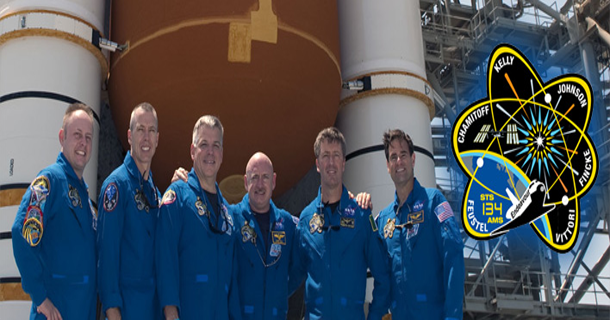
That's the routine all crews practice during the Terminal Countdown Demonstration Test, or TCDT. The STS-134 crew took part in the training March 30 as they prepared to launch on space shuttle Endeavour's last scheduled mission. The driving is a required course for each shuttle astronaut.

"Everybody has to drive the M113, so everybody kind of has to find their feel for maneuvering it," Seymour said.

Finding the feel for the M113 means adjusting to steering with a pair of levers instead of a wheel. Each lever controls one of the tracks on the M113. Push both of them forward and the vehicle goes forward. There's a gas pedal to determine how quickly it goes. Pull the right lever to turn right, pull the left lever to go left. Pull them both back to stop. Don't do it too hard, though, or everyone riding along will get thrown into the metal bulkheads. After all, there's no padding on the thick metal walls, corners or shelves.

For example, Seymour said one of the astronauts was driving the M113 during training down a path carved out near Launch Pad 39B. A row of wild boars moved across the path about 100 yards ahead and the driver jerked the levers back so hard the vehicle came to a skidding halt and the rest of the crew, riding in the metal box and sitting on the thinly padded benches, flew forward. But the pigs weren't hurt.

The limited field of view comes from four slits in front of the driver, each one a prism instead of an opening. With the driver's hatch down, it can be tough to make out everything around the vehicle while it's in motion. That's why the vehicles have gotten wet a couple of times by accident. Not to worry, though, it's amphibious. The Army designed it to float and drive through rivers and the like.

Some flight crews embrace the unusual vehicle and have a good time with the training, Myer said.

"These can be fun," Myer said. "It's exciting."

Seymour and Myer say they accept that it's unusual for people to want to work as firefighters, to want to train to run into bad situations and to wear bulky equipment and drive huge metal boxes on tracks, which is what the M113s are.

"There's nothing normal about a firefighter," Seymour said, laughing. "I told my dad one time that when I grow up, I want to be fireman. He looked at me, shaking his head smiling and said, 'You can't do both. You can't grow up and be a fireman.' "

The fun aspect for the firefighters does not obscure the seriousness with which they train for emergencies. Considering part of their job requires them to climb into the orbiter and pull the astronauts out of their seats on the flight deck.

"We want to give the astronauts , close-out crew and ice inspection team the comfort to know that when called we are going to be there no matter what happens," Seymour said.

Launch Pad Inspections Set For Saturday Following TCDT Conclusion Friday

 Technicians and engineers on Launch Pad 39A at NASA’s Kennedy Space Center in Florida, will begin detailed inspections of space shuttle Endeavour and its external fuel tank Saturday afternoon. 

They’ll look for any possible damage from severe storms that hit Kennedy on Wednesday and Thursday. Teams began an initial survey of the launch pad Friday, but weren’t able to do a thorough inspection because the pad was being used for a full launch dress rehearsal for Endeavour’s STS-134 mission called the Terminal Countdown Demonstration Test (TCDT). Endeavour’s six astronauts successfully completed the simulated launch countdown and related safety training Friday afternoon and returned home to NASA’s Johnson Space Center in Houston. Friday’s initial pad inspection did not find anything obvious, other than the previously identified minor foam insulation damage on Endeavour’s external tank that was caused by a strong storm on Wednesday.

Teams will install platforms Saturday morning that will allow for close up surveys, which will provide data to engineering reviews to confirm there are no other issues. Endeavour is targeted to launch to the International Space Station on April 19 at 7:48 p.m. EDT.