• 2010 nasa special
    a total eclipse of the Sun is visible from within a narrow corridor that traverses Earth's southern Hemisphere. The path of the Moon's umbral shadow crosses the South Pacific Ocean where it makes no landfall except for Mangaia (Cook Islands) and Easter Island (Isla de Pascua).
Showing posts with label NASA. Show all posts

Ophir Chasma

Ophir Chasma, Mars 

During its examination of Mars, the Viking 1 spacecraft returned images of Valles Marineris, a huge canyon system 5,000 km, or about 3,106 miles, long, whose connected chasma or valleys may have formed from a combination of erosional collapse and structural activity. This synthetic oblique view shows Ophir Chasma, the northern most one of the connected valleys of Valles Marineris. For scale, the large impact crater in lower right corner is about 18.5 miles, or 30 km, wide.

Ophir Chasma is a large west-northwest-trending trough about 62 miles, or 100 km, wide. The Chasma is bordered by high-walled cliffs, most likely faults, that show spur-and-gully morphology and smooth sections. The walls have been dissected by landslides forming reentrants. The volume of the landslide debris is more than 1,000 times greater than that from the May 18, 1980, debris avalanche from Mount St. Helens. The longitudinal grooves seen in the foreground are thought to be due to differential shear and lateral spreading at high velocities.

Discovering New Orbits with Kids in Micro-g

Cady Coleman and Ron Garan measure the orbiting radius of a water droplet 

Cady Coleman and Ron Garan measure the orbiting radius of a water droplet as it circles a piece of statically charged rubber tubing on the International Space Station. (NASA)

An example of water 'bending' towards a static charge created by a balloon 

An example of water 'bending' towards a static charge created by a balloon.
(Image credit: ©Faith Fashion & Photos LLC)

Even simple scientific experiments can yield amazing results and add to the collective knowledge of the research community. Take the winning proposal for the most recent round of the Kids in Micro-g competition, for example, which was designed by two 5th grade girls from Chabad Hebrew Academy in San Diego. Conducted in April 2011 on the International Space Station, this study, called "Attracting Water Drops," looked at static attraction in microgravity to reveal an exciting new understanding of physics in space.

Kids in Micro-g was a hands-on design challenge and part of NASA's Teaching from Space education program. Six finalists were selected in the 2011 Kids in Micro-g competition, earning the chance to have their proposed studies performed on the space station. The Attracting Water Drops experiment involved rubbing a piece of rubber tubing with a pair of nylon shorts to create a static charge. Then astronauts released a droplet of water close by and watched to see what happened.

Marilyn Sniffen, advanced placement science coordinator with Chabad Hebrew Academy, found out about the Kids in Micro-g competition while researching new challenges for her students online. Having previously participated with her classes in other NASA education challenges, she was aware of NASA as a resource to help foster a love of science in students. "I asked my current students if they would like to participate," said Sniffen. "There was no hesitation, as they immediately wanted to check out the list of supplies available for the physics tests that could be done aboard the space station."

Students did their own companion study in the classroom to gain results for the investigation under the force of gravity here on Earth. They observed that a piece of charged rubber tubing held near a stream of running water caused the flow of water to bend toward the tubing. Students learned that the action of rubbing the tubing with nylon transferred negatively charged electrons to the tubing, creating a negative static charge. Since opposite charges attract to each other, and water molecules have a polarity with a positive end, the negatively charged tubing held near the water caused the positive end of the water to draw towards the tubing.

Astronauts Cady Coleman and Ron Garan performed the Attracting Water Droplets experiment aboard the station on April 23, 2011. You can view a video of the investigation being performed here . Their objective was to study the electrostatic interaction of the charged rubber tubing and water drops in microgravity. Students anticipated a greater attraction of the water droplet to the electrostatic charge than found on Earth. "Their hypothesis was that the results in space would be dramatically different than on Earth," commented Sniffen. "This is because the force of gravity on the water was greater than the force attraction to the static charge on the tube."

In addition to successfully proving the hypothesis, however, students and crew members were astonished to see the water droplet actually orbit the charged piece of tubing. "Look at that!" exclaimed Cady Coleman during the experiment on the space station. "It is going around our tubing. You would think it would keep sailing; in microgravity it would keep sailing, but it is coming back to our tubing and around."

Sniffen echoed Coleman's surprise, as she detailed the student's expectations for the water droplets in space. "The students predicted that in micro-g, the drop would be free floating and that it could be 'pulled' around by the charged rubber tube without it falling to the ground. The actual experiment on the station showed they were able to pull the drop around in the air, but it also revealed a surprise we didn't predict. The droplet of water actually orbited the tube at about 6 cm! So our hypothesis was supported, but we learned something entirely new in the process. The kids were amazed, as were we!" said Sniffen.

The school plans to repeat the Earth-bound portion of the experiment while showing the video of the study done on the space station to allow more students to share in the science next school year. "This kind of collaboration is really important for our students as they so often feel that what they are learning in school has no real connection to everyday life," comments Sniffen. "This program has allowed our students to make connections with real science and scientists, real discovery, and other students. It has inspired analytical thinking, creativity and communication for all our students."

Hammin’ It Up

A satellite with amateur radio capabilities and a student-designed experiment was released into orbit around Earth on Aug. 3, 2011, during a spacewalk outside the International Space Station. The satellite is transmitting signals containing information that students around the world can access.

The Amateur Radio on the International Space Station Satellite-1, or ARISSat-1, is a follow-on project to the unique SuitSat-1. SuitSat-1 was an amateur radio transmitter fitted into a surplus Russian Orlan spacesuit that was released from the station into space in 2006. SuitSat-1 transmitted for about two weeks and orbited Earth for seven months before burning up in Earth’s atmosphere.

ARISSat-1
The rectangular ARISSat-1 is covered by six solar panels that will charge the batteries in the satellite for about six months as it orbits Earth. Credit: AMSAT]

Formerly known as SuitSat-2 and also called Radioskaf-V and Kedr by the project’s Russian partners, ARISSat-1 contains a student-designed experiment and other equipment that students can use to learn more about space and space exploration. ("Kedr," which is Russian for "Cedar" in English, was the call sign of Yuri Gagarin, a Russian cosmonaut and the first human in space.)

ARISSat-1 is a project by the Radio Amateur Satellite Corporation, or AMSAT, and affiliated with the Amateur Radio on the International Space Station. ARISS is an education activity where space station astronauts and cosmonauts use amateur radio equipment aboard the space station to talk with students around the world.

The development, launch and deployment of ARISSat-1 are being conducted as an educational mission with the support of the NASA Office of Education’s ISS National Lab Education Project and RSC-Energia. It is the first of a series of educational satellites planned for deployment from the space station. Future satellites will carry additional student-built experiments, which will have data sent to the ground via amateur radio signals.

AMSAT ARISSat-1 project manager Gould Smith said the educational mission of the project is to use the unique aspects of satellites and amateur radio transmissions to generate student interest in space, science, technology, engineering and mathematics.

ARISSat-1 traveled to the space station in late January aboard a Russian Progress cargo vehicle and was released into space during a spacewalk by Russian cosmonauts Sergei Volkov and Alexander Samokutyaev.

For ARISSat-1, the onboard experiment is from Kursk State Technical University in Kursk, Russia. The experiment is going to measure the vacuum in space at different altitudes as the satellite’s orbit decays, gathering 90 minutes of data each day and transmitting that data continuously back to Earth. By analyzing these data, student scientists can derive atmospheric density from in situ measurements. These data in turn can be used to better predict the orbital lifetime of ARISSat-1.

Close-up view of an experiment on ARISSat-1
Aboard ARISSat-1 is an experiment that will measure the vacuum in space at different altitudes as the spacecraft de-orbits. Credit: AMSAT

Originally designed -- like its predecessor -- to fit inside an Orlan spacesuit, ARISSat-1 was redesigned when the expired spacesuit allocated for the project was disposed of sooner than AMSAT could use it. The redesign actually turned out to be a good move for the project, project managers said, because it allowed capabilities to be expanded.

The rectangular spacecraft is covered by six solar panels that will charge the batteries in the satellite for about six months as it orbits Earth. Spoken telemetry values, with data such as temperature and battery life, are intended to promote science and mathematics education by encouraging schoolchildren to listen to the satellite, track its progress and plot the changes. AMSAT president Barry Baines said it’s a great opportunity for students to do actual science, by taking real-time, practical readings on a daily basis and plotting the changes. The telemetry data will be available live and over the Internet for schools and radio amateurs to study the operation and changes that the satellite experiences during its orbits around Earth.

The project website provides free downloadable software that can be used to decode the data. "They can look at all the values, but you can also get the Russian experiment data at the same time and actually look at that every day," Baines said. "Plus, that data will be stored online, and they will be able to access it via the Internet to be able to go back and look at historical data or just use it in a lesson to actually take the real data and analyze it."

"The most useful, exciting and effective element of learning in regards to this project is actually doing something hands-on and practical, rather than just sitting and listening to a lecture. If you can actually go out and collect the data and then do something with it, that’s a lesson that’s learned and understood at higher cognitive levels."

In addition to data, the satellite will transmit 24 pre-recorded greetings in 15 different languages -- French, Spanish, German, English and Chinese, to name a few. More than half of the messages were recorded by schoolchildren, Smith said. "Most of them are really creative and interesting to listen to, especially male and female voices, and even kind of a little rap by the Dutch group. Also, most of them have a secret word at the end, and there’s a contest: If you can identify the secret word and send an e-mail, we’ll return an e-mail back to you with a little certificate."

Attached to the inside of the satellite is a memory card containing images and documents from children around the world. A website has been set up to view the files on the card. There is also a contest to see who correctly copies the most Morse Code signals sent by ARISSat-1. The signals will consist of the call signs of all amateur radio operators who worked on the project. Additionally, still images of Earth will be transmitted from four cameras aboard the satellite. ARISSat-1 also will serve as an orbital communications relay station for use by amateur radio operators around the world. The ARISSat-1 website lists all of the ARISSat-1 contests and challenges.

Helping with the project is NASA retiree Lou McFadin. McFadin has been closely involved with amateur radio and human spaceflight through the Shuttle Amateur Radio Experiment, or SAREX, project, beginning with astronaut Owen Garriott’s first amateur radio communications on the STS-9 shuttle mission in 1983. McFadin is the ARISS hardware manager and has worked with the development of the ARISSat-1 hardware since the start of the project.

"I think if they (students) do the telemetry decode," McFadin said, "there’s a lot of opportunity for learning there. It has solar panel temperatures; it has solar panel data; it has battery voltage and all kinds of information there about what’s going on in the satellite. That kind of learning really connects to our goal of getting children and all Americans interested in space. That’s a big part of what we wanted to do."

A free-floating spacesuit and the curve of Earth
SuitSat-1 in orbit after its release from the International Space Station during Expedition 12. Credit: NASA
ARISSat-1 also will serve as a technology demonstration. "For AMSAT, it certainly was a way to try out some new ideas -- how to build the structure for the dynamics of the satellite itself, it’s a new power system, it’s a new transponder system we’ve not tried before, it’s the first time we’ve flown a software-defined transponder, and it’s paving the path for the future for us," Smith said.

McFadin said the software-defined transponder was the key to how they were able to design a satellite to do so many things at once. "It’s an FM transmitter, it’s a transponder, it’s a telemetry transmitter, and Morse code transmitter, all done with one system, all simultaneously," McFadin said. "We’ve never been able to do that before."

This was AMSAT’s second opportunity to release a satellite from the International Space Station, and Smith said they hope to continue the project with future spacecraft and more student-designed experiments. "It’s not any harder to build four of something than it is to build one, hardly. So we built four space frames, five actually, one for the prototype, and we built four flight versions," Smith said. "So it’ll be easy to do this again."

Mark Severance, manager for the ISS National Laboratory Education Project, sees ARISSat-1 as an important flight test for future educational satellites. "Future ARISSats will carry at least four student-designed and -built experiments," Severance noted. "This will give students the opportunity to go hands-on and build actual spaceflight experiment hardware. Furthermore, they can track the satellite using off-the-shelf amateur radio hardware and obtain the data from their experiment directly from their own ground station. In this manner, ARISSat can provide an 'end-to-end' space mission experience for participating students."

NASA's Office of Education's ISS National Laboratory Project will sponsor future ARISSats. The project provides hands-on opportunities for elementary, secondary and university students, as well as lifelong learners, to participate in the space station mission. The ARISS school contact activity is supported by the ISS National Laboratory Project as well as the Teaching From Space Office at NASA's Johnson Space Center in Houston. Teaching From Space facilitates education opportunities like ARISS that use the unique environment of space to increase student interest in science, technology, engineering and mathematics.

Check out the ARISSat-1 website at http://arissat1.org/  → for information on data transmissions, contests and student activities.

Space Shuttle Program: Spanning 30 Years of Discovery

Endeavour and Discovery meet during a nose-to-nose photo opportunity 
Image above: Space shuttles Endeavour and Discovery meet in a "nose-to-nose" photo opportunity as the vehicles switch locations Aug. 11 at NASA's Kennedy Space Center, Fla. Now in Orbiter Processing Facility-1 (OPF-1), Discovery will go through more preparations for public display at the Smithsonian's National Air and Space Museum Steven F. Udvar-Hazy Center in Virginia next spring. Endeavour will be stored in the Vehicle Assembly Building (VAB) until October, when it will be moved into OPF-2 to continue being readied for display at the California Science Center in Los Angeles next summer. Image credit: NASA/Frankie Martin

NASA's space shuttle fleet began setting records with its first launch on April 12, 1981 and continued to set high marks of achievement and endurance through 30 years of missions. Starting with Columbia and continuing with Challenger, Discovery, Atlantis and Endeavour, the spacecraft has carried people into orbit repeatedly, launched, recovered and repaired satellites, conducted cutting-edge research and built the largest structure in space, the International Space Station. The final space shuttle mission, STS-135, ended July 21, 2011 when Atlantis rolled to a stop at its home port, NASA's Kennedy Space Center in Florida.

As humanity's first reusable spacecraft, the space shuttle pushed the bounds of discovery ever farther, requiring not only advanced technologies but the tremendous effort of a vast workforce. Thousands of civil servants and contractors throughout NASA's field centers and across the nation have demonstrated an unwavering commitment to mission success and the greater goal of space exploration.
 

Astronauts go on spacewalk for station repairs

Floating in the International Space Station's Quest airlock compartment, astronauts Michael Fossum and Ronald Garan switched their spacesuits to battery power at 9:22 a.m. EDT to officially kick off a planned six-and-a-half-hour spacewalk.

"Ronny, you ready to rock and roll?" Fossum asked before floating out of the airlock.

"Ready to rock and roll," Garan replied.

"Let's go, buddy."

Fossum and Garan plan to accomplish their primary goal first, moving a failed ammonia pump module from a storage platform just outside the airlock to a carrier in the shuttle Atlantis' cargo bay. After that, the astronauts will move a robotic refueling demonstration apparatus from the shuttle to the station, install a materials science space exposure experiment and perform a few maintenance chores.

This is the 160th spacewalk devoted to station assembly and maintenance since construction began in 1998, the ninth so far this year, the seventh for Fossum and the fourth for Garan.

For identification, Fossum (call sign EV-1) will be wearing a suit with red stripes around the legs. Garan (EV-2) will be in an unmarked suit.

Atlantis unloads ton of food for space station
Atlantis docks at International Space Station
CBS Space Place: The latest news on shuttle mission

Shuttle pilot Douglas Hurley and Sandra Magnus will operate the station's robot arm during the excursion and shuttle flight engineer Rex Walheim will serve as the spacewalk coordinator, working from the flight deck of Atlantis.

Hurley and Magnus will use a robotics work station in the Tranquility module's multi-window cupola. A U.S. toilet also is located in Tranquility, along with equipment used to recover water from urine. The astronauts reported a strong odor from the equipment Monday and the urine processor will not be turned on during today's spacewalk.

"There are two toilets on the space station," said overnight Flight Director Courtenay McMillan. "There's one in the Russian segment, and it's working fine. And there's one, basically the same design, that's in the U.S. segment and it hooks up to our urine processor. So we got a report from the crew that there was a smell that was unexpected coming from that area, and it was pretty intense.

"At the time, we were processing urine in the urine processor, not the toilet itself, but the machine that it hooks up to recycle the water from the urine. We got some air in that system a little while ago and it needs to basically purge itself out over the course of processing. So we think, because everything looks fine in the system, we think it's just working its way out of the system. So we stopped the urine processing for the time being and we're using the toilet basically in stand-alone mode right now."

Flight controllers likely will resume urine processing Wednesday but "not while the crew is doing EVA support,:" McMillan said. "They'll be using the robotics work station in the cupola, which is in the vicinity of the toilet, so we don't really want to be making a smell while they're working in there."

Today's spacewalk is the first during a shuttle visit that will be carried out by space station personnel. Because of a short training flow and a requirement to launch Atlantis with a reduced crew of four, "we wanted to off load the training tasks on the shuttle crew and sort of level the load," lead station Flight Director Chris Edelen said before launch. "So we took advantage of the EVA experience of Mike Fossum and Ron Garan. They've actually done three spacewalks together on previous shuttle missions (and they) were able to get up to speed very quickly on this EVA."

Fossum has 42 hours and one minute of EVA time in his previous six spacewalks while Garan has 20 hours and 32 minutes of EVA experience.

Photos: NASA's final shuttle flight
Photos: The storied career of Atlantis

Returning the failed ammonia pump module is a high priority objective for NASA. The space station is equipped with two coolant loops that circulate ammonia through huge radiators to get rid of the heat generated by the space station's electrical systems. Last July 30, the pump in one coolant loop failed, forcing the crew to implement an emergency powerdown.

"I remember it because I was on console when it failed," Edelen said. "It was one of those moments where on a quiet Saturday and the crew's off duty and getting ready to go to bed and everything's going real well and it all changed in a second when that pump module failed. All the caution and warnings started going off and the crew had to very quickly scramble to reconfigure the systems and power down some of the systems in order to keep the station limping along on one remaining cooling loop.

"That was a major failure in the history of the space station program, the first major failure that required (U.S.) spacewalks without a shuttle present to fix a problem."

Over the course of three spacewalks, the pump module was successfully replaced by a pre-positioned spare. But the coolant system is critical to the station's long-term health and engineers want to find out what went wrong in the pump that failed. After troubleshooting, engineers plan to repair the pump and re-launch it aboard a Japanese cargo ship.

After mounting the pump module in Atlantis' payload bay, Fossum and Garan plan to move an experimental robotic refueling apparatus from the shuttle to a storage platform used by the Canadian Special Purpose Dexterous Manipulator, or SPDM, a robot arm extension also known as DEXTRE.

"We are taking up a payload, it's called the robotics refueling module, this is to demonstrate a capability for the Special Purpose Dexterous Manipulator, which hasn't seen a whole lot of use on the International Space Station to date, but we hope to turn that all around with this payload," said shuttle commander Christopher Ferguson.

"I've kind of likened it to a Fisher-Price play toy for a robot. And I don't mean that in a negative sense, it is really an opportunity for the SPDM to get in there and use several different tools and prove the capability to do something extremely novel, and that is to refuel satellites in orbit that were never designed to be refueled.

"So the manipulator will actually go in and pick up special cutter tools and cut safety wire, it has a drill that can actually drill into a fuel tank so there's some very unique capabilities that will be demonstrated using this. What capability will robots provide to us in the future? To think about going out there and perhaps grappling a satellite that was never designed to be refueled ... and refill it and use it for an additional five or 10 years is a dramatic example of how robotics can modify what we're doing in space."

Along with moving the pump module to Atlantis and installing the robotics refueling kit on the station, Fossum plans to inspect a robot arm mounting fixture on the Russian Zarya module to re-position a grounding wire that appears to be caught in an access door. Both spacewalkers then will install a thermal shield over an unused docking port attached to Tranquility before heading back to the Quest airlock.

The Last Space Shuttle Mission: Flight Day 6

When Space Shuttle Atlantis left Launch Pad 39A at the Kennedy Space Center on Friday, July 8, it marked the final liftoff for the long-running Space Shuttle Program, which has dominated NASA's manned operations for the past four decades. Over a 12-day mission (since extended to 13 days), the four-person crew on STS-135 will haul the Multi-Purpose Logistics Module (MPLM) Raffaello and a Lightweight Multi-Purpose Carrier (LMC) to the International Space Station. Over the course of the mission, we'll be providing daily updates.

After a long day -- flight engineers Mike Fossum and Ron Garan completed a spacewalk that lasted more than six hours -- the NASA crew onboard Space Shuttle Atlantis had an early night on flight day 5. For the best, as the morning wakeup song -- Elton John's "Rocket Man" -- came at 2:29 a.m. EDT this morning. Once awake, the astronauts were greeted with a special message from Sir Elton John himself: "Good morning, Atlantis, this is Elton John," he said in a recording. "We wish you much success on your mission. A huge thank you to all the men and women at NASA who worked on the shuttle for the last three decades."
Story continues after the gallery, which will be updated as the mission wears on.
  The Final Spacewalk
The message from Sir John was a good way to get the crew ready for a long day of ... moving, basically. The astronauts onboard Space Shuttle Atlantis spent most of flight day 6 moving equipment and supplies out of the Raffaello multi-purpose module and into the International Space Station. They took a break at 12:54 p.m. to speak with reporters from KGO-TV in San Francisco and WBNG-TV and WICZ-TV in Binghamton, New York.
As I write this daily update, the combined 10-person team on the International Space Station and the docked Space Shuttle are already asleep. Lights out for the day was at 4:59 p.m. EDT for the

NASA footing the bill for many to witness final space shuttle launch

For one career NASA engineer joining the thousands of Houstonians going to Florida this week for the final space shuttle launch, this trip wasn't necessarily a part of the plan.
Really, he'd have no problem staying at Mission Control in Houston, watching data flow into computer monitors about the shuttle's progress and trajectory as it rockets out of the atmosphere.
That is what Mack Henderson, 72, who began his career working on development of the Saturn V rocket, has done for decades. And it's the reason that he's only attended two spacecraft launches in his 51-year career, one of them for Apollo 12.
This time, however, NASA is paying for him and more than 140 other employees to watch the final space shuttle lift off in person.

"My hope is that after this launch, they'll say, 'Oh, we were just kidding. We're going to fly more space shuttle flights,' " said Henderson, who added that he's happy to be able to witness the milestone but will be sad that the program is ending.

Those may be the sentiments of many of the Houston space-industry workers, past and present, traveling in droves to Florida this week to watch the beginning of the end of NASA's space shuttle era, but they are going anyway.

"In some ways, it's just sad to see it end," said Lisa Reed, 50, who worked for nearly 15 years at NASA before leaving to join a private consulting firm. Reed, who helped train astronauts on docking and life support systems, will watch the launch in Florida with her relatives.
"I have so many good memories leading up to it, and just seeing it end and knowing that a lot of my friends will now be out of a job and that I love the space shuttle program and that it is ending" will be difficult, she said.

Though bittersweet, buzz about the final launch, scheduled for Friday, swept over Johnson Space Center in recent weeks as workers tried to secure coveted spaces on the NASA causeway at Cape Canaveral and planned flights, road trips and hotel stays to be a part of the historic day.

Bus space sells out

NASA, after noticing ballooning interest among its workers in seeing the final shuttle launches, began organizing charter buses, accommodations and a designated viewing area to help workers travel and watch the start of the final missions, said Lisa Rasco, who coordinated the travel program for NASA.

Spaces on the buses for this week's launch sold out several weeks ago, Rasco said. The buses set out on the 18-hour journey Wednesday. A total of 130 people had reserved bus or hotel bookings through the NASA service, she said. Thousands of other workers are flying on their own, driving and planning their own stays before meeting at a Kennedy Space Center recreation facility that can accommodate 10,000 viewers. That area is expected to be filled with NASA workers and their families, she said.

The final shuttle launch was a milestone that David Rose, 44, couldn't miss. A Florida native who worked at Johnson Space Center for 18 years before leaving and joining an engineering consulting firm, Rose helped train astronauts and has seen more than a dozen shuttle launches.
His life has been connected and inspired by the space program and industry, with him traveling to California in 2005 to see the first private spacecraft launch out of the atmosphere. He plans to watch Atlantis launch Friday with his parents-in-law and brother from the NASA causeway.

Excited, but also sad

Rose's life inspiration is not unique among the current and former NASA workers who scrambled to make plans to watch the final launch. 

NASA's human space flight program, with the shuttle's 30-year history, stirred the imaginations of many of the professionals who have dedicated their lives to the field. With the shuttle program being the agency's sole human space endeavor of the past three decades, pride in its achievements will draw many Houstonians to Florida this week, said Heather Hinkel, principal engineer of new docking and sensor technology tested in orbit on the final launch of Endeavour in May.

"We are definitely excited for what is next," said Hinkel, 42, who will watch the launch from Banana Creek at Kennedy Space Center. "I know NASA will always have great work, but the human space flight aspect is sort of my favorite thing, so it will just be sad to see that all come to an end."

zain.shauk@chron.com

Read more: http://www.chron.com/disp/story.mpl/chronicle/7642558.html#ixzz1ROeob6D1

Space Shuttle Mission: STS-134

STS-134 crew

Image above: The STS-134 crew aboard space shuttle Endeavour talks to reporters during a live in-flight media event on Monday. Photo credit: NASA TV

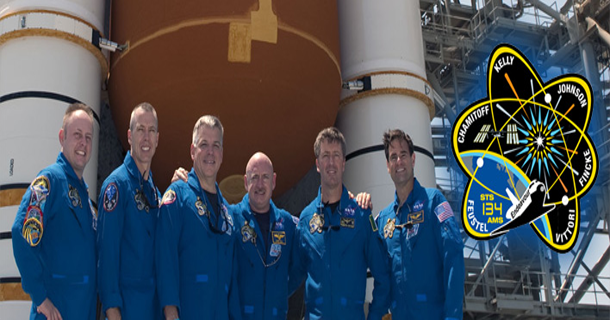
The crew members for space shuttle Endeavour's STS-134 mission are Commander Mark Kelly, Pilot Gregory H. Johnson and Mission Specialists Michael Fincke, Greg Chamitoff, Andrew Feustel and European Space Agency astronaut Roberto Vittori.

During the 16-day mission, Endeavour and its crew will deliver the Alpha Magnetic Spectrometer (AMS) and spare parts including two S-band communications antennas, a high-pressure gas tank and additional spare parts for Dextre.

NASA to Launch New Science Mission to Asteroid in 2016

NASA will launch a spacecraft to an asteroid in 2016 and use a robotic arm to pluck samples that could better explain our solar system's formation and how life began. The mission, called Origins-Spectral Interpretation-Resource Identification-Security-Regolith Explorer, or OSIRIS-REx, will be the first U.S. mission to carry samples from an asteroid back to Earth.

"This is a critical step in meeting the objectives outlined by President Obama to extend our reach beyond low-Earth orbit and explore into deep space," said NASA Administrator Charlie Bolden. "It’s robotic missions like these that will pave the way for future human space missions to an asteroid and other deep space destinations." 

NASA selected OSIRIS-REx after reviewing three concept study reports for new scientific missions, which also included a sample return mission from the far side of the Moon and a mission to the surface of Venus.

Asteroids are leftovers formed from the cloud of gas and dust -- the solar nebula -- that collapsed to form our sun and the planets about 4.5 billion years ago. As such, they contain the original material from the solar nebula, which can tell us about the conditions of our solar system's birth.

conceptual image of OSIRIS-REx 

Conceptual image of OSIRIS-REx. Credit: NASA/Goddard/University of Arizona
 
  After traveling four years, OSIRIS-REx will approach the primitive, near Earth asteroid designated 1999 RQ36 in 2020. Once within three miles of the asteroid, the spacecraft will begin six months of comprehensive surface mapping. The science team then will pick a location from where the spacecraft's arm will take a sample. The spacecraft gradually will move closer to the site, and the arm will extend to collect more than two ounces of material for return to Earth in 2023. The mission, excluding the launch vehicle, is expected to cost approximately $800 million.

The sample will be stored in a capsule that will land at Utah's Test and Training Range in 2023. The capsule's design will be similar to that used by NASA's Stardust spacecraft, which returned the world's first comet particles from comet Wild 2 in 2006. The OSIRIS-REx sample capsule will be taken to NASA's Johnson Space Center in Houston. The material will be removed and delivered to a dedicated research facility following stringent planetary protection protocol. Precise analysis will be performed that cannot be duplicated by spacecraft-based instruments.

RQ36 is approximately 1,900 feet in diameter or roughly the size of five football fields. The asteroid, little altered over time, is likely to represent a snapshot of our solar system's infancy. The asteroid also is likely rich in carbon, a key element in the organic molecules necessary for life. Organic molecules have been found in meteorite and comet samples, indicating some of life's ingredients can be created in space. Scientists want to see if they also are present on RQ36.

"This asteroid is a time capsule from the birth of our solar system and ushers in a new era of planetary exploration," said Jim Green, director, NASA's Planetary Science Division in Washington. "The knowledge from the mission also will help us to develop methods to better track the orbits of asteroids."

The mission will accurately measure the "Yarkovsky effect" for the first time. The effect is a small push caused by the sun on an asteroid, as it absorbs sunlight and re-emits that energy as heat. The small push adds up over time, but it is uneven due to an asteroid's shape, wobble, surface composition and rotation. For scientists to predict an Earth-approaching asteroid's path, they must understand how the effect will change its orbit. OSIRIS-REx will help refine RQ36's orbit to ascertain its trajectory and devise future strategies to mitigate possible Earth impacts from celestial objects.

Michael Drake of the University of Arizona in Tucson is the mission's principal investigator. NASA's Goddard Space Flight Center in Greenbelt, Md., will provide overall mission management, systems engineering, and safety and mission assurance. Lockheed Martin Space Systems in Denver will build the spacecraft. The OSIRIS-REx payload includes instruments from the University of Arizona, Goddard, Arizona State University in Tempe and the Canadian Space Agency. NASA’s Ames Research Center at Moffett Field, Calif., the Langley Research Center in Hampton Va., and the Jet Propulsion Laboratory in Pasadena, Calif., also are involved. The science team is composed of numerous researchers from universities, private and government agencies.

This is the third mission in NASA's New Frontiers Program. The first, New Horizons, was launched in 2006. It will fly by the Pluto-Charon system in July 2015, then target another Kuiper Belt object for study. The second mission, Juno, will launch in August to become the first spacecraft to orbit Jupiter from pole to pole and study the giant planet's atmosphere and interior. NASA's Marshall Space Flight Center in Huntsville, Ala., manages New Frontiers for the agency's Science Mission Directorate in Washington. 

Caterpillar Inc. Participates in NASA's Second Annual Lunabotics Mining Competition

Caterpillar promotes education and technology at international collegiate event

Showcasing its world-class technology leadership, Caterpillar Inc. (NYSE: CAT) is supporting the NASA Lunabotics Mining Competition at the Kennedy Space Center, Cape Canaveral, Florida. The event, May 26-28, is designed to engage and retain college students in the areas of science, technology, engineering and mathematics (STEM). For complete coverage, follow the competition on Twitter @CaterpillarInc. or #lmc2011.

Tana Utley, Caterpillar Vice President and Chief Technology Officer, will be a keynote speaker during the opening ceremonies of the three-day event. "Educational outreach has been an important part of our collaboration with NASA, and we look forward to continuing this focus during the Lunabotics Mining Competition," said Utley. "The technologies produced at the competition could one day be used in mine and work sites. What better way to enhance jobsite safety and efficiency than to design autonomous solutions."

Participants in the competition will design and build autonomous systems that could be used for future lunar exploration. Teams will test their designs in a head-to-head challenge to see which machine can excavate the most simulated lunar "dirt" over a specific timeframe. "Caterpillar has a long history of supporting educational opportunities that promote the STEM areas," said Eric Reiners, Caterpillar Automation Manager, who is lending his expertise as a judge at the event. "We need to encourage technology, innovation and ingenuity to students of all ages. The development of autonomous systems will ultimately help our global customers boost safety, efficiency and increase profitability."

Currently, there are 45 graduate and undergraduate student teams enrolled in the competition from various parts of the world. That number has more than doubled from last year's event. Caterpillar will have a 287C semi-autonomous Multi Terrain Loader (MTL) on display to showcase the technologies Caterpillar and NASA are developing.

For updates during the competition, find us on Twitter @CaterpillarInc. or #lmc2011 and www.caterpillar.com. To learn more about the Lunabotics Mining Competition, please go to

About Caterpillar:

For more than 85 years, Caterpillar Inc. has been making sustainable progress possible and driving positive change on every continent. With 2010 sales and revenues of $42.588 billion, Caterpillar is the world's leading manufacturer of construction and mining equipment, diesel and natural gas engines, industrial gas turbines and diesel-electric locomotives. 

The company also is a leading services provider through Caterpillar Financial Services, Caterpillar Remanufacturing Services, Caterpillar Logistics Services and Progress Rail Services. More information is available at: http://www.caterpillar.com.

Editorial: Endeavour's last flight: An ode to space exploration

Space+Suttle.JPG
The space shuttle Endeavour lifts off from Kennedy Space Center at Cape Canaveral, Fla., May 16, 2011.
We are fast closing in on the end of an era.

The last flight of space shuttle Endeavour (named and spelled in the British fashion for Capt. James Cook's ship) launched from the Kennedy Space Center Monday, and docked at the International Space Station Wednesday morning.
 
Then, on June 28, Atlantis is scheduled to begin the space shuttle's final journey.
Some reports are predicting that a million people will turn out to see that launch. After that, America will have no manned space rocket program. It seems strange to contemplate that.

On May 5, the U.S. marked a major milestone. As National Aeronautics and Space Administration chief Charles Bolden wrote: "50 years ago today, Alan Shepard rocketed into space on America's first manned space mission.

That flight set our nation on a path of exploration and discovery that continues to this day."
"May 5, 1961, was a good day," Bolden continued. "When Alan Shepard launched toward the stars that day, no American had ever done so, and the world waited on pins and needles praying for a good outcome. The flight was a great success, and on the strength of Shepard's accomplishment, NASA built the leadership role in human spaceflight that we have held ever since."

What people may not realize is the direct impact that our investment in space exploration has had on the quality of life on Earth. 

Because of scientific advances to protect astronauts from extreme heat during takeoff, race car drivers are safer in the cockpits of their cars. Because of scientific advances to protect the food that astronauts eat in space, the incidence of food poisoning among consumers had been reduced. Because of other scientific advances, spurred by the drive to explore space, we have more advanced breast cancer screening, heart defibrillators that restore heart rhythm and satellites that warn of coming hurricanes. 

Infrared cameras developed to monitor the blazing plume from the space shuttle help firefighters locate hot spots in wildfires. Technologies used for exploring space can be used to increase crop yields and find more fish at sea.

The material that NASA developed to protect its launch pads from the destructive effects of hot, humid and salt-laden air today protects the Statue of Liberty and Golden Gate Bridge from degradation.
As we seek our future in space, we also learn about our past.

The images from the Hubble space telescope provide breathtaking visual information. And multispectral imaging methods used to see the Martian surface have been applied to, as the Chicago Tribune reported, "badly charred Roman manuscripts that were buried during the eruption of Mt. Vesuvius in A.D. 79. Examining those carbonized manuscripts under different wavelengths of light suddenly revealed writing that had been invisible to scholars for two centuries," because of manuscript degradation.

The famous heart surgeon, Dr. Michael DeBakey, who collaborated with NASA on one of its most beneficial inventions, a tiny artificial heart pump, said, "NASA is engaged in very active research. It has as its goal to explore space. But to do so, you've got to do all kinds of research — biological research, physical research and so on. So it's really a very, very intensive research organization.
"And anytime you have any type of intensive research organization or activity going on, new knowledge is going to flow from it."

The knowledge that flowed from NASA in the past 50 years has saved lives and benefited mankind in countless ways. The return on that investment is beyond calculation.
And don't underestimate the power of those stories. Children around the world have been captivated by these accounts; and some of them went on to become the test pilots and astronauts, scientists and engineers who brought about these miraculous advancements.

Fifty years ago, the notion of a manned space program aroused our competitive spirit. It also brought out the best in us as we worked toward a goal that all could endorse and embrace.

The space shuttle program has served its purpose; its time is over. But that doesn't mean America should look down. The world is out of kilter when we're spending billions for war instead of to explore.
We would be wise to lift our eyes to the stars.

Mars Rover Driving Leaves Distinctive Tracks


A dance-step pattern is visible in the wheel tracks near the left edge of this scene 

A dance-step pattern is visible in the wheel tracks near the left edge of this scene recorded by the navigation camera on NASA's Mars Exploration Rover Opportunity during the 2,554th Martian day, or sol, of the rover's work on Mars (April 1, 2011). Image credit: NASA/JPL-Caltech
 
When NASA's Opportunity Mars rover uses an onboard navigation capability during backward drives, it leaves a distinctive pattern in the wheel tracks visible on the Martian ground. 

The pattern appears in an image posted at http://photojournal.jpl.nasa.gov/catalog/PIA14129 . 

The rover team routinely commands Opportunity to drive backward as a precaution for extending the life of the rover's right-front wheel, which has been drawing more electrical current than the other five wheels. Rover drivers can command the rover to check for potential hazards in the drive direction, whether the rover is driving backward or forward. In that autonomous navigation mode, the rover pauses frequently, views the ground with the navigation camera on its mast, analyzes the stereo images, and makes a decision about proceeding. 

When the drive is backward, the drive-direction view from the navigation camera is partially blocked by an antenna in the middle of the rover. Therefore, at each pause to check for hazards, the rover pivots slightly to the side to get a clear view. If it sees no hazard, it turns back to the direction it was going and continues the drive for about another 4 feet (1.2 meters) before checking again. This set of activities leaves tracks showing the slight turnout on a rhythmically repeated basis, like a dance step. 

Opportunity has driven more than 1.6 miles (about 2.6 kilometers) since leaving "Santa Maria" crater in late March and resuming a long-term trek toward the much larger Endeavour crater. Opportunity has now driven more than 18 miles (29 kilometers) on Mars. 

Opportunity and its twin rover, Spirit, completed their three-month prime missions on Mars in April 2004. Both rovers continued in years of bonus, extended missions. Both have made important discoveries about wet environments on ancient Mars that may have been favorable for supporting microbial life. Spirit has not communicated with Earth since March 2010. 

NASA's Jet Propulsion Laboratory, a division of the California Institute of Technology in Pasadena, manages the Mars Exploration Rover Project for the NASA Science Mission Directorate, Washington.
More information about the rovers is online at: http://www.nasa.gov/rovers . You can follow the rovers on Facebook at: https://www.facebook.com/mars.rovers and on Twitter @MarsRovers . A full list of JPL’s social media accounts is at: http://www.jpl.nasa.gov/social/ .
 
 
Guy Webster 818-354-6278
Jet Propulsion Laboratory, Pasadena, Calif.
guy.webster@jpl.nasa.gov

Robotics Work for Endeavour's Crew Today

The initial wake up call to the crew of space shuttle Endeavour was at 10:56 p.m. EDT, and the day's wake up song was uplinked about 30 minutes later because of a communications drop out. The song “Luna” by Jose Serrano was played for Mission Specialist Greg Chamitoff. The artist is a friend of his and wrote the song especially for this mission.

The fourth day of the mission will focus on the installation of the Alpha Magnetic Spectrometer-2 (AMS), a particle physics detector. The AMS is a 2-ton ring of powerful magnets and ultrasensitive detectors built to track, but not capture, cosmic rays in a search for various types of unusual matter. The 15,251-pound instrument will be connected to the outside of the International Space Station, tilted a bit so it will not interfere with any of the station's mechanisms and storage platforms. It will be operated remotely from Earth and should not require any attention from astronauts in orbit.

The mobile transporter is in position. The crew will extract AMS using the space shuttle robotic arm at 1:56 a.m. Shortly thereafter, the station crew will wake, and at 3:01 a.m., the shuttle robotic arm will transfer AMS to the station's robotic arm. At 3:41 a.m., the crew will manipulate the station arm to install AMS onto the starboard side of the station's truss structure on the zenith side.

Later this morning, the crew will participate in interviews.

Toward the end of the flight day, the crew will review procedures for the mission's first spacewalk, and spacewalkers Drew Feustel and Greg Chamitoff will begin their camp out at a reduced air pressure, a procedure that helps purge nitrogen from their bloodstreams and prevents the “bends” when they exit the airlock.

Tornado Challenges Satellite Damage Track Detection Techniques

Satellite image of Alabama tornado damage 

A composite of two ASTER views over North Alabama taken May 5. The image extends from near the Tennessee border line to Jasper, Ala. Several tornado tracks are evident, including the Phil Campbell to Harvest track. These tracks are not as obvious as the Tuscaloosa tornado track. This is not because of a difference in intensity, but from the underlying surface over which the tornadoes occurred. (NASA) 
Satellite image of Alabama tornado damage 

High resolution ASTER image corresponds to the Google Earth image area of Northern Madison county region and the Harvest area. Tornado track is barely identifiable. (NASA)  

View annotated composite image
The Short-term Prediction Research and Transition, or SPoRT, team has used satellite data from the North Alabama region to identify tornado damage from the April 27th super storm outbreak.

NASA's Terra satellite, part of the Earth Observing System of satellites, captured images of the damage path. An instrument aboard Terra called the Advanced Spaceborne Thermal Emission and Reflection Radiometer, or ASTER, was used to discern vegetation contrasts over the region.

"This is the first time ASTER data has been applied to such a massive outbreak of storms," said Gary Jedlovec, atmospheric scientist at Marshall Space Flight Center. "The usefulness of satellite information in providing improved accuracy along with damage assessment in severe weather events continues to evolve."

The tornado track signature observed by ASTER is seen as a disruption in the vegetation or other reflective surfaces over a region caused by tornado winds. Uprooted trees quickly stop the process of photosynthesis and change color -- this is easily detected by satellite.

However, detecting damage in areas outside of heavy forestland is challenging.

In Madison and Limestone counties much of the area scarred by the tornadoes are agricultural in nature. Fields are either pasture land or row crops -- therefore the effect of tornado winds is minimal and the mark on satellite imagery is suppressed.

While this indicates a limitation to the use of this particular image analysis for tornado track detection over primarily agricultural land use, the SPoRT team is exploring the use of temperature channels from ASTER to better identify damage marks on Earth's surface. Terra/ASTER is a joint activity between NASA's Science Mission Directorate Earth Science Division and Japan's Ministry of Economy, Trade and Industry. Terra is one of 14 NASA satellites that look at the Earth to study and understand changes in the Earth system and provide societal benefits.

The NASA image created by the Short-term Prediction and Research Transition or SPoRT project at the Marshall Space Flight Center in Huntsville, using data provided courtesy of NASA Goddard Space Flight Center, the Land Processes Distributed Active Archive Center, Japan’s Earth Remote Sensing Data Analysis Center, the Ministry of Economy, Trade and Industry, along with the Japan Research Observation System Organization.


Janet Anderson, 256-544-0034
Marshall Space Flight Center, Huntsville, Ala.
Janet.L.Anderson@nasa.gov

Preflight Interview: Sergei Volkov

JSC2011-E-027591 -- Expedition 28/29 Flight Engineer Sergei Volkov

Expedition 28/29 Flight Engineer Sergei Volkov responds to a question from a reporter during an Expedition 28/29 preflight press conference at NASA's Johnson Space Center. Photo credit: NASA or National Aeronautics and Space Administration

Q: Why did you want to be a cosmonaut?

  • A: Very tough question. It wasn’t just a kid dream. Actually it wasn’t a kid dream, because my father was a cosmonaut and I was able to see all pros and cons of this job, and when I was a kid it was more minuses than plusses always busy, studying all day long, exams. That’s why as for kid, it was really a, I think, not scared but kids usually not too ready, or at least imagine that will studying all their life. I think it’s the worst case scenario for all kids.

So you saw all the work and none of the fun?

  • Yes. That is why when I made a decision to become a cosmonaut it was sort of deep understanding that I can manage to do this job, and I wanted be useful to my country. That was one of the input, I wanted to be a cosmonaut, when I grew up and I thought, I’m a military pilot, why can’t I be a cosmonaut, it’s interesting job and I would like to participate.

Let me ask you, excuse me, a little bit about how you grew up and became a pilot, and start with your hometown. Tell me about where you grew up and what it was like there.

  • I grew up in Star City because my father was a cosmonaut and in our house, 11-story building, only cosmonauts lived, all famous cosmonauts: Valentina Tereshkova, Alexei Leonov, Yuri Gagarin’s wife, and all this famous cosmonauts, and I was able to meet them and Leonov personally covered all kids because father was always somewhere in trips or trainings or in space. That’s why he was sort of our mentor in our house, and then, I finished school in Star City and then I graduated from Tambov Military School of Pilots, and then as an air force pilot I flew on air force base, and then was selected a cosmonaut.

What was it that got you interested in wanting to be a pilot?

  • I always dreamed about to being a pilot since my first time I’ve been in a cockpit of the fighter, because originally my father was instructor of military school and when I was three years old he took me to the airfield, and while he flew with cadets his friends gave me a tour of the airfield and, of course, I was able to sit in the real fighter and that’s how the dreams appear and since that time I couldn’t imagine that I can be somebody [other] than the pilot.

But you did. As you said you went to college, to pilot school in the air force. Did you enjoy being an air force pilot?

  • Yes. It was great this first solo flight and to be able to fly the airplane, is great.

What was it, as you were a pilot then, what was it that made you feel, perhaps I could be a cosmonaut, too, that made you want to, to apply to do that job? Especially since, as you said, you had seen the hard side of it as a boy?

  • Maybe because the life of pilot wasn’t enough for me. I wanted something more to be able to fly a little bit higher.

So as a cosmonaut you have a job that, not unlike an air force pilot, does have a risk associated with it, but being a cosmonaut is a different kind of risk. So, Sergei, I wonder why you think that risk is worthwhile? What is it that we’re getting or what is it as people learn about, that makes it worth taking the risk for you?

  • I think the curiosity of mankind, that we want something unknown. Like 500 years ago, humankind wanted to know what the other side of the ocean is, and it was a very risky project and then we decided that probably we can fly; let’s fly higher. And now we’re flying space station, and still it’s not enough for us, we want to know what’s beyond. And I think there could be many answers on this question from very simple—because we are curious and we want to know what is beyond—and the complicated answer that we can stay longer, all time on our world and in Earth, and we need to somehow reach other planets because it’s always interesting for us. It’s not from the destination, but what was always the key point, try to find something, doesn’t matter when it happened, try to find something. Five hundred years ago it was spices, gold; right now, we don’t know what to expect when we reach Mars surface, we don’t know what we may expect from flying beyond the solar system, but we always wanted to know and I think its inspiring us and we continue to fly, even if it’s a really risky job.

Sergei, you are a member of the International Space Station’s Expedition 28 and 29 crews. Please give me a summary of the goals of your flight and tell me what your main responsibilities are going to be on this mission.

  • The main goals, I think, pretty the same as most of the crew does. It’s launch from Kazakhstan, and I’m going to be commander of Soyuz vehicle, S27, and then docking with International Space Station. Then we are ready to dock with three progresses that will be during our increment, one Russian EVA, potentially another EVA from Russian side, and at least one American EVA, and of course we are looking forward to see shuttle guys with us flying 10 days and landing according to schedule in middle of November. That’s a main milestone of our expeditions.

And between you’ll be doing a lot of science work and maintenance work on board the station.

  • Absolutely.

Now you spent almost 200 days in space on your first flight, when you were the commander of Expedition 17 three years ago. How has that experience helped you as you’ve trained for this mission?

  • It helps a lot because now I understand what I really need to know. It’s like when you are in school you can imagine what you will need from your background. For right now I know I need to focus myself or maybe focus all my crew members, Mike Fossum and Satoshi Furukawa, we can discuss not in theory but I can share my experience with them we flew together with Mike 10 days on board the station, and we know each other well and at least we know how to settle our life better.

What are you looking forward to about getting to spend another six months on board the space station?

  • First of all it’s my job to fly to space, and of course doing what you need to do is a great feeling. As a professional I’m looking forward to do EVA from Russian side. I’m going to support as arm operator American EVA, and it’s also very exciting task for me because I’ve trained a lot for this and I think we’ll manage success. That’s probably the two most exciting things that I am looking forward to.

Well let me get you to tell us about the place we’re talking about. Describe the International Space Station as it exists today, with all the different laboratories and modules and robotics that are there.

  • International Space Station, it’s huge I would say, space building. When you just can see it—and you can see it actually from five kilometers perfectly well when the sun is rising—and you can’t imagine, or can’t believe, that this miracle was built by people, by humans. Then your closer you can see all those modules and nodes. It was done practically during our Expedition 17, but still some new modules appeared, and now it’s, a very good house to live in and a great place to work. We have everything we need, we have equipment for the experiments, we have scientists who support us and provide those experiments to us, and the station’s great.

Well, let’s start by talking about the experiments ’cause now you’re going to a station where you’re going to have six crew members and several laboratories to take advantage of, so there’s a lot more science that is being done these days…

  • Absolutely.

…than Expedition 17. A lot of this is designed to find out how people can live and work in space.

  • I agree with you.

Tell me about a few of those kinds of experiments that you and your crewmates are going to be involved in.

JSC2011-E-005839 -- Expedition 28/29 crew members
  • Expedition 28 Flight Engineer and Expedition 29 Commander Mike Fossum (center) and Flight Engineers Sergei Volkov (left) and Satoshi Furukawa are pictured during a cake-cutting ceremony in the Jake Garn Simulation and Training Facility at NASA's Johnson Space Center. Photo credit: NASA or National Aeronautics and Space Administration
  • One of the newest experiments from the Russian side, it’s sort of following previous it’s, the main problem is bone [mass loss] and now we have the piece of bones with us and we will manage to see the actual degradation of the calcium from the bones, it’s not only a problem for the cosmonauts and astronauts but for many of people who live on Earth. I think it’s very valuable to have another result and maybe find the cure from this disease because, that’s the newest one that we didn’t perform before. And, of course, the benefits of the station, that you continue experiments for a long period of time, and a lot of experiments will just continue, some of them I’ve already done before during my expedition, now it’s just a sequence of those experiments, and it’s going to Plazmennyi Kristall [Plasma Crystal] and it’s going to be a lot of research of human body, what we can do, we need to know, and how we going to live on Mars and beyond, and that’s a great source to have this data is from astronauts and cosmonauts flying International Space Station.

Is just the fact that you’re there and living in that environment is really one big experiment in itself?

  • I would say, it’s part of the experiment but for the scientists it’s not enough just to send people somewhere, they stay in weightlessness, have fun, and then successfully return. We need to do a lot of tasks to succeed in all these experiments and from each side we have thousands, and 24 hours is not enough for us right now.

Are there other life sciences experiments that are going to be new for you this time?

  • I don’t think so. Most of the experiments are just like continuing of previous experiments.

I guess then there is some value in getting data from the same subject again a second time?

  • Absolutely, and all the same subject do the same experiment, what had happened when you did it like two years ago. Now with your knowledge, your experience, and analysis from the ground, you may see the improvement my expectation is to see some improvement in some experiments.

Now there are a lot of other kinds of science besides the human life sciences that you and your crewmates will be doing. You will be the operators of experiments. Give me a sense of the different kinds of research work that you guys will be doing on board the station this time.

  • Studying the radiation in space and actually on the Earth, it’s a problem. We sort of know how to prevent our bodies from these extremely dangerous rays but to be able to analyze the data, to collect this data without any safety layers like ozone layer or atmosphere, the space station is a perfect place. Of course, Earth science, Earth observation targets, we not just observe the events that had happened during our flight like volcano erupture or maybe the results of earthquake, but you can see how the people ruin the world, their home here, and this is also very valuable because when you stay inside of the woods, you can’t imagine how huge this forest is or how huge the damage or impact of the human beings is. But from space, when you can see at the same time like 10,000 kilometers square, you can imagine how harmful we are.

You also mentioned a moment ago that you have like physics research, the plasma crystal experiment, there’s biological research other kinds of science that you’re doing, too.

  • Of course, growing some plants, it’s going to be one of our tasks we have a small greenhouse it can’t provide food for us but at least for the scientists they can make their, again, studying of these products, how well they are, were grown, and will we be able to maybe have fresh food when you fly far[ther] than 400 kilometers above the Earth.

Now, along with all the science work that you guys will do, you are responsible for taking care to make sure that the station is operating properly as well. Give me a sense of the other kinds of maintenance work that a space station crew member is responsible for.

  • According to my previous experience you train to react on all failures and you are ready to perform R&R [remove and replace] for some equipment, but nobody can tell you for sure to be ready that this device will have failure, or you need backup. That is why have scheduled maintenance because everything unfortunately that man can build get the expiration date. We need perform the replacement without any failures of equipment. but you probably have heard some issues with Electrons right now; I hope that we do manage to repair it or change the tank. So far I can’t see any issues that we have.

One of the first highlights that will come on your schedule will be the final visit from a space shuttle mission, and STS-135 is going include a spacewalk for Mike Fossum and Ron Garan. Usually it’s shuttle crew members who go outside during these spacewalks; why are station crew members going outside during a shuttle visit?

  • I maybe because Mike and Ron already done EVAs and they perform three EVAs during their flight, STS-124, during my mission, and to have, it’s always benefit have two experienced crew member who already performed EVA and the other reason I think because there are going to be only four crew members [on the shuttle] instead of six, and probably guys need somebody else in that some other specialists deal with autonomous flight and then docking phase, and to have this source of two very well experienced astronauts on board the station and not to use this resource, I think it’s not good.

Well, and you mentioned a moment ago that you’re going to be involved in this spacewalk as an operator of the robotic arm. So tell us about what tasks there are scheduled for this EVA.

  • There are three main tasks on this EVA. First, very important put the failed ammonia pump from the truss to the payload bay and then they need to take a new fluid experiment from the shuttle bay and install it on the truss. Those two tasks are very big and long, and the third task is repairment of external camera that’s installed on one of the truss.

So for your arm operations, I take it, you’re going to be maneuvering your crewmates around outside.

  • That’s my expectation, yeah. Somebody will stand on the end effector and I will fly him from one structure to another structure.

You look like you’re going to, look forward to that.

  • Absolutely.

What else is on the timeline for this flight—what other sort of work will be done during STS-135’s visit?

  • Because it’s the last flight and all participants of ISS program would like to bring as much spare parts as possible, the shuttle will be full by the equipment and food and needed stuff. That is why it’s a lot of transportation work we will unload the shuttle and we’ll, I’m pretty sure that we will fill with some failed equipment and trash.

And the last opportunity to bring things back home…

  • Yes, yes…

…large things back home…

  • Yes, absolutely.

…like the pump module. Because this flight of Atlantis is the last mission in the Space Shuttle Program, what are your thoughts, Sergei, about the space shuttle’s place in the history of human spaceflight and the role that it’s played in building this space station?

  • I think thanks to this machine, we manage to build the space station, because all trusses, all modules from American side were delivered by the shuttle and were assembled by shuttle crew or some ISS crew members who flew with the shuttle crew members. I think that’s the biggest plus of utilizing the shuttle and I think almost 80% of success to building of International Space Station is built on shuttle wings.

Well, just a couple of weeks after Atlantis departs the current schedule calls for you and Alexander Samokutyaev to do a spacewalk out of the Russian segment of the space station. Tell me what’s on the plan for this EVA.

  • Because we continue to build Russian part of station, there were two modules new modules, appeared previous year, MRM [Mini Research Module] 2 and MRM 1, and the Docking Compartment [Pirs] is relatively old. That’s why we need to reorganize some equipment that was installed on surface of Docking Compartment. One is a Strela, and we will uninstall one of the Strelas from Docking Compartment and bring to the MRM 2. That’s also the biggest task, probably takes like one hour and a half. Then installation new experiment for communication and we’ll try laser communication, and that’s also the milestone of our EVA usual tasks is install new experiments and take just experiments that we need to take from the surface of station and move them back. That’s the main goal.

Bring back samples…

  • Samples and new task just recently appeared. It’s this small Sputnik that was built by the students of Moscow University, and we will just fly it….

You’re going to release the satellite?

  • …and it will translate some information voices of famous people that kind of experiment.

Nice. Now there’s a possibility that there will be a second Russian spacewalk during your increment, correct? What’s the plan there?

  • Because it’s possibility, we just discuss this, and we didn’t have any training on it, that’s why I can’t tell you about the second EVA so far.

But it is a thing that all crew members have to do they have to train for spacewalks just in case they come up.

  • Absolutely, and there is the basic training it’s not only on Russian side but American side, we have basic training like everybody who going to fly as a International Space Station crew member supposed to know how to do the EVA. That’s one of our tasks.

There’s also a plan for some new cargo ships that have been developed on the American side under NASA’s Commercial orbiter Transportation, Orbital Transportation Services program, that have test flights that are coming up later on this year. Tell me about those vehicles and what work you or your crewmates, you have to do to get the station ready for that.

JSC2011-E-017441 -- Expedition 28/29 Flight Engineer Sergei Volkov
  • Expedition 28/29 Flight Engineer Sergei Volkov participates in an emergency scenario training session in an International Space Station mock-up/trainer in the Space Vehicle Mock-up Facility at NASA's Johnson Space Center. Photo credit: NASA or National Aeronautics and Space Administration
  • I know that Mike and Satoshi trained for catching free-flying objects and it’s great to have a new vehicle, always great to see something new that’s flying, potentially can dock to the station, and because of the shuttle retirement we need another vehicles, not only Progress, and ATVs [Automated Transfer Vehicles] also good, HTV [H-II Transfer Vehicle], but I think it’s great that each country participant will have the cargo vehicle with their plusses and minuses.

So there’s a, a chance you may get to see a brand new kind of vehicle at the station.

  • Yeah, it would be great to see a new vehicle.

You’ve got commercial cargo ships that are just, that’s just one way that spaceflight has changed in its first 50 years since Gagarin’s flight—have gone from one man in a tiny capsule to this giant space building, as you described it. Where do you think human space exploration will be 50 years from now? How is the International Space Station getting us ready for that?

  • Hard to tell. We are so dependent on government money it depends on how much money the budget will provide us, and we need to believe that at least have the moon base on surface—this is my dream, actually, to spend at least one month on surface of the moon and do some work there. Maybe Mars; who knows? It’s hard to tell right now. I don’t want to just dream, or imagine; I’m a professional, and what I can tell based on my knowledge what is going on in the program.

How is what you’re doing on the International Space Station helping prepare for those possibilities?

  • As we mentioned before the human research experiment that provides data, how the human body will react on the long weightlessness will we be able to go out of the capsule after landing to Mars surface, and what you need to do, maybe what kind of pills we need to use or maybe what kind of physical exercise we need to perform to be ready not just to lay around the capsule and see the red sky and red sand but to be able to perform some tasks on the surface of Mars. I think the International Space Station is the best source of this information.