• 2010 nasa special
    a total eclipse of the Sun is visible from within a narrow corridor that traverses Earth's southern Hemisphere. The path of the Moon's umbral shadow crosses the South Pacific Ocean where it makes no landfall except for Mangaia (Cook Islands) and Easter Island (Isla de Pascua).
Showing posts with label nasa news update. Show all posts

Dawn Reaches Milestone Approaching Asteroid Vesta

Artist's concept of Dawn NASA's Dawn spacecraft, illustrated in this artist's concept, is propelled by ion engines. Image credit: NASA/JPL

› Journal entry on approach phase

PASADENA, Calif. – NASA's Dawn spacecraft has reached its official approach phase to the asteroid Vesta and will begin using cameras for the first time to aid navigation for an expected July 16 orbital encounter. The large asteroid is known as a protoplanet – a celestial body that almost formed into a planet.

At the start of this three-month final approach to this massive body in the asteroid belt, Dawn is 1.21 million kilometers (752,000 miles) from Vesta, or about three times the distance between Earth and the moon. During the approach phase, the spacecraft's main activity will be thrusting with a special, hyper-efficient ion engine that uses electricity to ionize and accelerate xenon. The 12-inch-wide ion thrusters provide less thrust than conventional engines, but will provide propulsion for years during the mission and provide far greater capability to change velocity.

"We feel a little like Columbus approaching the shores of the New World," said Christopher Russell, Dawn principal investigator, based at the University of California in Los Angeles (UCLA). "The Dawn team can't wait to start mapping this Terra Incognita."

Dawn previously navigated by measuring the radio signal between the spacecraft and Earth, and used other methods that did not involve Vesta. But as the spacecraft closes in on its target, navigation requires more precise measurements. By analyzing where Vesta appears relative to stars, navigators will pin down its location and enable engineers to refine the spacecraft's trajectory. Using its ion engine to match Vesta's orbit around the sun, the spacecraft will spiral gently into orbit around the asteroid. When Dawn gets approximately 16,000 kilometers (9,900 miles) from Vesta, the asteroid's gravity will capture the spacecraft in orbit.

"After more than three-and-a-half years of interplanetary travel, we are finally closing in on our first destination," said Marc Rayman, Dawn's chief engineer, at NASA's Jet Propulsion Laboratory in Pasadena, Calif. "We're not there yet, but Dawn will soon bring into focus an entire world that has been, for most of the two centuries scientists have been studying it, little more than a pinpoint of light."

Scientists will search the framing camera images for possible moons around Vesta. None of the images from ground-based and Earth-orbiting telescopes have seen any moons, but Dawn will give scientists much more detailed images to determine whether small objects have gone undiscovered.

The gamma ray and neutron detector instrument also will gather information on cosmic rays during the approach phase, providing a baseline for comparison when Dawn is much closer to Vesta. Simultaneously, Dawn's visible and infrared mapping spectrometer will take early measurements to ensure it is calibrated and ready when the spacecraft enters orbit around Vesta.

Dawn's odyssey, which will take it on a journey of 4.8-billion kilometers (3-billion miles), began on Sept. 27, 2007, with its launch from Cape Canaveral Air Force Station in Florida. It will stay in orbit around Vesta for one year. After another long cruise phase, Dawn will arrive at its second destination, an even more massive body in the asteroid belt, called Ceres, in 2015.

These two icons of the asteroid belt will help scientists unlock the secrets of our solar system's early history. The mission will compare and contrast the two giant bodies, which were shaped by different forces. Dawn's science instrument suite will measure surface composition, topography and texture. In addition, the Dawn spacecraft will measure the tug of gravity from Vesta and Ceres to learn more about their internal structures.

The Dawn mission to Vesta and Ceres is managed by JPL for NASA's Science Mission Directorate in Washington. Dawn is a project of SMD's Discovery Program, which is managed by NASA's Marshall Space Flight Center in Huntsville, Ala. UCLA is responsible for overall Dawn mission science. Orbital Sciences Corp. of Dulles, Va., designed and built the Dawn spacecraft. 

The framing cameras have been developed and built under the leadership of the Max Planck Institute for Solar System Research in Katlenburg-Lindau in Germany, with significant contributions by the German Aerospace Center (DLR) Institute of Planetary Research in Berlin, and in coordination with the Institute of Computer and Communication Network Engineering in Braunschweig. The framing camera project is funded by NASA, the Max Planck Society and DLR.

JPL is a division of the California Institute of Technology, Pasadena.

For more information about Dawn, visit: http://www.nasa.gov/dawn and http://dawn.jpl.nasa.gov

To learn more about Dawn's approach phase, read the latest Dawn Journal at http://blogs.jpl.nasa.gov/2011/05/dawn-begins-its-vesta-phase/


Jia-Rui C. Cook 818-354-0850
Jet Propulsion Laboratory, Pasadena, Calif.
jia-rui.c.cook@jpl.nasa.gov

Bobko, Helms Join Astronaut Hall of Fame

Astronaut Karol Bobko 

Astronaut Karol "Bo" Bobko flew on three space shuttle missions beginning with STS-6 in 1983. Photo credit: NASA
  

Astronauts Karol Bobko and Susan Helms 

Astronaut Susan Helms made her first space shuttle flight in 1993 and spent 163 days on the International Space Station in 2001. Photo credit: NASA

One of the space shuttle program's earliest commanders and the first woman to live on the International Space Station took their places alongside the nation's space heroes May 7 as they were welcomed into the U.S. Astronaut Hall of Fame.

Karol "Bo" Bobko and Susan Helms joined the Hall of Fame during a ceremony at the Kennedy Space Center Visitor Complex at NASA's Kennedy Space Center in Florida. The celebration came two days after NASA marked the 50th anniversary of Alan Shepard's flight in 1961 that made him the first American in space.

Bobko flew as the pilot on STS-6, the first flight of space shuttle Challenger, in April 1983. Two years later, he commanded Discovery on STS-51D and landed the shuttle safely despite a blown main gear tire. Six months later, Bobko commanded Atlantis on its maiden flight, STS-51J.

"My wife said whenever I was given a chance, I chose the career path toward space," Bobko said. "All spaceflight is beautiful and inspiring."

The astronaut thought he would go into space a lot sooner. The Air Force chose him for its own astronaut corps in 1966 to crew the Manned Orbiting Laboratory, or MOL, a project the Air Force later canceled. Like STS-1 Pilot Bob Crippen and five others who were in the MOL program, Bobko joined NASA. He worked on the Apollo-Soyuz Test Project as a support team member before flying as a chase pilot on the shuttle prototype Enterprise landing tests.

"Bo loved spaceflight and he wanted everyone working with him to enjoy it as much as he did," said Bobko's presenter, former astronaut Jeff Hoffman. "He enjoyed flying so much that his family said they could judge how close he was getting to a flight because the smile on his face kept getting bigger and bigger and bigger."

Helms, an Air Force veteran like Bobko, flew five times on the shuttle beginning with STS-54 in January 1993. Her spaceflight career included flights on Endeavour, Discovery, Columbia, Atlantis and the International Space Station. She spent more than 5,000 hours in space, with 163 days of that on the station.

"It was one of the most amazing things that I've ever had the chance to do, which was be part of a space outpost" Helms said. "That truly was a human adventure that has no equal."

Working from Discovery, Helms performed a world-record spacewalk lasting eight hours and 56 minutes.

Endurance was kind of a trademark of Helms, said her presenter, NASA Administrator and former astronaut Charlie Bolden. She went for a jog on one occasion with her dog, Radar, and when she and the dog got back, she said the jog had gone fine. But Radar went and laid down on the bed for two days.

"She outran the dog," Bolden said.

Bobko and Helms join a group that includes the legends of Mercury, Gemini and Apollo, along with the astronauts who flew the space shuttle on some of its most noted missions.


Steven Siceloff
NASA's John F. Kennedy Space Center

IBM celebrates tech behind first U.S. manned space flight

Computerworld - As NASA marks the 50th anniversary of the first U.S. manned space flight, IBM is celebrating the mathematicians and engineers who helped make it happen.

While people around the world held their breath and watched astronaut Alan Shepard blast off on May 5, 1961, workers at IBM sat on the edge of their seats watching their technology go to work. IBM not only had been in charge of installing and maintaining three "large-scale" computers for the mission, it also was also responsible for developing the technology that enabled NASA to track the spacecraft and provide real-time information to Mission Control.

"Alan Shepard was the bravest of the brave, and his flight ushered in America's space age," said Arthur Cohen, the mathematician who led IBM's Project Mercury Team. "The IBM team had the honor of applying computing power and mathematics to support the project.... We experienced an unforgettable sense of excitement when Alan Shepard safely accomplished his mission. I will forever remember May 5, 1961, and the incredible team of NASA and IBM men and women I had the opportunity to work with."

Cohen, in an email to Computerworld noted that IBM's work involved an early manifestation of real-time and predictive analytics. What IBM technicians put together for NASA helped to usher in the days of real-time communication.

According to IBM, its team of more than 75 employees working on the Mercury Project from 1959 to 1963 developed a "real-time channel" called the IBM 7281, which could receive up to 1,000 bits of data per second.

They also created advanced software programs and mathematics models to analyze incoming data and provide mission-critical information to NASA flight controllers throughout the space flight.

"The real-time aspect -- receiving asynchronous data -- was new and breakthrough," said Cohen. "The 7281 real-time channel and the data that was streaming in had to be received and evaluated in real time to be able to use information to drive displays at [Cape Canaveral]. That was brand new. It had never been done before. Of course, real time then was 1,000 bits of data per second. Today, it's, of course, trillions of bits per second."

Cohen noted the monitor that took in all the real-time information was particularly challenging to develop, but its creation also had long-term benefits on the advancement of computing.

"The monitor accepted information real-time and decided which software needed to be addressed to proceed so Mission Control would get the information it required," he added.

He said that the other technology that had a big impact on the future of computing was the mathematics IBM developed specifically for the mission. Cohen said IBM's team had to create the math needed to determine the spacecraft's trajectory, correct the trajectory, and track the capsule into re-entry or abort.

To provide real-time information to Mission Control, the IBM team built and ran three large-scale computers that funneled in all flight information. There were two 7090 transistorized computers installed at the Goddard Space Flight Center in Greenbelt, Md., and a 709 computer at the Bermuda Control Center, which acted as a backup to the project's Mission Control facility at Cape Canaveral.

Cohen remembers the entire project as an incredible amount of painstaking work.

"It was a tremendous amount of work," he said. "We sometimes worked 36 hours straight or more. As we got closer to launch, we were waiting for liftoff to occur and we couldn't leave the computing centers, so sometimes we had to sleep there with the computers.... There was a lot of suspense involved as we anticipated a man going on top of a rocket. We knew the computer systems would work, but we were in suspense of the first U.S. man going to space."

Shuttle Endeavour Launch No Earlier Than May 8

CAPE CANAVERAL — NASA managers have determined space shuttle Endeavour will not launch before Sunday, May 8, but will not officially set a new launch date until early this week. 

After Friday’s launch scrub, Kennedy Space Center technicians searched for the cause of a failure in a heater circuit associated with Endeavour’s hydraulic power system. The failure was found to be in a power circuit in a switchbox in the shuttle’s aft compartment.

Managers and engineers are developing a schedule to remove and replace the switchbox and retest the new unit. That work will delay Endeavour’s launch until at least May 8.

The shuttle has three Auxiliary Power Units (APUs) that provide hydraulic power to steer the vehicle during ascent and entry. The hydrazine fuel lines on each APU have two heater circuits that prevent the fuel from freezing while the shuttle is in space.

NASA launch commit criteria and flight rules require all three APUs and heater circuits to be operational for liftoff.
Endeavour’s six astronauts have returned to NASA’s Johnson Space Center in Houston for several days of additional training.

Cargo Craft Undocking Sets Stage for More Arrivals

ISS Progress 41 cargo craft

The ISS Progress 41 cargo craft backs away from the International Space Station after undocking Friday morning. Credit: NASA TV
The departure of an unpiloted Russian cargo craft Friday set the stage for the arrival of the next supply ship and a final visit from space shuttle Endeavour.

The ISS Progress 41 cargo craft, filled with trash and other unneeded items, undocked from the Pirs docking compartment at 7:41 a.m. EDT Friday as the International Space Station flew 220 miles over China. As the Progress slowly backed away from the station, Expedition 27 Commander Dmitry Kondratyev photographed the cargo craft through a window in the Russian segment of the orbiting complex to assess the condition of the rubber seals on its docking interface.

The Russian supply vehicle will remain in orbit a safe distance from the station for engineering tests before being commanded by flight controllers Tuesday to descend to a destructive re-entry into Earth’s atmosphere over the Pacific Ocean.

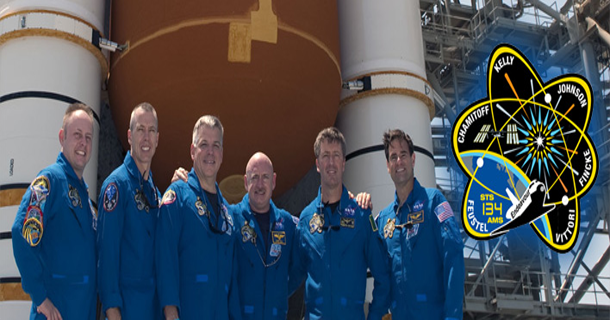
The departure of Progress 41 clears the way for the next unpiloted supply ship, ISS Progress 42, which is set to launch Wednesday from the Baikonur Cosmodrome in Kazakhstan. The new Progress will arrive at the station on April 29 at 10:29 a.m., just a little more than five hours before Endeavour launches to the station on its final trip into space. The shuttle’s STS-134 crew will deliver the Alpha Magnetic Spectrometer and spare parts including two S-band communications antennas, a high-pressure gas tank and additional spare parts for Dextre.

Flight Engineer Ron Garan spent some time Friday preparing for the arrival of Endeavour as he reviewed the robotics operations involved in removing the Orbiter Boom Sensor System from the shuttle’s payload bay with Canadarm2 and handing it off to the shuttle’s robotic arm.

Meanwhile Flight Engineer Paolo Nespoli performed maintenance on the spacesuits that the STS-134 crew will wear during the four spacewalks planned when Endeavour visits the station. Nespoli performed a water dump and refill of the feedwater tanks and conducted maintenance on the cooling loops of the suits.

Garan and Nespoli joined Flight Engineer Cady Coleman as they continue to unload cargo from the “Johannes Kepler” Automated Transfer Vehicle-2. The European Space Agency supply ship, which delivered seven tons of cargo when it docked to the aft port of the Zvezda service module on Feb. 24, will be reloaded with trash and undocked from the station for disposal in late June.

Cosmonauts Andrey Borisenko and Alexander Samokutyaev, both flight engineers, participated in the Pneumocard experiment, which studies the adaptation of the crew’s cardiovascular system during long-duration spaceflight.

Over the weekend the station’s six residents will enjoy some light-duty time as they attend to some weekly housekeeping chores, perform voluntary science activities and continue their daily two-hour exercise regimen to stave off the physical effects associated with long-duration spaceflight.

Changing the Game: Ceramic Coatings

Bryan Harder spraying ceramic coating in the rig 

The Plasma Spray – Physical Vapor Deposition (PS-PVD) rig at NASA's Glenn Research Center uses new technology to create super thin ceramic coatings. Here, Bryan Harder, the lead for the PS-PVD, installs a sample in the rig. Image Credit: NASA Turbines, or rotary engines that create power, have a multitude of uses. They are used in machines that perform work on Earth and are essential components of airplanes. Currently, most turbines are built using metallic based components, and these metal components require cooling to avoid reaching their thermal limits. New, more efficient engine technology requires components that can survive higher temperatures and reduced cooling.

Silicon based ceramic components show great potential for use in advanced, higher efficiency engines, as they are capable of withstanding higher temperatures and weigh less than metal components. However, when unprotected, these silicon based ceramic components react and erode in turbine engine environments due to the presence of water vapor.

New coating processing technology is being pioneered at NASA Glenn's Research Center in Cleveland. The technology is used to protect advanced silicon based ceramic engine components that are being developed for future engines. This coating processing technology will enable more complex and thinner coatings than are currently possible. This is important for coating turbine blades, which need to endure engine environments and stress conditions, while still remaining smooth to avoid the disruption of airflow. This coating processing technology, called Plasma Spray – Physical Vapor Deposition (PS-PVD), has the potential to radically improve the capabilities of ceramic composite turbine components.

"PS-PVD technology is really necessary for the integration of silicon-based ceramic airfoil components into turbine engines. The use of these silicon-based ceramics as engine airfoil components would increase engine operation temperature, which translates into higher efficiencies," says Bryan Harder, the lead for the PS-PVD Facility at Glenn.

Plasma Spray – Physical Vapor Deposition

PS-PVD rig outer view 

The PS-PVD rig uses a system of vacuum pumps and a blower to remove air from the chamber, reducing the pressure to one Torr (1/760th of normal atmospheric pressure). Image Credit: NASA It has been known for decades that enveloping metals and other substances, such as silicon based ceramic components, with a ceramic coating can protect them. But there is new, cutting-edge technology that can create ceramic coatings in an extremely precise, uniform fashion—the coatings can be controlled to a thickness of ten microns (a micron is one-millionth of a meter). This technology is made possible by Glenn's Plasma Spray – Physical Vapor Deposition (PS-PVD) Facility.

The Plasma Spray – Physical Vapor Deposition (PS-PVD) Coater was completed at Glenn in 2010. Created in collaboration with Sulzer Metco, the PS-PVD rig is one of only two such facilities in the U.S.A. and one of four in the entire world. The PS-PVD rig, which is currently a research and development facility, uses a state of the art processing method of creating thin ceramic coatings. Planning began for the facility in 2007, and construction began in 2008 (previously constructed infrastructure was reused and is now the base for the new rig).

The rig is nearing completion of its capabilities testing and assessment phase. A team of five, led by Bryan Harder, a materials research engineer, has put the rig through its paces. The rig will soon begin supporting the Supersonic Project within NASA's Aeronautics Research Mission Directorate at Glenn. Eventually, the rig could be of service to many other areas and projects within Glenn, other NASA centers and governmental entities, and private industry partners.

"When you have something that has broad capabilities like this, it really allows us to work with a lot of different areas, which is a great thing," says Bryan Harder.

Super Thin Ceramic Coatings

Ceramic powder pumped into PS-PVD rig 

Ceramic powder is pumped into the PS-PVD rig. It will be transformed inside the chamber to become a thin, precise, accurate ceramic coating. Image Credit: NASA The Plasma Spray-Physical Vapor Deposition (PS-PVD) rig creates thin, extremely precise ceramic coatings. These coatings are created on metal, ceramic, or other appropriate materials.

"To create these coatings, ceramic powder is injected into a very high power plasma flame under a vacuum. During operation, the plasma is approximately 7 feet long and 3 feet wide. The ceramic material is vaporized within the plasma, and condenses onto the target component," says Bryan Harder.

The coatings can be single or multilayer, and they protect the components from environmental and thermal impact. The extremely high heat and the vacuum within the chamber allow the ceramic coating to be precisely applied, creating durable, long-lasting, effective coatings.

"If you can reduce the thickness, and still provide an effective barrier layer — you can reduce the weight, you can reduce your cost. There are a lot of benefits that come from this technology," Harder says.

Inside the Chamber

an extrememly hot plasma flame within the ps-pvd 

Within the PS-PVD, an extremely hot plasma flame is created. The plasma can reach a temperature of 10,000 degrees Celsius—ten times hotter than a candle flame. Image Credit: NASA Located at Glenn, the Plasma Spray – Physical Vapor Deposition (PS-PVD) is installed in a dedicated room. A large, blimp-shaped chamber is made of stainless steel. The exterior metal, which is welded to a second sheet of stainless steel beneath, has cool water pumped through it to keep the chamber from getting too warm.

Inside the chamber is a steel arm which holds a plate made of a nickel-based superalloy. This plate holds the component that will be coated. Several feet away from this plate is the torch, where the ceramic powder is injected into the plasma. Once the chamber is closed, a system of vacuum pumps and a blower remove air from the chamber, reducing the pressure to one Torr (1/760th of normal atmospheric pressure). Then, helium and argon gases are introduced to the torch. An arc is created between the anode and cathode inside the chamber, ionizing the gases and creating the high temperature plasma.

The plasma, which can grow to seven feet in length, can be observed through one of three portals on the side of the rig. Its steady, fierce, concentrated glow resembles a Lightsaber from the Star Wars movies. Once the vacuum and plasma are stable, the ceramic powder is introduced to the torch. The plasma immediately begins to change colors. Depending on which ceramic powder is introduced, the plasma dramatically erupts into oranges, yellows, aquas, purples and blues.

The gas stream moves at a speed of Mach 2 — a rate of more than 2,000 feet per second. As the ceramic powder and the plasma blast the arm and plate where the component being coated is attached, the plasma appears to envelop the component and splash around it. The plasma, which appeared like a Lightsaber, seems to morph into the effect of the undulating stream of magic that occurs when Harry Potter's wand meets with Lord Voldemort's wand, in the Harry Potter movies.

ceramic power introduced into plasma flame 

Inside the PS-PVD, ceramic powder is introduced into the plasma flame. The plasma vaporizes the ceramic powder, which then condenses to form the ceramic coating. Image Credit: NASA The entire process is over in about five minutes. The plasma is extinguished and the exhaust system clears the chamber. The pressure is returned to normal atmospheric conditions, and then the chamber can be opened. The newly-coated component glows red hot and must cool down for an hour before it can be handled. The plasma within the chamber can reach a scorching 10,000 degrees Celsius — ten times hotter than a candle flame.

After the sample cools, it will be tested and evaluated to ensure the coating is an effective barrier. And then the sample — be it a small test button or an essential component of a supersonic aircraft — is ready to go. The front, sides and inside of the sample can be coated — a capability never previously available from vapor deposition techniques.

"The PS-PVD allows us to do things that you can't do anywhere else," Harder says.

Game-Changing Technology

This newly developed technology could have myriad applications, both within NASA and with potential industry partners. The potential applications are only beginning to be discovered — from membrane technology to fuel cells to ion conductors and beyond.

The rig is a game-changing technology; Glenn is maturing and developing a technology that doesn't exist elsewhere, while making direct contributions to the NASA mission.

"This is new ground," Bryan Harder says. "This was only developed in the last couple of years… and we don't even know the limits of what it [PS-PVD] is capable of."


-Tori Woods, SGT Inc.
NASA's Glenn Research Center

Canadarm2 Turns 10: Canadian Space Agency Celebrates a Decade of Success

ISS026-E-033204 -- The Kounotori2 H-II Transfer Vehicle In the grasp of Canadarm2 

Image above: In the grasp of the International Space Station's Canadarm2, the Kounotori2 H-II Transfer Vehicle is moved from the space-facing side of the Harmony node back to the Earth-facing port of Harmony in March 2011. Photo credit: NASA

Ten years ago today, Canadarm2 was launched to the International Space Station (ISS) aboard space shuttle Endeavour. A larger, more robust successor to the Shuttle’s Canadarm, Canadarm2 has provided a full decade of flawless service as the Station’s sophisticated “construction crane,” having assembled the ISS module by module in space.


Canadarm2 has unloaded hundreds of tons of equipment and supplies ferried by the shuttle and assisted almost 100 spacewalks. Endeavour’s last flight later this month will mark Canadarm2’s 28th Shuttle mission. Additionally, the robotic arm performed two “cosmic catches” where it captured, docked and later released two unpiloted Japanese resupply ships (HTV-1 and HTV-2).

Built for the Canadian Space Agency (CSA) in Brampton, Ontario, by MDA, Canadarm2 was installed on the ISS by astronaut Chris Hadfield during the first spacewalk by a Canadian. He was assisted in this feat by NASA Astronaut Scott Parazynski. In 2006, Steve MacLean, former astronaut and current President of the Canadian Space Agency became the first Canadian ever to operate Canadarm2 in space. CSA astronauts Julie Payette and Robert Thirsk are the only other Canadians to have ever operated Canadarm2 in space. The robotic arm is routinely operated by flight controllers at NASA’s Johnson Space Center and the Canadian Space Agency’s headquarters in Saint-Hubert, Quebec.

STS100-396-007 -- Astronaut Scott E. Parazynski works with cables associated with the Space Station Remote Manipulator System or Canadarm2
Astronaut Scott E. Parazynski, mission specialist, works with cables associated with the Space Station Remote Manipulator System or Canadarm2 during one of two days of extravehicular activity during STS-100. Photo credit: NASA

Canadarm2’s role on the International Space Station will expand as the orbital lab nears completion: in addition to performing routine maintenance, the robotic arm will make more frequent cosmic catches. When the Space Shuttle retires, reusable commercial spacecraft, like SpaceX’s Dragon and Orbital’s Cygnus, will be used to bring supplies and equipment to the ISS. Canadarm2 will capture each of these visiting vehicles, as well as the Japanese HTV transport vessels. In late 2011 and early 2012, Canadarm2 will capture a series of 6 commercial spacecraft in just 7 months, beginning with the Dragon spacecraft, currently scheduled to arrive in October 2011.

About the Canadian Space Agency

Established in 1989, the Canadian Space Agency (CSA) coordinates all civil, space-related policies and programs on behalf of the Government of Canada. The CSA directs its resources and activities through four key thrusts: Earth Observation, Space Science and Exploration, Satellite Communications, and Space Awareness and Learning. The Agency conducts its activities through three key business lines: 

Space Utilization: serving the needs of Government Departments; Space Exploration: positioning Canadian Science and Technology to advantage in future international space exploration missions; and, Space Science and Technology: which drives synergy and builds capacity in Academia, Industry and government to respond to the current and future needs of Canada’s Space Program. By leveraging international cooperation, the CSA generates world-class scientific research and industrial development for the benefit of humanity.

For more information, please contact:

Media Relations
Canadian Space Agency
450-926-4370
http://www.asc-csa.gc.ca