• 2010 nasa special
    a total eclipse of the Sun is visible from within a narrow corridor that traverses Earth's southern Hemisphere. The path of the Moon's umbral shadow crosses the South Pacific Ocean where it makes no landfall except for Mangaia (Cook Islands) and Easter Island (Isla de Pascua).
Showing posts with label nasa space shuttle mission. Show all posts

Exploring the Wonders of the Universe

Exploring the Wonders of the Universe

The newly-installed Alpha Magnetic Spectrometer-2 is visible at center of the International Space Station's starboard truss. The Alpha Magnetic Spectrometer, or AMS, is the largest scientific collaboration to use the orbital laboratory. 

This investigation is sponsored by the U.S. Department of Energy and made possible by funding from 16 nations. Led by Nobel Laureate Samuel Ting, more than 600 physicists from around the globe will be able to participate in the data generated from this particle physics detector. 

The mission of the AMS is, in part, to seek answers to the mysteries of antimatter, dark matter and cosmic ray propagation in the universe. 

 International Space Station

Space Shuttle Mission: STS-134

Commander Mark Kelly and Mission Specialist Mike Fincke 

Image above: Commander Mark Kelly (left) and Mission Specialist Mike Fincke aboard space shuttle Endeavour talk to students at Mesa Verde Elementary School in Tucson, Ariz. Photo credit: NASA TV

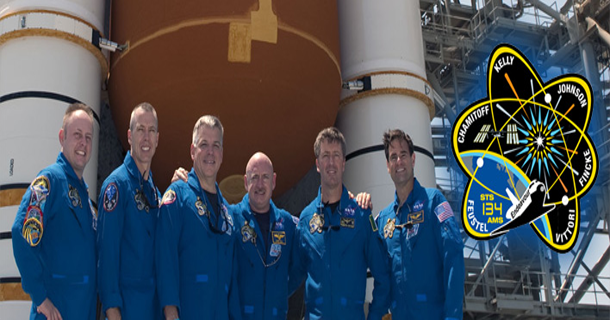
The crew members for space shuttle Endeavour's STS-134 mission are Commander Mark Kelly, Pilot Gregory H. Johnson and Mission Specialists Michael Fincke, Greg Chamitoff, Andrew Feustel and European Space Agency astronaut Roberto Vittori.

During the 16-day mission, Endeavour and its crew will deliver the Alpha Magnetic Spectrometer (AMS) and spare parts including two S-band communications antennas, a high-pressure gas tank and additional spare parts for Dextre.

The Power of A Moon Rock

"This is a moon rock and it's on our kitchen table. This rock encapsulates all of the optimism and unlimited potential that Americans had at the time. It made me believe that anything is possible. I wanted kids of this generation to have this experience. So, although it wasn't easy -- I borrowed a Moon Rock from NASA."
--Debra Sea in "Moon Rock"
Between 1969 and 1972 six Apollo missions brought back 382 kilograms (842 pounds) of lunar rocks, core samples, pebbles, sand and dust from the lunar surface. The six space flights returned 2,200 separate samples from six different exploration sites on the Moon.

Debra Sea and her brothers, David and William, admire an Apollo 11 moon rock on their kitchen table

In 1970, Debra Sea and her brothers, David and William, admire a Moon Rock from Apollo 11 as it sits atop their kitchen table.

Credit: Sea Family
To view the film, "Moon Rock," by Debra Sea, please visit:

moonrockthemovie.com/movie.html
The sample that sat before Debra and two of her younger brothers in 1970 returned to Earth from Apollo 11. And it landed on her kitchen table by way of her father, Duane Sea, a former a NASA science demonstrator, also known as a Spacemobiler.

Duane and his Spacemobile traveled to schools across the Mid-West, reaching more than 400,000 students. In the summer, Debra and her siblings would go along for the ride.

"Like everyone else, we were wildly optimistic about the future of space science," Debra said.

At age 10, her Moon Rock experience was documented with a photograph, which was labeled as "Moon Rock" in her family album. So, it was only natural that her film would also be labeled as "Moon Rock."

"It was always a story I wanted to tell," said Debra. "The timing was perfect."

Perfect because she was a working on her Master's of Fine Arts (MFA) at the University of North Carolina Greensboro when she chose "Moon Rock" as her Master Production film project. She was one of three students chosen to receive a 2011 Carole Fielding Student Grants awarded by the University Film and Video Association.

Debra Sea with Apollo 14 moon rock 

For her thesis film, "Moon Rock," Debra Sea borrowed a Moon Rock from NASA's Langley Research Center in Hampton, Va.

Credit: NASA/Sean Smith
But Debra quickly learned that borrowing a Moon Rock from NASA was no easy task.

After six months and a great deal of determination, her Lunar Sample Application was approved. For pick-up, she was referred to NASA's Langley Research Center in Hampton, Va., because it was in her outreach region.

The larger, display Moon Rocks are considered a national treasure that cannot be shipped, only hand carried. With possession, comes a strict set of guidelines. It must be kept in sight or in a safe. It can't be kept in a motel room overnight. And don't touch the Lucite without gloves, because the oil from skin can damage and cloud the Lucite.

"We were like old friends," Debra said of the Moon Rock. Except this was a different rock -- from Apollo 14. And this time, she was responsible for it. That was quite the burden for Debra, who constantly worried about the rock, much like a mother worries for her child.

Meghan Guethe, Langley's exhibits manager, helped Debra through the process. She understood and appreciated Debra's desire to keep it safe. "Everything is priced when it is sent out with an exhibit," Guethe said. "We cannot price these."

Debra Sea and her brothers beside their father's Spacemobile van 

In the summer, Debra Sea and her brothers would travel in a Spacemobile driven by their father Duane, a former NASA Science demonstrator, also known as a Spacemobiler.

Credit: Sea Family
It took a lot of planning to prepare the invaluable Moon Rock's trip to three classrooms at Wadena-Deer Creek, a K-12 school in Minnesota, where Debra's brother David teaches. She created a contingency plan for each airport.

And when she and her film assistant Adrienne Ostberg, a first-year MFA student, had their last flight canceled, they rotated staying with the rock in a private, locked room, purposed for nursing moms.

Their "baby" was a Moon Rock, which was enclosed in a Lucite pyramid. The 115-gram rock had its own carrying case and a small brass plate on the case reads, "IF FOUND, RETURN TO -- NASA, JOHNSON SPACE CENTER, HOUSTON, TEXAS 77058."

Duane accompanied her to the school. And despite the fact that he hadn't worked for NASA in 40 years, he smoothly converted back into his Spacemobiler ways.

"Have you ever driven a nail with a banana?" Duane asked the students after dipping one into a container of liquid nitrogen and freezing it solid.

As the banana proved to have the power of a hammer, the looks of authentic amazement and surprise on the student's faces spoke powerfully. And so did their questions.

Apollo 14 moon rock 
This Moon Rock, from Apollo 14, visited three classes at Wadena-Deer Creek, a K-12 school in Minnesota, where Debra's brother David teaches.
Credit: NASA/Sean Smith
"Is this a magic trick?" a student asked.

"No, magic. Just science" Duane replied.

"He had such a presence," Debra said of her father.

The Moon Rock temporarily abolished his presence. The students put gloves on and one-by-one touched the pyramid and gazed into the rock that had traveled some 238,857 miles (384,403 km) back to Earth 40 years prior.

"Everyone wanted to touch it, like a relic," Debra said of the students, and even airport security personnel that help her to guard it from harm.

But the contact that truly mattered was that of the students.

"I keep hearing that kids are different today than they were years ago. I just don't buy that," Duane said. "Kids are kids. The same eager faces that you see in front of you today are the same that I saw in front of me 40 years ago."

Debra and two of her brothers recreated the "Moon Rock" photo, and the moment that sparked their own sense of wonder. It seemingly had a great affect on them as each studied and works in a science-related field.

Whether Science or magic, their Moon Rock experience was afforded to a new generation. And now, it's up to them to decide what to do with it.

"I see incredible optimism and potential in these kids. And after bringing the Moon Rock home, I feel really hopeful about the future," Debra said. "I still believe that anything is possible. And I know I always will."


Denise Linberry
The Researcher News
NASA Langley Research Center

Free-Floating Planets May Be More Common Than Stars

This artist's conception illustrates a Jupiter-like planet alone in the dark of space, floating freely without a parent star. 

This artist's conception illustrates a Jupiter-like planet alone in the dark of space, floating freely without a parent star. Image credit: NASA/JPL-Caltech
 
PASADENA, Calif. -- Astronomers, including a NASA-funded team member, have discovered a new class of Jupiter-sized planets floating alone in the dark of space, away from the light of a star. The team believes these lone worlds were probably ejected from developing planetary systems. 
                     
The discovery is based on a joint Japan-New Zealand survey that scanned the center of the Milky Way galaxy during 2006 and 2007, revealing evidence for up to 10 free-floating planets roughly the mass of Jupiter. The isolated orbs, also known as orphan planets, are difficult to spot, and had gone undetected until now. The newfound planets are located at an average approximate distance of 10,000 to 20,000 light-years from Earth.
"Although free-floating planets have been predicted, they finally have been detected, holding major implications for planetary formation and evolution models," said Mario Perez, exoplanet program scientist at NASA Headquarters in Washington. 

The discovery indicates there are many more free-floating Jupiter-mass planets that can't be seen. The team estimates there are about twice as many of them as stars. In addition, these worlds are thought to be at least as common as planets that orbit stars. This would add up to hundreds of billions of lone planets in our Milky Way galaxy alone. 

"Our survey is like a population census," said David Bennett, a NASA and National Science Foundation-funded co-author of the study from the University of Notre Dame in South Bend, Ind. "We sampled a portion of the galaxy, and based on these data, can estimate overall numbers in the galaxy."
The study, led by Takahiro Sumi from Osaka University in Japan, appears in the May 19 issue of the journal Nature. 

The survey is not sensitive to planets smaller than Jupiter and Saturn, but theories suggest lower-mass planets like Earth should be ejected from their stars more often. As a result, they are thought to be more common than free-floating Jupiters. 


Previous observations spotted a handful of free-floating, planet-like objects within star-forming clusters, with masses three times that of Jupiter. But scientists suspect the gaseous bodies form more like stars than planets. These small, dim orbs, called brown dwarfs, grow from collapsing balls of gas and dust, but lack the mass to ignite their nuclear fuel and shine with starlight. It is thought the smallest brown dwarfs are approximately the size of large planets. 

On the other hand, it is likely that some planets are ejected from their early, turbulent solar systems, due to close gravitational encounters with other planets or stars. Without a star to circle, these planets would move through the galaxy as our sun and other stars do, in stable orbits around the galaxy's center. The discovery of 10 free-floating Jupiters supports the ejection scenario, though it's possible both mechanisms are at play.
"If free-floating planets formed like stars, then we would have expected to see only one or two of them in our survey instead of 10," Bennett said. "Our results suggest that planetary systems often become unstable, with planets being kicked out from their places of birth." 


The observations cannot rule out the possibility that some of these planets may have very distant orbits around stars, but other research indicates Jupiter-mass planets in such distant orbits are rare.
The survey, the Microlensing Observations in Astrophysics (MOA), is named in part after a giant wingless, extinct bird family from New Zealand called the moa. A 5.9-foot (1.8-meter) telescope at Mount John University Observatory in New Zealand is used to regularly scan the copious stars at the center of our galaxy for gravitational microlensing events. These occur when something, such as a star or planet, passes in front of another, more distant star. The passing body's gravity warps the light of the background star, causing it to magnify and brighten. Heftier passing bodies, like massive stars, will warp the light of the background star to a greater extent, resulting in brightening events that can last weeks. Small planet-size bodies will cause less of a distortion, and brighten a star for only a few days or less. 


A second microlensing survey group, the Optical Gravitational Lensing Experiment (OGLE), contributed to this discovery using a 4.2-foot (1.3 meter) telescope in Chile. The OGLE group also observed many of the same events, and their observations independently confirmed the analysis of the MOA group.
NASA's Jet Propulsion Laboratory, Pasadena,Calif., manages NASA's Exoplanet Exploration program office. JPL is a division of the California Institute of Technology in Pasadena. 

More information about exoplanets and NASA's planet-finding program is at http://planetquest.jpl.nasa.gov.
 
 
Whitney Clavin 818-354-4673
Jet Propulsion Laboratory, Pasadena, Calif.
whitney.clavin@jpl.nasa.gov

Trent Perrotto 202-358-0321
Headquarters, Washington
trent.j.perrotto@nasa.gov

STATUS REPORT : STS-134-06

STS-134 MCC Status Report #06

 HOUSTON – On tap today is the top scientific priority of the STS-134 mission, installing Alpha Magnetic Spectrometer-2 (AMS-2) on the International Space Station’s truss, where it can sift through cosmic particles, seeking the answers to fundamental questions of physics.

The $2 billion, 15,251- pound instrument will be plucked from Endeavour’s payload bay by Mission Specialists Andrew Feustel and Roberto Vittori using the space shuttle’s robotic arm. They’ll hand it off to the space station’s Canadarm2 at 2:01 a.m. CDT Thursday, and Pilot Greg Johnson and Mission Specialist Greg Chamitoff will then install it on the starboard side of the station’s truss.

From its new perch on top of the station’s truss, it will begin observations of the cosmos and automatically send information to scientists on Earth for the life of the station.
Endeavour’s crew and Expedition 27 Flight Engineer Ron Garan, who is matching schedules with the shuttle crew, were awakened at 9:56 p.m. The wake-up song “Luna,” performed by Jose Serrano for his friend Chamitoff, was transmitted about 30 minutes later after a communications drop-out cleared.

Endeavour docked with the International Space Station at 5:14 a.m. CDT Wednesday, and installed Express Logistics Carrier, a cargo platform loaded with spare parts for the station. Overnight, robotics experts in Mission Control moved the station’s Mobile Transporter from a worksite on the far end of the port side of the truss to a site on the far starboard side to prepare for the AMS-2 handoff. Installation should be complete by 2:41 a.m.

The combined crew also will begin preparations for the first spacewalk of the mission by Feustel and Chamitoff, which is scheduled for Friday. The team will review plans for the spacewalk, which will involve retrieval of one materials experiment and installation of another, installation of a floodlight, some cooling loop fill equipment and a wireless communications antenna.

Feustel and Chamitoff will camp out in the Quest airlock overnight to prepare their bodies for action in the reduced pressure of their spacesuits on the following day. The spacesuits were among the first items transferred from the shuttle to the station after docking and hatch opening.
Meanwhile, mission managers are continuing to review more than 500 images taken by Expedition 27’s Dmitry Kondratyev, Paolo Nespoli and Cady Coleman. Several areas of thermal protection tile were shown to be damaged, and managers are waiting for analysis to be completed before deciding whether to seek additional focused inspection of those areas later in the mission.

The next status report will be issued before the crew goes to sleep at 1:26 p.m., or earlier if warranted.

- end -

Mars Mission Components Delivered to Florida

Heat shield prepared for Mars spacecraft 

The heat shield for NASA's Mars Science Laboratory is the largest ever built for a planetary mission. Image credit: NASA/JPL-Caltech/Lockheed Martin 

  Preparing Mars Science Laboratory heat shield 

Technicians at Lockheed Martin Space Systems, Denver, prepare the heat shield for NASA's Mars Science Laboratory, in this April 2011 photo. Image credit: NASA/JPL-Caltech/Lockheed Martin

An Air Force C-17 transport plane delivered the heat shield, back shell and cruise stage of the Mars Science Laboratory spacecraft to NASA's Kennedy Space Center, Fla., on May 12, 2011. The heat shield and back shell together form the aeroshell, which will encapsulate the mission's rover and descent stage. The cruise stage will perform critical communication and navigation functions during the flight from Earth to Mars.
The mission will launch in late 2011 and deliver its rover, Curiosity, to the surface of Mars in August 2012. 

For more information about this week's delivery of flight system components, see 

NASA's Jet Propulsion Laboratory, a division of the California Institute of Technology, Pasadena, Calif., manages the Mars Science Laboratory Project for the NASA Science Mission Directorate, Washington. More information about the Mars Science Laboratory is available online at 

A live feed of Curiosity being built and tested in a clean room at JPL, with a chat feature available most days, is online at: http://www.ustream.tv/nasajpl . You can also follow the mission on Facebook at http://www.facebook.com/MarsCuriosity and Twitter @MarsCuriosity .
 
 
Guy Webster 818-354-6278
Jet Propulsion Laboratory, Pasadena, Calif.
Guy.webster@jpl.nasa.gov

2011-143
 

The Far Side of the Moon -- And All the Way Around


image of lunar far side


Because the moon is tidally locked  And what a surprise -­ unlike the widespread maria on the nearside, basaltic volcanism was restricted to a relatively few, smaller regions on the farside, and the battered highlands crust dominated. A different world from what we saw from Earth.

Of course, the cause of the farside/nearside asymmetry is an interesting scientific question. Past studies have shown that the crust on the farside is thicker, likely making it more difficult for magmas to erupt on the surface, limiting the amount of farside mare basalts. Why is the farside crust thicker? That is still up for debate, and in fact several presentations at this week's Lunar and Planetary Science Conference attempt to answer this question.

The Clementine mission obtained beautiful mosaics with the sun high in the sky (low phase angles), but did not have the opportunity to observe the farside at sun angles favorable for seeing surface topography. This WAC mosaic provides the most complete look at the morphology of the farside to date, and will provide a valuable resource for the scientific community. And it's simply a spectacular sight!

The Lunar Reconnaissance Orbiter Camera (LROC) Wide Angle Camera (WAC) is a push-frame camera that captures seven color bands (321, 360, 415, 566, 604, 643, and 689 nm) with a 57-km swath (105-km swath in monochrome mode) from a 50 km orbit. One of the primary objectives of LROC is to provide a global 100 m/pixel monochrome (643 nm) base map with incidence angles between 55°-70° at the equator, lighting that is favorable for morphological interpretations. 
Each month, the WAC provides nearly complete coverage of the Moon under unique lighting. As an added bonus, the orbit-to-orbit image overlap provides stereo coverage. Reducing all these stereo images into a global topographic map is a big job, and is being led by LROC Team Members from the German Aerospace Center (Deutsches Zentrum für Luft- und Raumfahrt; DLR). Several preliminary WAC topographic products have appeared in LROC featured images over the past year (Orientale basin, Sinus Iridum). 
For a sneak preview of the WAC global DEM with the WAC global mosaic, view a rotating composite moon (70 MB video from ASU's LROC website). The WAC topographic dataset will be completed and released later this year.

The global mosaic released today is comprised of over 15,000 WAC images acquired between November 2009 and February 2011. The non-polar images were map projected onto the GLD100 shape model (WAC derived 100 m/pixel DTM), while polar images were map projected on the LOLA shape model. In addition, the LOLA derived crossover corrected ephemeris, and an improved camera pointing, provide accurate positioning (better than 100 m) of each WAC image.

As part of the March 2011 PDS release, the LROC team posted the global map in ten regional tiles. Eight of the tiles are equirectangular projections that encompass 60° latitude by 90° longitude. In addition, two polar stereographic projections are available for each pole from ±60° to the pole. These reduced data records (RDR) products will be available for download on March 15, 2011. As the mission progresses, and our knowledge of the lunar photometric function increases, improved and new mosaics will be released! Work your way around the moon with these six orthographic projections constructed from WAC mosaics. The nearside view linked below is different from that released on 21 February.


images of the moon Six orthographic views of the Moon created from the new WAC global mosaic. From upper left to lower right the central longitude is 0°, 60°, 120°, 180°, 240°, 300°. Credit: NASA/Goddard/Arizona State University.

Preflight Interview: Sergei Volkov

JSC2011-E-027591 -- Expedition 28/29 Flight Engineer Sergei Volkov

Expedition 28/29 Flight Engineer Sergei Volkov responds to a question from a reporter during an Expedition 28/29 preflight press conference at NASA's Johnson Space Center. Photo credit: NASA or National Aeronautics and Space Administration

Q: Why did you want to be a cosmonaut?

  • A: Very tough question. It wasn’t just a kid dream. Actually it wasn’t a kid dream, because my father was a cosmonaut and I was able to see all pros and cons of this job, and when I was a kid it was more minuses than plusses always busy, studying all day long, exams. That’s why as for kid, it was really a, I think, not scared but kids usually not too ready, or at least imagine that will studying all their life. I think it’s the worst case scenario for all kids.

So you saw all the work and none of the fun?

  • Yes. That is why when I made a decision to become a cosmonaut it was sort of deep understanding that I can manage to do this job, and I wanted be useful to my country. That was one of the input, I wanted to be a cosmonaut, when I grew up and I thought, I’m a military pilot, why can’t I be a cosmonaut, it’s interesting job and I would like to participate.

Let me ask you, excuse me, a little bit about how you grew up and became a pilot, and start with your hometown. Tell me about where you grew up and what it was like there.

  • I grew up in Star City because my father was a cosmonaut and in our house, 11-story building, only cosmonauts lived, all famous cosmonauts: Valentina Tereshkova, Alexei Leonov, Yuri Gagarin’s wife, and all this famous cosmonauts, and I was able to meet them and Leonov personally covered all kids because father was always somewhere in trips or trainings or in space. That’s why he was sort of our mentor in our house, and then, I finished school in Star City and then I graduated from Tambov Military School of Pilots, and then as an air force pilot I flew on air force base, and then was selected a cosmonaut.

What was it that got you interested in wanting to be a pilot?

  • I always dreamed about to being a pilot since my first time I’ve been in a cockpit of the fighter, because originally my father was instructor of military school and when I was three years old he took me to the airfield, and while he flew with cadets his friends gave me a tour of the airfield and, of course, I was able to sit in the real fighter and that’s how the dreams appear and since that time I couldn’t imagine that I can be somebody [other] than the pilot.

But you did. As you said you went to college, to pilot school in the air force. Did you enjoy being an air force pilot?

  • Yes. It was great this first solo flight and to be able to fly the airplane, is great.

What was it, as you were a pilot then, what was it that made you feel, perhaps I could be a cosmonaut, too, that made you want to, to apply to do that job? Especially since, as you said, you had seen the hard side of it as a boy?

  • Maybe because the life of pilot wasn’t enough for me. I wanted something more to be able to fly a little bit higher.

So as a cosmonaut you have a job that, not unlike an air force pilot, does have a risk associated with it, but being a cosmonaut is a different kind of risk. So, Sergei, I wonder why you think that risk is worthwhile? What is it that we’re getting or what is it as people learn about, that makes it worth taking the risk for you?

  • I think the curiosity of mankind, that we want something unknown. Like 500 years ago, humankind wanted to know what the other side of the ocean is, and it was a very risky project and then we decided that probably we can fly; let’s fly higher. And now we’re flying space station, and still it’s not enough for us, we want to know what’s beyond. And I think there could be many answers on this question from very simple—because we are curious and we want to know what is beyond—and the complicated answer that we can stay longer, all time on our world and in Earth, and we need to somehow reach other planets because it’s always interesting for us. It’s not from the destination, but what was always the key point, try to find something, doesn’t matter when it happened, try to find something. Five hundred years ago it was spices, gold; right now, we don’t know what to expect when we reach Mars surface, we don’t know what we may expect from flying beyond the solar system, but we always wanted to know and I think its inspiring us and we continue to fly, even if it’s a really risky job.

Sergei, you are a member of the International Space Station’s Expedition 28 and 29 crews. Please give me a summary of the goals of your flight and tell me what your main responsibilities are going to be on this mission.

  • The main goals, I think, pretty the same as most of the crew does. It’s launch from Kazakhstan, and I’m going to be commander of Soyuz vehicle, S27, and then docking with International Space Station. Then we are ready to dock with three progresses that will be during our increment, one Russian EVA, potentially another EVA from Russian side, and at least one American EVA, and of course we are looking forward to see shuttle guys with us flying 10 days and landing according to schedule in middle of November. That’s a main milestone of our expeditions.

And between you’ll be doing a lot of science work and maintenance work on board the station.

  • Absolutely.

Now you spent almost 200 days in space on your first flight, when you were the commander of Expedition 17 three years ago. How has that experience helped you as you’ve trained for this mission?

  • It helps a lot because now I understand what I really need to know. It’s like when you are in school you can imagine what you will need from your background. For right now I know I need to focus myself or maybe focus all my crew members, Mike Fossum and Satoshi Furukawa, we can discuss not in theory but I can share my experience with them we flew together with Mike 10 days on board the station, and we know each other well and at least we know how to settle our life better.

What are you looking forward to about getting to spend another six months on board the space station?

  • First of all it’s my job to fly to space, and of course doing what you need to do is a great feeling. As a professional I’m looking forward to do EVA from Russian side. I’m going to support as arm operator American EVA, and it’s also very exciting task for me because I’ve trained a lot for this and I think we’ll manage success. That’s probably the two most exciting things that I am looking forward to.

Well let me get you to tell us about the place we’re talking about. Describe the International Space Station as it exists today, with all the different laboratories and modules and robotics that are there.

  • International Space Station, it’s huge I would say, space building. When you just can see it—and you can see it actually from five kilometers perfectly well when the sun is rising—and you can’t imagine, or can’t believe, that this miracle was built by people, by humans. Then your closer you can see all those modules and nodes. It was done practically during our Expedition 17, but still some new modules appeared, and now it’s, a very good house to live in and a great place to work. We have everything we need, we have equipment for the experiments, we have scientists who support us and provide those experiments to us, and the station’s great.

Well, let’s start by talking about the experiments ’cause now you’re going to a station where you’re going to have six crew members and several laboratories to take advantage of, so there’s a lot more science that is being done these days…

  • Absolutely.

…than Expedition 17. A lot of this is designed to find out how people can live and work in space.

  • I agree with you.

Tell me about a few of those kinds of experiments that you and your crewmates are going to be involved in.

JSC2011-E-005839 -- Expedition 28/29 crew members
  • Expedition 28 Flight Engineer and Expedition 29 Commander Mike Fossum (center) and Flight Engineers Sergei Volkov (left) and Satoshi Furukawa are pictured during a cake-cutting ceremony in the Jake Garn Simulation and Training Facility at NASA's Johnson Space Center. Photo credit: NASA or National Aeronautics and Space Administration
  • One of the newest experiments from the Russian side, it’s sort of following previous it’s, the main problem is bone [mass loss] and now we have the piece of bones with us and we will manage to see the actual degradation of the calcium from the bones, it’s not only a problem for the cosmonauts and astronauts but for many of people who live on Earth. I think it’s very valuable to have another result and maybe find the cure from this disease because, that’s the newest one that we didn’t perform before. And, of course, the benefits of the station, that you continue experiments for a long period of time, and a lot of experiments will just continue, some of them I’ve already done before during my expedition, now it’s just a sequence of those experiments, and it’s going to Plazmennyi Kristall [Plasma Crystal] and it’s going to be a lot of research of human body, what we can do, we need to know, and how we going to live on Mars and beyond, and that’s a great source to have this data is from astronauts and cosmonauts flying International Space Station.

Is just the fact that you’re there and living in that environment is really one big experiment in itself?

  • I would say, it’s part of the experiment but for the scientists it’s not enough just to send people somewhere, they stay in weightlessness, have fun, and then successfully return. We need to do a lot of tasks to succeed in all these experiments and from each side we have thousands, and 24 hours is not enough for us right now.

Are there other life sciences experiments that are going to be new for you this time?

  • I don’t think so. Most of the experiments are just like continuing of previous experiments.

I guess then there is some value in getting data from the same subject again a second time?

  • Absolutely, and all the same subject do the same experiment, what had happened when you did it like two years ago. Now with your knowledge, your experience, and analysis from the ground, you may see the improvement my expectation is to see some improvement in some experiments.

Now there are a lot of other kinds of science besides the human life sciences that you and your crewmates will be doing. You will be the operators of experiments. Give me a sense of the different kinds of research work that you guys will be doing on board the station this time.

  • Studying the radiation in space and actually on the Earth, it’s a problem. We sort of know how to prevent our bodies from these extremely dangerous rays but to be able to analyze the data, to collect this data without any safety layers like ozone layer or atmosphere, the space station is a perfect place. Of course, Earth science, Earth observation targets, we not just observe the events that had happened during our flight like volcano erupture or maybe the results of earthquake, but you can see how the people ruin the world, their home here, and this is also very valuable because when you stay inside of the woods, you can’t imagine how huge this forest is or how huge the damage or impact of the human beings is. But from space, when you can see at the same time like 10,000 kilometers square, you can imagine how harmful we are.

You also mentioned a moment ago that you have like physics research, the plasma crystal experiment, there’s biological research other kinds of science that you’re doing, too.

  • Of course, growing some plants, it’s going to be one of our tasks we have a small greenhouse it can’t provide food for us but at least for the scientists they can make their, again, studying of these products, how well they are, were grown, and will we be able to maybe have fresh food when you fly far[ther] than 400 kilometers above the Earth.

Now, along with all the science work that you guys will do, you are responsible for taking care to make sure that the station is operating properly as well. Give me a sense of the other kinds of maintenance work that a space station crew member is responsible for.

  • According to my previous experience you train to react on all failures and you are ready to perform R&R [remove and replace] for some equipment, but nobody can tell you for sure to be ready that this device will have failure, or you need backup. That is why have scheduled maintenance because everything unfortunately that man can build get the expiration date. We need perform the replacement without any failures of equipment. but you probably have heard some issues with Electrons right now; I hope that we do manage to repair it or change the tank. So far I can’t see any issues that we have.

One of the first highlights that will come on your schedule will be the final visit from a space shuttle mission, and STS-135 is going include a spacewalk for Mike Fossum and Ron Garan. Usually it’s shuttle crew members who go outside during these spacewalks; why are station crew members going outside during a shuttle visit?

  • I maybe because Mike and Ron already done EVAs and they perform three EVAs during their flight, STS-124, during my mission, and to have, it’s always benefit have two experienced crew member who already performed EVA and the other reason I think because there are going to be only four crew members [on the shuttle] instead of six, and probably guys need somebody else in that some other specialists deal with autonomous flight and then docking phase, and to have this source of two very well experienced astronauts on board the station and not to use this resource, I think it’s not good.

Well, and you mentioned a moment ago that you’re going to be involved in this spacewalk as an operator of the robotic arm. So tell us about what tasks there are scheduled for this EVA.

  • There are three main tasks on this EVA. First, very important put the failed ammonia pump from the truss to the payload bay and then they need to take a new fluid experiment from the shuttle bay and install it on the truss. Those two tasks are very big and long, and the third task is repairment of external camera that’s installed on one of the truss.

So for your arm operations, I take it, you’re going to be maneuvering your crewmates around outside.

  • That’s my expectation, yeah. Somebody will stand on the end effector and I will fly him from one structure to another structure.

You look like you’re going to, look forward to that.

  • Absolutely.

What else is on the timeline for this flight—what other sort of work will be done during STS-135’s visit?

  • Because it’s the last flight and all participants of ISS program would like to bring as much spare parts as possible, the shuttle will be full by the equipment and food and needed stuff. That is why it’s a lot of transportation work we will unload the shuttle and we’ll, I’m pretty sure that we will fill with some failed equipment and trash.

And the last opportunity to bring things back home…

  • Yes, yes…

…large things back home…

  • Yes, absolutely.

…like the pump module. Because this flight of Atlantis is the last mission in the Space Shuttle Program, what are your thoughts, Sergei, about the space shuttle’s place in the history of human spaceflight and the role that it’s played in building this space station?

  • I think thanks to this machine, we manage to build the space station, because all trusses, all modules from American side were delivered by the shuttle and were assembled by shuttle crew or some ISS crew members who flew with the shuttle crew members. I think that’s the biggest plus of utilizing the shuttle and I think almost 80% of success to building of International Space Station is built on shuttle wings.

Well, just a couple of weeks after Atlantis departs the current schedule calls for you and Alexander Samokutyaev to do a spacewalk out of the Russian segment of the space station. Tell me what’s on the plan for this EVA.

  • Because we continue to build Russian part of station, there were two modules new modules, appeared previous year, MRM [Mini Research Module] 2 and MRM 1, and the Docking Compartment [Pirs] is relatively old. That’s why we need to reorganize some equipment that was installed on surface of Docking Compartment. One is a Strela, and we will uninstall one of the Strelas from Docking Compartment and bring to the MRM 2. That’s also the biggest task, probably takes like one hour and a half. Then installation new experiment for communication and we’ll try laser communication, and that’s also the milestone of our EVA usual tasks is install new experiments and take just experiments that we need to take from the surface of station and move them back. That’s the main goal.

Bring back samples…

  • Samples and new task just recently appeared. It’s this small Sputnik that was built by the students of Moscow University, and we will just fly it….

You’re going to release the satellite?

  • …and it will translate some information voices of famous people that kind of experiment.

Nice. Now there’s a possibility that there will be a second Russian spacewalk during your increment, correct? What’s the plan there?

  • Because it’s possibility, we just discuss this, and we didn’t have any training on it, that’s why I can’t tell you about the second EVA so far.

But it is a thing that all crew members have to do they have to train for spacewalks just in case they come up.

  • Absolutely, and there is the basic training it’s not only on Russian side but American side, we have basic training like everybody who going to fly as a International Space Station crew member supposed to know how to do the EVA. That’s one of our tasks.

There’s also a plan for some new cargo ships that have been developed on the American side under NASA’s Commercial orbiter Transportation, Orbital Transportation Services program, that have test flights that are coming up later on this year. Tell me about those vehicles and what work you or your crewmates, you have to do to get the station ready for that.

JSC2011-E-017441 -- Expedition 28/29 Flight Engineer Sergei Volkov
  • Expedition 28/29 Flight Engineer Sergei Volkov participates in an emergency scenario training session in an International Space Station mock-up/trainer in the Space Vehicle Mock-up Facility at NASA's Johnson Space Center. Photo credit: NASA or National Aeronautics and Space Administration
  • I know that Mike and Satoshi trained for catching free-flying objects and it’s great to have a new vehicle, always great to see something new that’s flying, potentially can dock to the station, and because of the shuttle retirement we need another vehicles, not only Progress, and ATVs [Automated Transfer Vehicles] also good, HTV [H-II Transfer Vehicle], but I think it’s great that each country participant will have the cargo vehicle with their plusses and minuses.

So there’s a, a chance you may get to see a brand new kind of vehicle at the station.

  • Yeah, it would be great to see a new vehicle.

You’ve got commercial cargo ships that are just, that’s just one way that spaceflight has changed in its first 50 years since Gagarin’s flight—have gone from one man in a tiny capsule to this giant space building, as you described it. Where do you think human space exploration will be 50 years from now? How is the International Space Station getting us ready for that?

  • Hard to tell. We are so dependent on government money it depends on how much money the budget will provide us, and we need to believe that at least have the moon base on surface—this is my dream, actually, to spend at least one month on surface of the moon and do some work there. Maybe Mars; who knows? It’s hard to tell right now. I don’t want to just dream, or imagine; I’m a professional, and what I can tell based on my knowledge what is going on in the program.

How is what you’re doing on the International Space Station helping prepare for those possibilities?

  • As we mentioned before the human research experiment that provides data, how the human body will react on the long weightlessness will we be able to go out of the capsule after landing to Mars surface, and what you need to do, maybe what kind of pills we need to use or maybe what kind of physical exercise we need to perform to be ready not just to lay around the capsule and see the red sky and red sand but to be able to perform some tasks on the surface of Mars. I think the International Space Station is the best source of this information.

NASA Kepler Mission Manager Update - Another 93 Gigabits of Data Added to the Archive

image
During a regularly scheduled science data download on Tuesday, April 26, the project team reoriented the Kepler spacecraft to downlink data from its solid-state recorder (SSR). All data collected since March 20 was returned successfully. The Quarter 9, Month 1 science data collection download now is complete.

Communications with Kepler while it is in the science attitude is accomplished using a low gain antenna on the spacecraft that operates on X-band frequency. To return all the science and engineering data that has been stored on the SSR, a high-gain antenna (HGA) operating in Ka-band frequency is used. The HGA must be pointed at Earth to support the high rate downlink (4.3 Mbps). This temporarily prohibits the spacecraft from pointing at the science field-of-view.

The monthly activity includes collection of science calibration data; turning the HGA toward Earth; and, playing back the SSR data - approximately 45 minutes for engineering data and another 5.25 hours for 37 days of science data. The number of days in each month's science set varies a bit due to Deep Space Network, or DSN, availability and other scheduling constraints. A total of 93 gigabits of data was downloaded in approximately six hours before reorienting the spacecraft to science attitude.

In order to return to the fine point attitude control, which is the highest pointing stability and what is required for science, the project team must wait for the spacecraft to return to the thermal condition it was in before the break. When the spacecraft is turned to a different attitude, the sun shines on different parts of the structure, which causes it to warp ever so slightly. This slight warping means that the angle between the star trackers and the telescope line of sight is a bit off. 

When it's maneuvered back to the science attitude, it takes time to settle back to its original shape. Until the spacecraft has thermally settled, the telescope will not be aligned with its guide stars well enough for us to transition to fine point. This can take eight hours or more. This month's activity went very well, and the total science break, which includes the collection of calibration data, was about 17 hours. The monthly budget is 20 hours.

The data is downloaded via NASA's DSN operated by the Jet Propulsion Laboratory (JPL), a division of the California Institute of Technology (Caltech) in Pasadena, Calif. From the DSN, the data flows to the Mission Operations Center in Boulder, Colo., and on to the Data Management Center in Baltimore, Md. The raw pixels are archived at the Data Management Center and then transmitted to the Kepler Science Operations Center (SOC) at NASA's Ames Research Center in Moffett Field, Calif.

The data has arrived at the SOC and will be processed this week.

Kepler is currently 32 million kilometers from Earth, collecting science data at the Spring attitude (the angular orientation of the spacecraft), in its 9th quarter of operations. All subsystems are operating normally. The next download of science data is scheduled for May 25.

TRMM Maps a Wet Spring, 2011 for the Central U.S.

NASA's Tropical Rainfall Measuring Mission satellite has been keeping track of the drenching rainfall that has been occurring in the central U.S. this springtime, and a newly created rain map from that data from April to May 4, 2011 shows those soaked areas.

A combination of heavy rains and a large snow melt has put parts of the central U.S. at risk for record flooding this spring with several locations along the Mississippi already at or near record levels. One likely culprit is La Niña. Despite the fact that the current La Niña appears to be winding down, its effects in the atmosphere can persist for a while. Furthermore, although not every La Niña brings major flooding to the region, La Niña's are conducive for above-normal rainfall from East Texas and northern Louisiana up through Arkansas and the Tennessee and Ohio Valleys with below-normal rainfall across Texas, southern Louisiana and Florida.

Rainfall anomalies were created in this rainfall map for the period April 4 to May 4, 2011 for the eastern two thirds of the country.

TMPA rainfall anomalies were created in this rainfall map for the period April 4 to May 4, 2011 for the eastern two thirds of the country. The anomalies were constructed by computing the average rainfall rate over the period and then subtracting the 10-year average rate for the same period. Credit: NASA/SSAI, Hal Pierce

During La Niña, below-normal sea surface temperatures occur in the equatorial East Pacific and above-normal temperatures in the West Pacific. This pattern leads to enhanced tropical thunderstorm activity over the West Pacific, which in turn can influence the weather in middle latitudes by shifting the jet stream pattern. On average, La Niña's favor an upper-level trough over the Midwest with the jet stream dipping down out of the northern Rockies and flowing west-to-east across the central Mississippi and Ohio Valleys before heading back up over the Northeast. This pattern steers developing low pressure systems across the Plains and central Mississippi into the Tennessee and Ohio Valleys. These areas of low pressure provide the focus for showers and storms while drawing warm moist air up from the Gulf of Mexico, resulting in enhanced rainfall across the central part of the country.

The main objective of the Tropical Rainfall Measuring Mission or TRMM satellite is to measure rainfall over the global Tropics. TRMM measures rainfall using a combination of passive microwave and active radar sensors. For expanded coverage, TRMM can be used to calibrate rainfall estimates from other satellites. The TRMM-based, near-real time Multi-satellite Precipitation Analysis (TMPA) at the NASA Goddard Space Flight Center, Greenbelt, Md. provides rainfall estimates over the global Tropics.

TMPA rainfall anomalies were created in a rainfall map for the period April 4 to May 4, 2011 for the eastern two thirds of the country. The anomalies were constructed by computing the average rainfall rate over the period and then subtracting the 10-year average rate for the same period. The resulting pattern shows a broad area of above-normal rainfall (shown in green and blue) stretching from eastern Oklahoma across the central Mississippi Valley and up into the lower Ohio Valley with below-normal rainfall along the northern Gulf Coast. This rainfall pattern is consistent with a La Niña.

In addition to rainfall, this type of jet stream pattern can lead to strong storms by allowing strong jet stream winds to override warm moist air from the Gulf as was evidenced by the recent tornado outbreak. In fact, some of the biggest tornado outbreaks, including the previous record "Super Outbreak" in 1974, have occurred during La Niña's.

TRMM is a joint mission between NASA and the Japanese space agency JAXA.
 
Steve Lang
SSAI/NASA Goddard Space Flight Center

New Deputy Brings International Education Experience

Dean Aaron Kern 

Dean Aaron Kern Credit: NASA Exploration for a different challenge and new opportunities has landed Dean Aaron Kern a new position as Deputy Director for the Office of Education at Goddard. He arrives with a wealth of national and international teaching experience he hopes to share with others.

Kern admits being excited about his new position because of a positive NASA experience over 20 years ago. “My first exposure to NASA was part of an international group of teachers attending a two-week training project at the Johnson Space Center. At the end I remember saying this was a great opportunity for teachers to receive training from the experts and lots of great resources for the classroom,” he said.

In college Kern admits he was a typical student, altering his direction of study several times before settling on a duel major in elementary and special education. Ultimately, he had to decide between a course in classroom design or neuropsychology. “Neuropsychology and disabilities was much more interesting and led to my interest in learning more about how to work with students with disabilities in the classroom.”

After receiving a bachelor’s degree from Northern Arizona University (NAU) Kern began his teaching career in Phoenix, Arizona. “I’ve been a special and elementary education teacher at all levels of K-12 and even taught music at one point in my career” he said. Along the way, Kern obtained a Master of Arts degree in education administration from NAU, and continued doctorial studies at the University of Colorado at Denver.

Kern spent 10 years teaching in four different countries working in international American and British sponsored schools before returning to the U.S. He worked for several more years in the emerging education school choice effort known as charter schools at the local and state levels before joining the U.S. Department of Education in 2002 as Director of the Charter Schools Program. “I became interested in the charter school programs from a civil rights and social perspective where you are addressing a critical issue and the achievement challenges for kids because of their zip code, ethnicity, and/or race,” Kern said. “I see the NASA experience as another opportunity to use my educational background to have a positive influence on student learning.”

As Deputy Director, Kern will oversee Goddard’s educational programs. “We are indeed fortunate to have Dean join the Goddard staff,” said Dr. Robert Gabrys, director of Goddard’s Office of Education. “His background in education at the school, state, and government levels provides us with a depth of education expertise that will serve both the Center and Headquarters (NASA) well.”

According to Kern, NASA’s Summer of Innovation program is definitely a part of the national conversation. “It brings to the forefront more visibility for STEM (Science, Technology, Engineering, and Mathematics), which is becoming part of the mainstream conversation when talking about education reform.”

Kern believes this opportunity will allow direct influence over programs that will inspire our next generation to explore. “I believe insight is key when rolling out new programs, initiatives, or training. How will it be received at the teacher, state, and national level is key to successfully gaining classroom access. Whatever you are doing, it must support the national policy conversation in education, at all levels.”

For the avid bike rider, Kern’s new position in Maryland puts an end to the daily 20-mile bike commute from Old Town Alexandria, Virginia to the Department of Education in Washington, D.C. “On the weekends I cram to make up those miles.” In addition to traveling with wife Monica, Kern enjoys singing in the Metropolitan Chorus and bargain hunting at second-hand stores.
 
 
Dewayne Washington
NASA's Goddard Space Flight Center

Explore@NASA Goddard: Saturday, May 14, 2011, 11 a.m. - 5 p.m. FREE!

Explore at NASA Goddard logo Have a blast exploring the universe at a FREE open house event at NASA Goddard Space Flight Center in Greenbelt, Maryland. Explore@NASA Goddard, on Saturday, May 14, from 11am to 5pm rain or shine, is full of family fun, music, food, and science. Free satellite parking and transportation to Goddard will be provided. There is no public parking at the Center.

Explore@NASA Goddard will include indoor and outdoor exhibits and entertainment that will thrill and educate at the same time.

The event is organized into six zones:

* Earth Science: Experience how NASA measures and monitors our changing Earth from space

* Solar System: Discover how solar cycles affect Earth’s climate and how space weather changes the magnetosphere. Witness planetary science in action

* Universe: Explore the many ways the universe and everything in it is constantly changing

* Engineering & Technology: See discoveries in science through technological research, development, and engineering

* People: Investigate the diverse people and careers at Goddard Space Flight Center

* On the Mall: Discover the fun activities, great food, crafts, and entertainment on our mall area. Fantastic foods abound, from soul food to BBQ, and ice cream to souvlaki. Music features the a cappella group Sweet Honey in the Rock®, and Milkshake with great music for kids.


Facebook logo › Check out Explore@NASA Goddard on Facebook

Six NASA Astronauts - Including D.C. Native - Available For Interview

Joshua Buck
Headquarters, Washington     
202-358-1100
jbuck@nasa.gov
 
May 6, 2011
 
MEDIA ADVISORY : M11-089
 
 
Six NASA Astronauts - Including D.C. Native - Available For Interviews
 
 
WASHINGTON -- The astronauts who flew aboard space shuttle Discovery's last flight will visit NASA Headquarters in Washington on Tuesday, May 10. They will give a presentation about their 13-day mission at 11 a.m. EDT and will be available for media interviews from 2 p.m. to 4 p.m.

The STS-133 crew consists of Commander Steve Lindsey, Pilot Eric Boe, mission specialists Alvin Drew, Nicole Stott, Steve Bowen and Michael Barratt. Drew was born in the District of Columbia and graduated from the city's Gonzaga College High School.

The crew will share mission highlights with agency employees, their families and reporters in the NASA Headquarters' James E. Webb Auditorium, located at 300 E Street SW. The presentation will air live on NASA Television. Reporters must call 202-358-1100 to attend the presentation or to schedule an interview.

STS-133 was the last mission for the longest-serving veteran of NASA's space shuttle fleet. Since 1984, Discovery flew 39 missions, spent 365 days in space, orbited Earth 5,830 times and traveled 148,221,675 miles.

Discovery and its crew delivered to the International Space Station the Permanent Multipurpose Module, or PMM, which was converted from the multipurpose logistics module Leonardo. The PMM can host experiments in fluid physics, materials science, biology, biotechnology and other areas.

STS-133 also brought critical spare components and the Express Logistics Carrier 4 to the International Space Station. Robonaut 2, or R2, became the first human-like robot in space and a permanent resident of the station. The mission's two spacewalks assisted in outfitting the station and completed a variety of other tasks designed to upgrade station systems.

For more information about the STS-133 crew members and their mission, visit: